Buy Custom Size Mining Ventilation Duct | OEM Manufacturer Guide
A mining ventilation duct is never just “bought by the meter.” Custom dimensions must be engineered around shaft air volume, tunnel cross-section, and destination-country safety codes — getting the spec right matters far more than getting the price right.
Ordering a mining ventilation duct is fundamentally different from sourcing generic PVC tubing. The diameter, length, coating weight, and flame retardant rating must all be confirmed simultaneously; a deviation in any single parameter can render the entire shipment unusable underground. I learned this the hard way. Years ago, while handling export documentation at Qingdao port, I processed a shipment of PVC ducts bound for a copper operation in southern Africa. The customs declaration used a generic PVC pipe HS code. When the cargo reached the destination port, local mine safety regulators demanded a flame retardant classification report aligned with their national mining safety act. We only had a basic oxygen index test result — not a graded certification. The containers sat at the port for over a month, and the demurrage charges wiped out most of the margin. Since then, every mining order I handle starts with confirming the destination country’s safety certification requirements before a single production parameter is locked in. [NEED_CITE: destination-country mine safety certification requirements vary significantly across African, Southeast Asian, and Middle Eastern mining jurisdictions]
Getting these fundamentals right from the start is what separates a smooth commissioning from a costly delay. Let’s walk through the key specifications, matching logic, standards, and supplier selection criteria that determine whether a custom mining ventilation duct will perform as intended.
What Specifications Matter When Ordering Custom Mining Ventilation Ducts?
Diameter, length, coating weight, and flame retardant grade are the four parameters that must be locked together before production begins. Changing one after the others are set creates cascading mismatches in airflow performance, physical fit, and regulatory compliance.
Many buyers assume that a thicker coating automatically means a more durable duct. The reality is more nuanced: tear resistance depends more on the coating adhesion process and the base fabric weave density than on coating thickness alone. A heavily coated duct with poor adhesion will delaminate under repeated folding and unfolding, while a moderately coated duct with a tight base fabric weave can outlast it in abrasive tunnel conditions. [NEED_CITE: relationship between PVC coating adhesion, base fabric weave density, and tear resistance in flexible mining ducts]
Similarly, buyers often treat custom sizing as simply adjusting the length. In practice, every change in diameter alters the friction resistance coefficient and the air volume match entirely. A diameter shift of even one standard increment changes the cross-sectional area enough to affect static pressure distribution along the entire duct run.
| Specification | What It Controls | Typical Range | Compliance Impact |
|---|---|---|---|
| Diameter | Air volume capacity and friction loss | 300mm–1200mm | Must match fan output and tunnel profile |
| Length per section | Installation joints and leakage points | 5m–50m | Longer sections mean fewer joints but harder handling |
| Coating weight | Abrasion resistance and flexibility | Light to heavy grade | Heavier suits abrasive rock; lighter suits short-term use |
| Flame retardant grade | Fire safety compliance | Basic self-extinguishing to full graded certification | Dictated by destination-country mining law |
| Anti-static property | Ignition risk in gaseous environments | Standard to high dissipation | Mandatory in gassy mines |
A mid-tier mining operation in Southeast Asia once ordered a full set of mining ventilation duct based on the “standard” diameter their previous supplier had always provided. The new tunnel cross-section was narrower, and the main fan had been upgraded. The existing diameter created excessive friction loss, and the effective air volume at the working face fell well below the ventilation plan requirement. The entire batch had to be re-manufactured to a different diameter — at a cost that ran well into five figures. [NEED_CITE: friction loss calculation methodology for flexible ducting in mine ventilation planning]
The takeaway is straightforward: treat these four parameters as an interconnected system, not a checklist of independent choices.
How to Match Duct Diameter with Mine Air Volume and Tunnel Cross-Section?
The duct diameter must be calculated from the fan’s rated air volume and the tunnel’s cross-sectional profile — default sizes are rarely the correct sizes.
The matching logic follows a clear sequence. First, determine the required air volume at the working face based on the number of workers, diesel equipment operating hours, and blasting gas dilution needs. [NEED_CITE: mine ventilation air volume calculation factors including personnel, diesel equipment, and blasting gas] Next, reference the main fan’s performance curve to identify the available static pressure at that air volume. Then, calculate the friction loss per unit length for candidate duct diameters — larger diameters reduce friction loss but may not physically fit within the tunnel profile alongside track, piping, and cable runs.
The tunnel cross-section sets the hard upper limit. In a narrow decline tunnel with a single track, a large-diameter mining ventilation duct may physically obstruct equipment passage or hang too low for safe clearance. In a wider development heading, the same diameter fits comfortably with adequate hang height.
| Tunnel Type | Typical Constraint | Duct Diameter Implication |
|---|---|---|
| Narrow decline with single track | Tight lateral clearance | Smaller diameter, possibly dual-run |
| Wide development heading | Adequate space | Larger diameter feasible, fewer joints |
| Raise boring access | Vertical alignment | Flexible coupling critical |
| Long single-drive heading | Cumulative friction loss | Larger diameter to minimize pressure drop |
An African gold mine once specified a mining ventilation duct diameter based solely on the fan outlet flange size, without accounting for the friction loss over a particularly long drive. The result was acceptable air volume near the fan but a noticeable drop at the working face beyond the halfway point. The fix required either adding a booster fan — an expensive and maintenance-heavy solution — or replacing the duct with a larger diameter. The larger diameter option proved more economical in the end, but the delay set back the development schedule substantially.
The principle is simple: start from the working face air requirement, work backward through friction loss to the fan, and let the tunnel profile confirm or constrain the diameter. Never assume the fan outlet size equals the correct duct size.
Which Flame Retardant Standards Apply to Mining Ducts in Different Countries?
Flame retardancy in mining is not a single test — it is a multi-parameter regulatory framework that varies by country, and meeting one standard does not guarantee acceptance in another.
Most buyers equate flame retardancy with “self-extinguishing when the flame source is removed.” That is only the most basic level. Mining safety regulations in different jurisdictions impose graded requirements covering oxygen index, anti-static surface resistivity, smoke density, and flame spread index — and the specific thresholds differ from one country to the next. [NEED_CITE: international comparison of mine ventilation duct flame retardant and anti-static regulatory requirements]
A mining ventilation duct that passes a basic oxygen index test in one market may fail the smoke density requirement in another, or lack the anti-static certification needed for gassy mine classification. The consequences of mismatch are severe: rejected shipments, failed mine safety inspections, and in some cases, orders to halt production until compliant ventilation is installed.
| Regulatory Parameter | What It Measures | Why It Matters Underground |
|---|---|---|
| Oxygen index | Minimum oxygen concentration to sustain combustion | Higher values indicate harder ignition |
| Anti-static surface resistivity | Static charge dissipation rate | Prevents spark ignition in gassy atmospheres |
| Smoke density | Opacity of smoke produced during combustion | Affects escape visibility during fire events |
| Flame spread index | Rate of flame propagation along the surface | Controls fire spread along ventilation runs |
The copper operation in southern Africa I mentioned earlier required a flame retardant classification aligned with their national mining safety act — not just a generic oxygen index number. The documentation gap meant the cargo could not clear customs for delivery to the mine site. The lesson was costly but permanent: always confirm the specific regulatory standard and certification format required at the destination before confirming production specs.
Another case involved a mining ventilation duct order for a coal operation where the anti-static requirement was not communicated clearly to the production team. The ducts were manufactured with standard PVC compound — adequate for non-gassy environments but non-compliant for the gassy classification of that particular mine section. The entire order had to be re-coated with anti-static compound, adding weeks to the delivery timeline.
The practical rule: request the destination mine’s safety regulation document or the purchasing specification sheet before quoting. Match every regulatory parameter explicitly, and ensure the test reports are issued in the format the local inspector expects.
How to Choose a Reliable OEM Mining Ventilation Duct Manufacturer?
Evaluate a manufacturer’s coating line capability, customization flexibility, and export documentation completeness — not just the unit price.
The lowest per-meter quote often comes from a workshop that runs a single coating weight, uses unverified base fabric, and cannot produce test reports in internationally recognized formats. When a mining ventilation duct order encounters a compliance issue at the destination, the cost of re-manufacturing, re-shipping, and project delay dwarfs any initial price saving.
A credible OEM manufacturer should demonstrate several capabilities. First, the ability to coat across a meaningful range of fabric weights — from light-duty to heavy-duty — on a single production line, rather than outsourcing certain weights to third parties. This ensures consistent coating adhesion and quality control across the full product range. Second, the flexibility to produce non-standard diameters and lengths without excessive minimum order requirements, since mining ventilation plans often call for dimensions outside catalog sizes. Third, the ability to provide complete export documentation: commercial invoice, packing list, bill of lading, certificate of origin, and — critically — test reports from recognized laboratories covering oxygen index, anti-static resistivity, and flame spread as required by the destination market.
| Manufacturer Capability | Why It Matters for Mining Duct Orders |
|---|---|
| Multi-weight coating line | Consistent quality across light and heavy grades |
| Custom diameter and length | Matches non-standard mine ventilation plans |
| In-house or partnered lab testing | Produces acceptable compliance reports |
| Complete export documentation | Prevents customs and site acceptance delays |
| Production trial sample | Confirms spec before full-batch commitment |
A West African mining contractor once switched suppliers after their original manufacturer could not provide an anti-static test report in the format required by the mine’s safety auditor. The new manufacturer — a factory in Shandong with an integrated coating line and an established relationship with an accredited testing laboratory — produced the sample, ran the tests, and delivered the full order with complete documentation. The unit price was slightly higher, but the total landed cost was lower because there were no compliance delays, no re-testing expenses, and no site rejection risk.
The principle: a manufacturer’s ability to handle the full chain — from raw fabric coating through custom fabrication to certified test reporting — is a more reliable indicator of order success than the quoted price per meter.
What Are the Common Pitfalls in Shipping and Receiving Custom Mining Ventilation Ducts?
Packaging reinforcement and container loading plans for large-diameter custom ducts directly determine the damage rate at destination — confirm the logistics plan before placing the order.
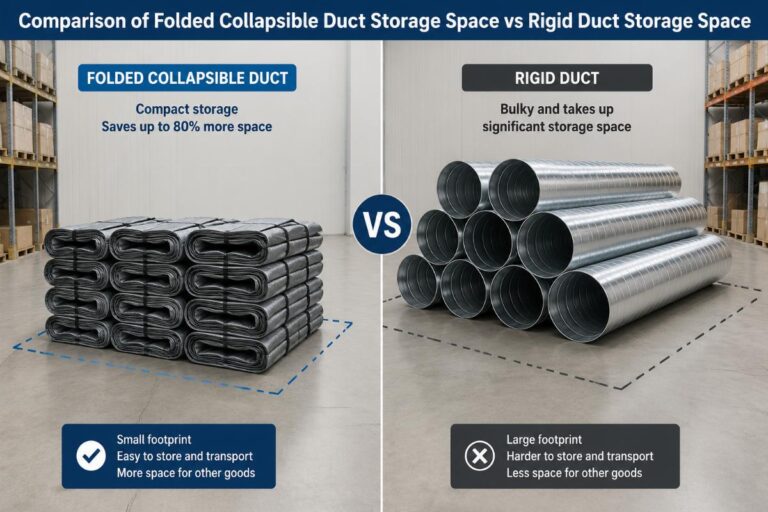
Mining ventilation ducts are bulky, flexible, and deceptively vulnerable to compression damage during ocean freight. A standard roll of PVC-coated fabric can withstand considerable handling stress, but a finished duct — especially one with reinforced wire helix or large-diameter rigid rings — behaves differently. Improper stacking, insufficient strapping, or overfilling a container can cause permanent deformation of the duct profile, crushed coupling rings, or coating abrasion where rolls press against each other during transit.
The most common shipping pitfalls include:
- Overloaded containers without internal bracing. Duct rolls stacked loosely shift during vessel motion, causing edge compression and coating scuffing.
- Incorrect loading orientation. Large-diameter ducts loaded horizontally without cradle support flatten at the contact points, making them difficult to unfold at the mine site.
- Missing moisture protection. Condensation inside the container during tropical sea passages can cause mildew on the inner fabric surface if rolls are not wrapped adequately.
- No loading plan shared with the receiver. The mine site team expects a certain number of ducts per container and a specific unloading sequence. Without a shared loading plan, the receiving team faces unexpected delays in inventory verification.
| Shipping Risk | Root Cause | Consequence at Destination |
|---|---|---|
| Profile deformation | Insufficient internal bracing | Ducts difficult to hang, poor seal at joints |
| Coating abrasion | Loose stacking, roll-to-roll friction | Reduced service life, air leakage |
| Coupling ring crush | Horizontal loading without support | Joint failure, re-manufacturing needed |
| Mildew on inner surface | Missing moisture barrier | Air quality concern, cleaning cost |
A Middle Eastern mining project received a shipment of large-diameter mining ventilation duct where the container had been loaded without a bracing plan. Several rolls had shifted during the sea crossing, and the coupling rings on the bottom layer were visibly deformed. The site team managed to salvage most of the order, but a significant portion had to be cut and re-coupled on-site — a labor-intensive process that delayed the ventilation commissioning.
The fix is preventive, not corrective. Before the order goes into production, confirm the container loading plan with the manufacturer: how many rolls per container, what bracing method, what moisture protection, and what labeling for identification at the receiving end. A few hours of planning at the origin saves days of disruption at the destination.
Conclusion
Custom mining ventilation duct procurement is an engineering exercise, not a commodity purchase. Diameter must match air volume and tunnel profile, flame retardant grades must align with destination-country mining regulations, and the manufacturer must be evaluated on coating capability and documentation completeness rather than unit price alone. Shipping plans for large-diameter ducts require the same upfront attention as the production specs. Get these elements right at the inquiry stage, and the duct will perform underground as designed — without costly surprises at the port or the mine face.