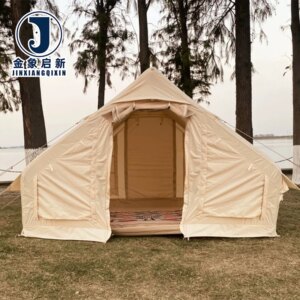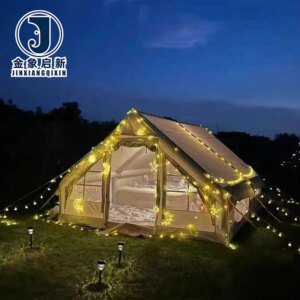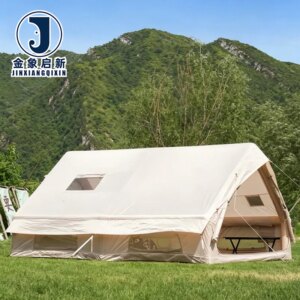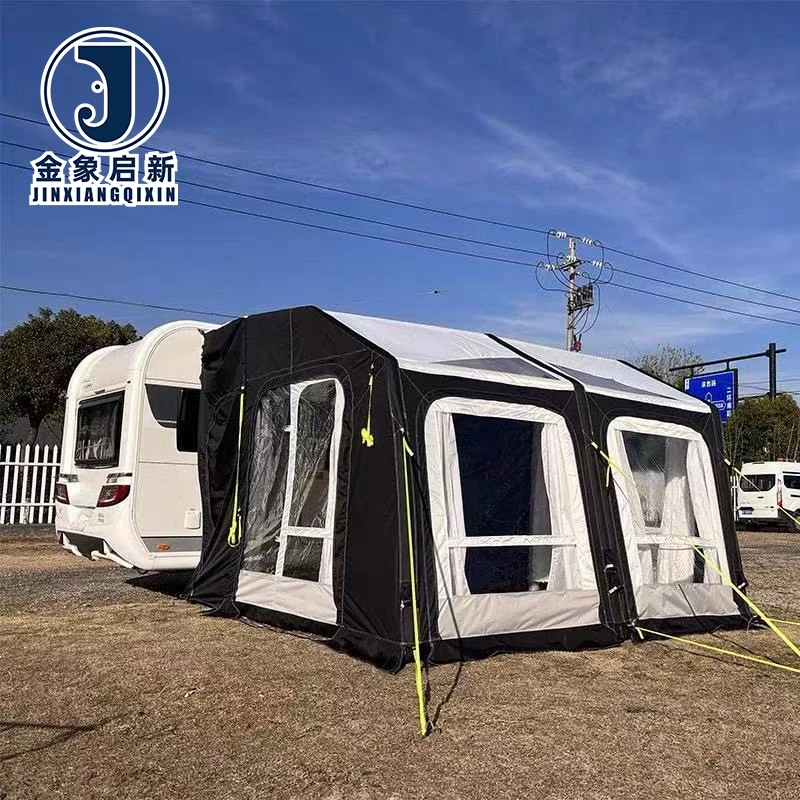
Coating Weight Control — every roll of PVC tarpaulin used in these inflatable shelters is checked against the stated specification before leaving the 9,180 m² production floor.
Technical Specifications
| Parameter | Value |
|---|---|
| Product Type | Inflatable Tent |
| Core Material | PVC tarpaulin |
| Key Performance | Waterproof, tear-resistant |
| UV Resistance | Available with UV-resistant treatment — confirm the grade required for your market |
| Flame Retardant | Available in flame retardant grades — confirm the grade required for your market |
| Product Forms | Inflatable structure with quick automatic opening mechanism |
| Customization | OEM & ODM, sample customization, pattern printing |
| Production Lines | 3 full production lines |
| Processing Equipment | 36 sets of professional processing equipment |
| R&D Team | 10 technicians |
| Quality Control | Full-process inspection with dedicated QA & QC staff |
| Certifications | ISO9001, ISO14001, ISO45001, CE |
Application Suitability
| Application | Exposure & Requirement |
|---|---|
| Construction site temporary workspace | Continuous outdoor UV exposure, wind loading, abrasion from equipment movement, rapid deployment need |
| Equipment storage during maintenance | Weather protection, dust ingress prevention, repeated inflation and deflation cycles |
| Disaster recovery logistics rapid response units | Fast inflation under field conditions, waterproof integrity in heavy rain, transportability between sites |
| Material staging at loading docks | Forklift proximity abrasion, overhead crane clearance, daily setup and breakdown |
| On-site project coordination shelter | Crew occupancy comfort, wind stability, branded visibility for fleet identification |
Why an Inflatable Shelter Fails When the Fabric Spec Is Chosen Blindly
The membrane only performs as well as the coating adhesion and base fabric weave behind it.
I have seen inflatable emergency shelters arrive at a disaster staging area, inflate correctly the first time, then develop pinhole leaks along the heat-welded seams by the third deployment cycle. The root cause is rarely the inflation mechanism — it is a PVC tarpaulin membrane specified by appearance rather than by the tensile and tear demands of repeated pressurization and folding. For transport fleet operators and logistics contractors who deploy these structures across multiple sites, a membrane that cannot survive twenty setup cycles turns a rapid-response asset into recurring replacement cost. [NEED_CITE: tensile and tear test methods for coated fabrics per ISO 1421]
How Transport Fleets Put Inflatable Shelters Under Stress
When a logistics operator deploys an Inflatable Tent aftermarket supplier structure at a transfer yard, the PVC membrane faces a combination of static inflation pressure, wind-induced flexing, and ground contact abrasion that static tent designs simply do not encounter. The base fabric weave must distribute the internal air pressure evenly so that stress does not concentrate at the weld lines where panels join.
Tear propagation is the failure mode that ends a shelter’s service life fastest. Once a small cut initiates at a corner gusset or a tie-down attachment point, the pressurized membrane forces the tear to extend with each wind gust. Selecting a PVC tarpaulin with adequate warp and weft density is the primary defense against this cascade.
The Rapid Deployment Requirement That Changes Material Selection
A quick automatic opening mechanism means the fabric must unfold from a tightly packed state, stretch into its full geometry, and hold pressure — all within minutes and without manual tensioning of individual panels. This demands a membrane that remains supple enough to pack tightly yet rigid enough to maintain structural shape once inflated. [NEED_CITE: coated fabric flexibility and cold-crack testing standards]
For disaster recovery logistics teams, the shelter may be deployed on uneven ground where partial inflation creates asymmetric loading. The PVC tarpaulin must tolerate localized stress concentrations at contact points without delaminating or developing seam separation. This is where coating adhesion strength, measured through peel testing, becomes the specification that matters more than surface finish or colour.
Reading the Specification Sheet Beyond the Headline Numbers
The PVC tarpaulin core material in these inflatable structures performs as a composite system: the base fabric provides tensile and tear strength, while the coating delivers waterproof integrity, UV protection, and the surface characteristics that determine weldability. A higher GSM reading alone does not guarantee better performance — a heavily coated fabric with a low-density base fabric can show strong weight numbers yet tear easily under point loads.
The coating method influences how well heat-welded seams hold during repeated inflation cycles. Knife-over-roll coating typically produces higher adhesion between the PVC layer and the base fabric compared to simple lamination, which matters when seam integrity is the difference between a standing shelter and a collapsed one. For inflatable structures, weld peel strength should be verified on every production batch, not just on the initial sample.
UV-resistant treatment and flame retardant properties are both available across the product range, but the specific grade must be confirmed against the regulatory requirements of the target market. A construction site in one jurisdiction may require a different fire classification than a logistics yard in another, and ordering without specifying the exact grade leaves compliance to chance.
What Happens When the Membrane Specification Misses the Mark
When an inflatable shelter is specified primarily on price per unit without verifying coating adhesion or base fabric density, the typical failure sequence begins at the welded seams. The heat-affected zone along each weld line is the weakest point in the membrane, and if the PVC coating does not bond adequately to the base fabric, pressurized flexing will cause delamination at these joints first. [NEED_CITE: heat-welded seam peel strength testing for PVC tarpaulin]
For fleet operators staging shelters at multiple locations, a batch of units that perform identically on first deployment but diverge in durability by the fifth cycle points to inconsistent coating weight control during production. This is the kind of variance that pre-shipment inflation testing under controlled conditions is designed to catch before the product reaches the field.
Why Production Control Matters for Inflatable Membrane Orders
Three full production lines and 36 sets of professional processing equipment support batch consistency across large orders — every shelter in a fleet deployment order is manufactured under the same coating parameters. The 10-person R&D team develops custom samples within days, allowing fleet operators to verify dimensions and inflation behaviour before committing to full production.
Full-process quality inspection with dedicated QA and QC staff means each inflatable unit undergoes an inflation test under controlled conditions before dispatch, with an inspection record provided per batch. ISO9001, ISO14001, ISO45001, and CE certifications accompany every shipment, giving procurement teams the documentation trail required for site safety audits and regulatory submissions.
Documentation & Verification
- Material specification sheet stating core PVC tarpaulin composition and coating parameters for each batch
- Pre-shipment full inflation test inspection record supplied per production batch
- UV and flame retardant test reports provided where the grade is specified in the purchase order
- ISO9001, ISO14001, ISO45001, and CE certificates included with every dispatch
- Batch inspection report detailing dimensional verification and performance compliance data
- Product data sheet documenting custom sizing, structural dimensions, and OEM specifications
Fabrication, Handling & Storage
- Heat-weld seams using temperature and dwell time parameters matched to the PVC tarpaulin coating thickness specified for your inflatable unit
- Store deflated and folded shelters in dry conditions away from direct sunlight to preserve coating flexibility between deployments
- Avoid dragging the PVC membrane across abrasive ground surfaces during field setup to prevent base fabric scuff damage
- Clean with mild detergent and soft brush; avoid solvent-based cleaners that can degrade the PVC coating surface
- Inspect welded seam lines after every five deployment cycles for early signs of peel delamination at stress points
- Pack units with adequate cushioning between folds to prevent permanent crease marks forming in the PVC tarpaulin during transport
What We Need to Move Your Enquiry Forward
Provide the deployment scenario — whether the inflatable shelters will serve a fixed loading dock, a rotating construction site schedule, or a disaster response fleet — along with the expected frequency of inflation and deflation cycles. Specify any fire classification or UV-resistance grade required by your site safety regulations so we can match the correct PVC tarpaulin treatment from the outset.
If your fleet vehicles or site footprints require custom dimensions, share the target inflated envelope measurements and the packed transport size constraint. Confirm whether pattern printing or branded panels are needed, and whether you require completed inflatable units or membrane panels for your own assembly line. A sample unit can be developed for inflation testing at your facility before full production is scheduled.
Frequently Asked Questions
Q: What custom sizing and OEM options are available for inflatable shelters?
A: Shelters can be produced to custom inflated dimensions matching specific fleet vehicle footprints or site layouts. OEM and ODM services include sample customization, pattern printing, and branded panel integration. The R&D team develops prototypes for buyer approval before full production runs, ensuring the inflated geometry and packed transport size both meet your deployment requirements.
Q: How is UV resistance verified for outdoor inflatable tent fabric?
A: UV-resistant treatment is available across the PVC tarpaulin range, with specific grades matched to your target market’s exposure conditions. Test reports documenting the treatment grade are supplied when specified in the purchase order. Buyers should confirm the UV performance classification required by their site safety regulations so the correct formulation is applied during coating.
Q: What fire-retardant grades can be supplied for industrial site compliance?
A: Flame retardant PVC tarpaulin grades are available to meet various industrial safety standards. The specific grade must be confirmed against your jurisdiction’s fire classification requirements before production. Test reports for the selected flame retardant grade are included in the shipment documentation package for site audit and regulatory submission purposes.
Q: How is the automatic opening mechanism tested before shipment?
A: Each inflatable unit undergoes full inflation testing under controlled conditions as part of the pre-shipment inspection protocol. The quick automatic opening mechanism is cycle-tested to verify reliable deployment and structural integrity across repeated inflation sequences. An inspection record documenting test results is provided per batch, giving buyers confidence in field performance.
Q: What lead times apply for custom-sized inflatable shelter orders?
A: Lead times depend on the level of customization, order volume, and whether sample approval is required before production. Custom dimensions, pattern printing, and specific treatment grades each add time to the production schedule. Buyers are encouraged to confirm required delivery dates at the enquiry stage so production can be scheduled across the available lines accordingly.