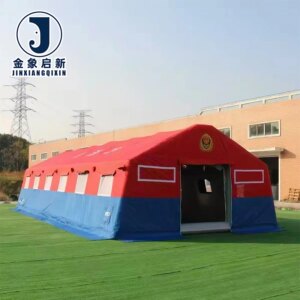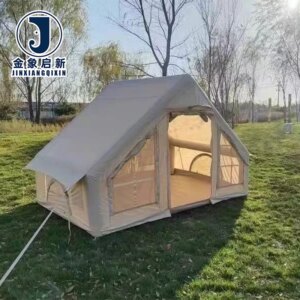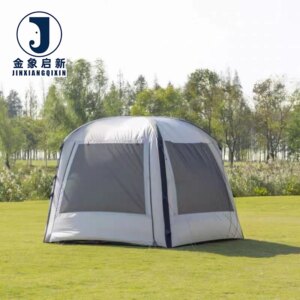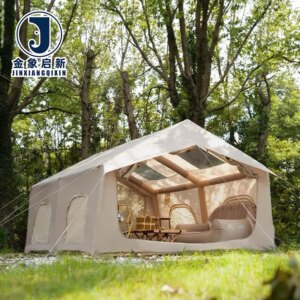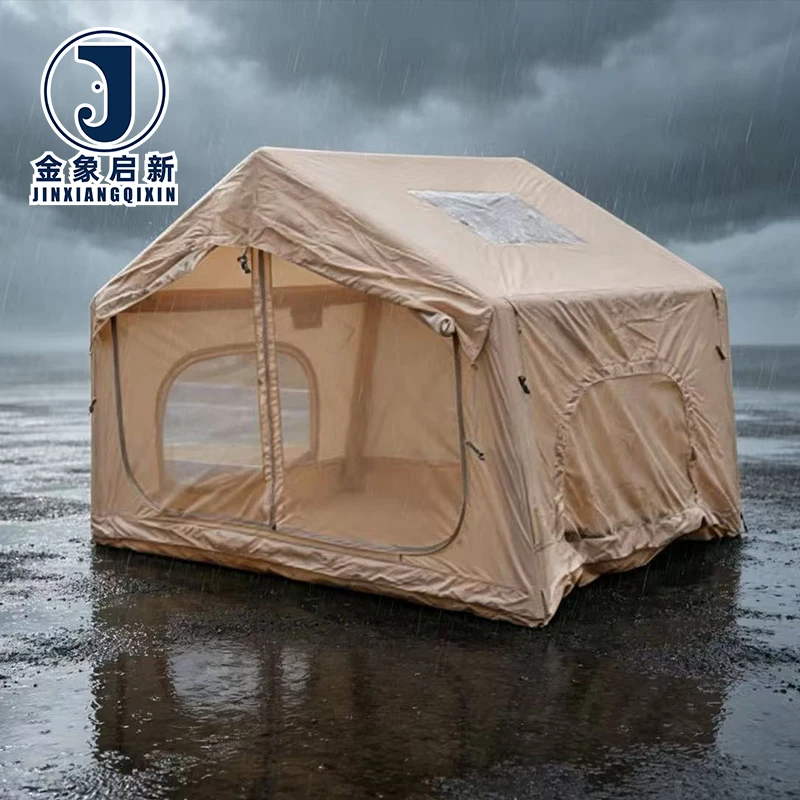
Rapid Deployment Expertise — Engineered inflatable shelter systems with quick auto-opening mechanisms for transport fleet staging areas and mobile field stations requiring immediate weather protection.
Technical Specifications
| Parameter | Value |
|---|---|
| Product Type | Inflatable Tent |
| Core Material | Waterproof UV-Resistant PVC Fabric |
| Key Performance | Waterproof, UV-Resistant, Quick Auto Opening |
| Product Forms | Inflatable Camping Tent |
| UV Treatment | (test basis not stated in source) |
| Waterproof Rating | Waterproof (hydrostatic head value not provided) |
| Printing Option | Pattern printing supported |
| Customization Service | OEM & ODM with sample customization |
| Standards | ISO 9001, ISO 14001, ISO 45001, CE |
Application Suitability
| Application | Exposure & Requirement |
|---|---|
| Transport fleet loading zones | Constant weather exposure, rapid deployment needed, vehicle traffic proximity |
| Construction site mobile field stations | Dust, debris, temporary storage requirements, repeated setup and teardown |
| Logistics cargo staging areas | Weather protection during inspection, quick assembly for time-sensitive operations |
| Roadside emergency response shelters | Immediate deployment, wind resistance, visibility requirements |
When Quick Setup Matters More Than Traditional Pole Structures
Inflatable tent systems eliminate the hours-long erection process that delays critical operations during weather events.
Traditional pole tents require multiple crew members, extensive ground anchoring, and significant time investment before providing adequate shelter. For transport fleet operators managing tight loading schedules or construction teams responding to sudden weather changes, this delay creates operational bottlenecks and exposes valuable cargo or equipment to moisture damage. The inflatable tent for truck and transport shelter applications addresses this fundamental mismatch between shelter deployment speed and operational tempo [NEED_CITE: rapid deployment shelter requirements for logistics operations].
Engineered for Transport and Logistics Environments
The inflatable tent for truck and transport shelter operations uses waterproof PVC fabric construction that maintains integrity during repeated inflation cycles and exposure to road spray, loading dock moisture, and precipitation. Unlike temporary pole structures that require complete disassembly for relocation, these inflatable systems can be deflated, moved, and redeployed within hours rather than days. The quick auto-opening mechanism reduces setup time from hours to minutes, allowing fleet operators to establish weather-protected staging areas without disrupting delivery schedules or requiring specialized erection crews.
Addressing Flex Point Failures in Mobile Shelter Systems
Transport and logistics environments subject shelter materials to constant stress at connection points, inflation chambers, and ground contact zones where traditional sewn seams often fail before the base fabric reaches its service life limit. The reinforced seams at high-stress flex points in this inflatable tent system address the specific failure modes observed in mobile field station deployments [NEED_CITE: welded seam performance under repeated inflation cycles for inflatable structures]. UV-resistant treatment maintains structural integrity during extended outdoor exposure at construction sites and loading zones where shelters remain deployed for weeks or months between relocation cycles.
Understanding Material Selection for Inflatable Shelter Performance
Waterproof PVC fabric selection for inflatable tent applications requires balancing multiple performance factors beyond simple water resistance ratings. The coating method and weight determine both air retention capability within inflation chambers and overall structural rigidity when fully pressurized. Base fabric denier and weave density influence puncture resistance during deployment on unprepared ground surfaces common at construction sites and temporary logistics hubs. Surface finish selection affects both cleaning ease after exposure to construction dust and road grime, and the adhesion quality for pattern printing when company branding or safety markings are required for site identification purposes.
The Hidden Cost of Incorrect Specification Selection
Selecting inflatable tent systems without verifying material specifications against actual deployment conditions leads to predictable failure patterns that disrupt operations and create replacement costs. Insufficient coating weight results in air leakage through inflation chambers, requiring constant re-pressurization and eventual structural collapse during critical operations. UV treatment claims without documented test basis lead to premature fabric degradation, chalky surface appearance, and reduced tensile strength after only one or two deployment seasons [NEED_CITE: UV degradation patterns in PVC-coated fabrics for outdoor structures]. Batch color inconsistency becomes visible when multiple inflatable tent units are deployed side-by-side at large logistics facilities or construction sites, creating unprofessional appearance for client-facing operations.
Why Procurement Teams Specify This Source
Nearly 30 years of focused coated fabric production provides process control over coating weight consistency and adhesion quality that directly impacts inflatable chamber performance and seam integrity. Three full production lines with 36 sets of professional processing equipment support bulk capacity requirements while maintaining reliable on-time delivery schedules that transport fleet operators depend on for seasonal deployment planning. The 10-person R&D team handles material selection, pattern printing specifications, custom sizing development, and sample confirmation processes that ensure final production matches approved prototypes. Dedicated QA/QC inspection at every production stage with 100% pre-shipment verification catches coating defects, seam weaknesses, and dimensional variations before products reach deployment sites where failures create operational disruptions.
Documentation & Verification
- Material specification sheet confirming GSM, base fabric denier, coating weight, and color reference for each production batch
- UV treatment test documentation supporting anti-UV claims for extended outdoor deployment verification
- Pre-shipment inspection records with dimensional verification and inflation chamber pressure testing
- Custom sample approval documentation confirming specifications before mass production authorization
- ISO and CE certification copies supporting site compliance requirements for commercial operations
Fabrication, Handling & Storage
- Heat welding parameters must match PVC coating thickness to ensure seam strength equals base fabric tensile capacity
- Inflation chamber seams require reinforced welding at stress concentration points where repeated pressurization cycles occur
- Store deflated units in dry conditions away from sharp objects that could puncture waterproof PVC fabric layers
- Avoid folding at identical points during storage to prevent permanent crease formation in coated fabric structure
- Use compatible PVC cleaners that do not degrade UV-resistant treatment or compromise waterproof coating integrity
- Repair minor punctures with PVC-compatible adhesive patches applied to clean, dry surfaces following manufacturer instructions
Moving Forward With Your Specification
Provide deployment environment details including expected wind loads, duration of continuous outdoor exposure, and ground surface conditions where the inflatable tent for truck and transport shelter applications will be anchored. Specify any company branding requirements, pattern printing needs, or color matching requirements for multi-unit deployments at client-facing facilities. Indicate target market compliance requirements including fire safety standards, building code considerations, or site-specific material certifications required for commercial operation approval. Confirm whether sample units are needed for fitment verification and performance testing before authorizing full production quantities.
Frequently Asked Questions
Q: How is tent sizing matched to specific trailer or site dimensions?
A: Custom sizing begins with detailed dimension drawings showing required coverage area, inflation chamber configuration, and anchoring point locations. The R&D team develops samples based on these specifications for approval before mass production, ensuring the final inflatable tent fits your exact application rather than forcing adaptation to off-the-shelf dimensions.
Q: What UV test basis supports the anti-UV claim for long-term outdoor exposure?
A: UV treatment specifications vary by application requirements and target market standards. Request documentation showing test methodology and exposure duration results for your specific deployment climate and expected service conditions. Verification testing ensures the waterproof PVC fabric maintains structural integrity during your operational timeline.
Q: How is batch color consistency maintained when multiple tents are installed side by side?
A: Production batches use controlled pigment mixing procedures with color reference verification at multiple stages. Pre-shipment inspection includes side-by-side comparison of rolls or finished units from the same order to detect variations before dispatch, preventing visible inconsistencies when multiple inflatable tent units are deployed together.
Q: What customization options are available and what is the sample approval process?
A: OEM and ODM services include custom sizing, pattern printing for company branding, color specification, and inflation chamber configuration modifications. Sample development occurs within days for most requirements, with approval required before mass production authorization to ensure final products match your exact specifications.
Q: What certifications and documentation accompany each shipment for site compliance?
A: Shipments include ISO 9001, ISO 14001, ISO 45001, and CE certification documentation along with material specification sheets, pre-shipment inspection records, and test reports for applicable performance claims. Certificate of origin and customs support documentation facilitate international procurement and site compliance verification processes.