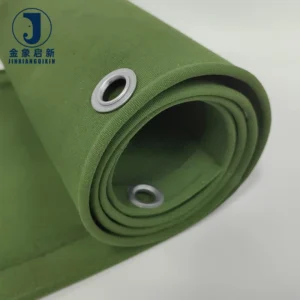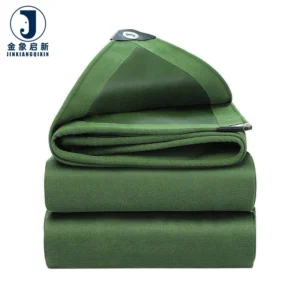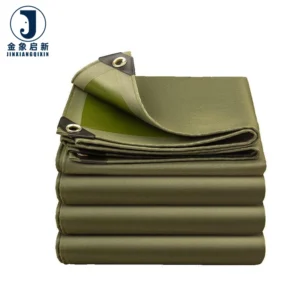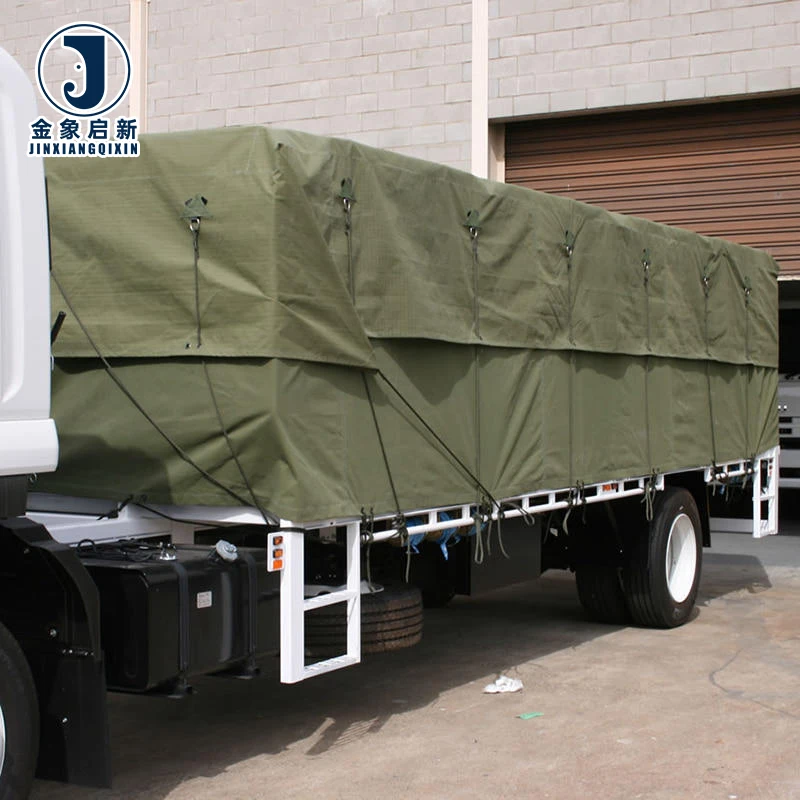
Deep process control over coating weight and adhesion — every 600gsm polyester-cotton canvas roll is verified against the stated specification before dispatch, ensuring truck and trailer covers perform consistently across fleet deployments.
Technical Specifications
| Parameter | Value |
|---|---|
| Product Type | PVC Coated Canvas Tarpaulin |
| Base Material | Polyester cotton industrial textile, 8-12 strands fine cotton yarn |
| Weight | 600gsm |
| Total Thickness Options | 0.5mm / 0.6mm / 0.7mm |
| Roll Width | 2m |
| Roll Length | 100m |
| Color Options | Army Green Camouflage / Custom |
| Eyelets | Rust-proof aluminum, spaced every 1 meter at corners and hem |
| Edge Reinforcement | Folded hems, seams welded and sewn with poly ropes |
| Key Features | Wear-resistant, corrosion-resistant, tensile-resistant, high- and low-temperature resistant |
| UV Treatment | Claimed UV resistant (test basis not stated — confirm grade required) |
| Waterproof Rating | Claimed waterproof (grade not stated — confirm requirement) |
| Anti-Mildew | Claimed mold resistant (test basis not stated — confirm certification needed) |
| Standards | CE, ISO |
Application Suitability
| Application | Exposure & Requirement |
|---|---|
| Flatbed and tipper truck covers | Road vibration, wind flap at speed, load flex at seams, tie-down strap abrasion |
| Asphalt and aggregate transport | High surface temperature contact, abrasive particulate, frequent deployment and folding |
| Construction site load protection | UV exposure, rain and wind, rough handling by site personnel and machinery |
| Curtain-side trailer fabric | Constant flex cycling, tension from track systems, lateral abrasion against cargo |
| Transport equipment builder roll stock | Batch-to-batch consistency, predictable weld and sew behaviour, roll width for yield |
Why a Generic-Size Canvas Tarpaulin for Truck Cover Fails Before the Fabric Does
The cover shifts, the load is exposed at the edges, and the seams split where the tarp flexes over uneven cargo.
Generic-size covers never match the trailer properly. Excess fabric catches wind at highway speed, accelerating wear at the hem and pulling eyelets from the reinforced edge. Short covers leave the cargo exposed and force operators to over-tension the tie-downs, concentrating stress at points the material was not designed to handle. I have seen otherwise sound PVC coated canvas fail within months not because the fabric was inadequate, but because the cut dimensions and seam placement did not match the load profile [NEED_CITE: common failure modes in transport tarpaulins].
How Cut-to-Fit Dimensioning Changes Cover Behaviour on the Road
A canvas tarpaulin for truck and transport cover use must match the trailer’s load envelope, not just its deck dimensions. The cover needs enough drop to shield the cargo sides without pooling water, and enough length to seal the rear without dragging. When these margins are calculated from the specific vehicle model, the tie-down load distributes evenly across the eyelet line rather than concentrating at two or three overstressed points.
Welded-and-sewn seams placed at natural flex zones — where the cover bends over the cargo peak or folds at the trailer hinge — resist the cyclical fatigue that splits stitched-only seams. The poly rope sewn into the hem adds a structural element that holds the edge geometry under tension, preventing the hem from rolling and exposing the cut edge to fraying.
Matching Thickness to the Abrasion Profile of Your Fleet
The three available thickness options — 0.5mm, 0.6mm and 0.7mm — correspond to different exposure intensities. A flatbed carrying palletised building materials on short urban routes subjects the cover to different abrasion than a tipper hauling aggregate over haul roads. Thicker canvas resists surface wear longer but adds weight to every deployment cycle, affecting how readily a single operator can handle the cover during loading and unloading [NEED_CITE: relationship between coated fabric thickness and abrasion resistance].
Fleet operators running mixed trailer types often standardise on a single thickness across the fleet for interchangeability, accepting that some covers will be over-specified for lighter routes in exchange for reduced inventory complexity.
Reading the 600gsm Weight in Context
The 600gsm figure represents the combined weight of the polyester-cotton base fabric and the PVC coating, not the base fabric alone. The 8-12 strand fine cotton yarn construction provides the tensile skeleton; the coating fills the weave, locks the yarns in place, and provides the weather barrier. A heavier coating on a lighter base fabric can yield the same GSM as a lighter coating on a denser base — but the tensile and tear behaviour will differ substantially.
For transport covers subjected to tie-down tension and road vibration, the base fabric density matters as much as the total weight. The polyester-cotton blend in this canvas balances the dimensional stability of polyester with the flex fatigue resistance of cotton, a combination that holds up under the repeated folding and deployment cycles typical of fleet operations.
What Happens When the Wrong Canvas Reaches the Fleet
A cover that is undersized forces operators to stretch it beyond its intended tension, accelerating eyelet pull-out and seam separation. A cover that is oversized flaps in the slipstream, wearing through the PVC coating at the contact points long before the base fabric is compromised. Batch-to-batch colour variation across an order of multiple rolls becomes visible when covers from different rolls are deployed side by side on the same job site, undermining the professional appearance a fleet operator presents to clients [NEED_CITE: batch colour consistency standards in coated textile production].
Seam failure that occurs before the fabric itself shows meaningful wear typically points to incorrect weld temperature or insufficient seam overlap for the material thickness, not to a deficiency in the canvas specification.
Production Discipline That Shows in the Finished Cover
Nearly three decades focused on coated fabric production means the relationship between coating weight, base fabric density and weld behaviour is managed as a system, not as isolated variables. Three full production lines and 36 sets of professional equipment support consistent output volume without the quality drift that occurs when capacity is pushed beyond equipment limits.
A 10-person R&D team handles the translation from your trailer model drawing to a cover pattern that accounts for hem take-up, eyelet placement and seam position relative to the load flex zones. Dedicated quality control at every production stage, with 100% inspection before shipment, catches GSM deviation, colour drift and eyelet alignment issues before the roll leaves the facility.
Documentation & Verification
- Material specification sheet stating exact 600gsm base fabric and coating weight breakdown
- Pre-shipment inspection record confirming custom cut dimensions match trailer model drawing
- Roll packing list with individual roll weights and dimensions for receiving verification
- Certificate of origin prepared for customs clearance in destination market
- UV and waterproof test documentation where specific grades have been confirmed at inquiry stage
Fabrication, Handling & Storage
- Weld temperature must be matched to the selected thickness option (0.5mm, 0.6mm or 0.7mm) to avoid coating burn-through or cold-weld delamination.
- Poly rope sewn into hems requires needle spacing adjusted to the 600gsm canvas density to prevent yarn damage along the stitch line.
- Store rolls horizontally on a clean, flat surface to prevent permanent creasing in the PVC coating layer.
- Allow cold-stored canvas to reach ambient temperature before unfolding to avoid cracking the PVC coating at fold lines.
- Clean with mild detergent only; solvent-based cleaners can degrade the PVC coating surface on this canvas tarpaulin.
Preparing Your Specification for Quotation
To move from inquiry to sample, provide the trailer model designation or load deck dimensions with the required drop length, along with the preferred thickness and eyelet spacing confirmation. If your fleet operates under specific UV exposure or fire compliance requirements, state the grade needed so the correct treatment can be included and documented. Indicate whether you require finished, hemmed and eyeleted covers or roll stock for in-house fabrication.
Frequently Asked Questions
Q: How do I specify the exact truck or trailer model for a custom-fit canvas cover?
A: Provide the manufacturer model designation along with load deck length, width and the required side and rear drop. If the trailer has non-standard features such as raised headboards or tail lift recesses, include those dimensions so the pattern accounts for them. A dimensioned sketch is sufficient where model drawings are unavailable.
Q: What eyelet spacing and reinforcement options are available for heavy road vibration?
A: The standard configuration uses rust-proof aluminum eyelets spaced every 1 meter at corners and hems, set into folded and welded-and-sewn hems reinforced with poly rope. For high-vibration routes, confirm whether closer spacing or additional corner reinforcement patches are required for your tie-down arrangement.
Q: How do welded-and-sewn seams compare for durability at load flex points?
A: Welding fuses the PVC coating layers together, creating a continuous bond that stitched seams alone cannot achieve. The additional poly rope sewing through the welded seam provides mechanical reinforcement that resists peel forces where the cover flexes over shifting cargo, addressing the zone where transport covers typically fail first.
Q: What is the batch-to-batch colour consistency when ordering multiple rolls in Army Green Camouflage?
A: Colour consistency is managed through controlled coating formulation and in-process inspection at each production stage. For fleet-wide deployments where covers from different rolls will be visible together, request a pre-production sample from the production batch to confirm the shade meets your requirement before full order release.
Q: Is the canvas treated for UV and flame retardancy, and can I get a test report?
A: UV and flame-retardant treatments are available, but the specific grade must be confirmed at the inquiry stage to match your market’s regulatory or site requirements. Test documentation is supplied for the confirmed grade; state your compliance standard when requesting a quotation so the correct treatment is applied and recorded.