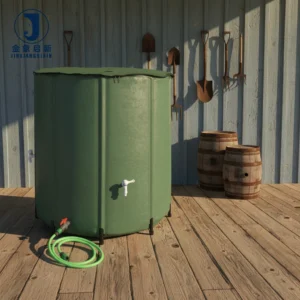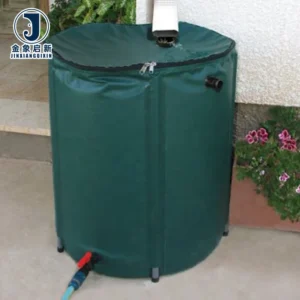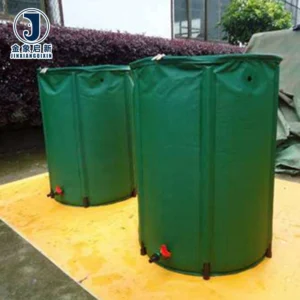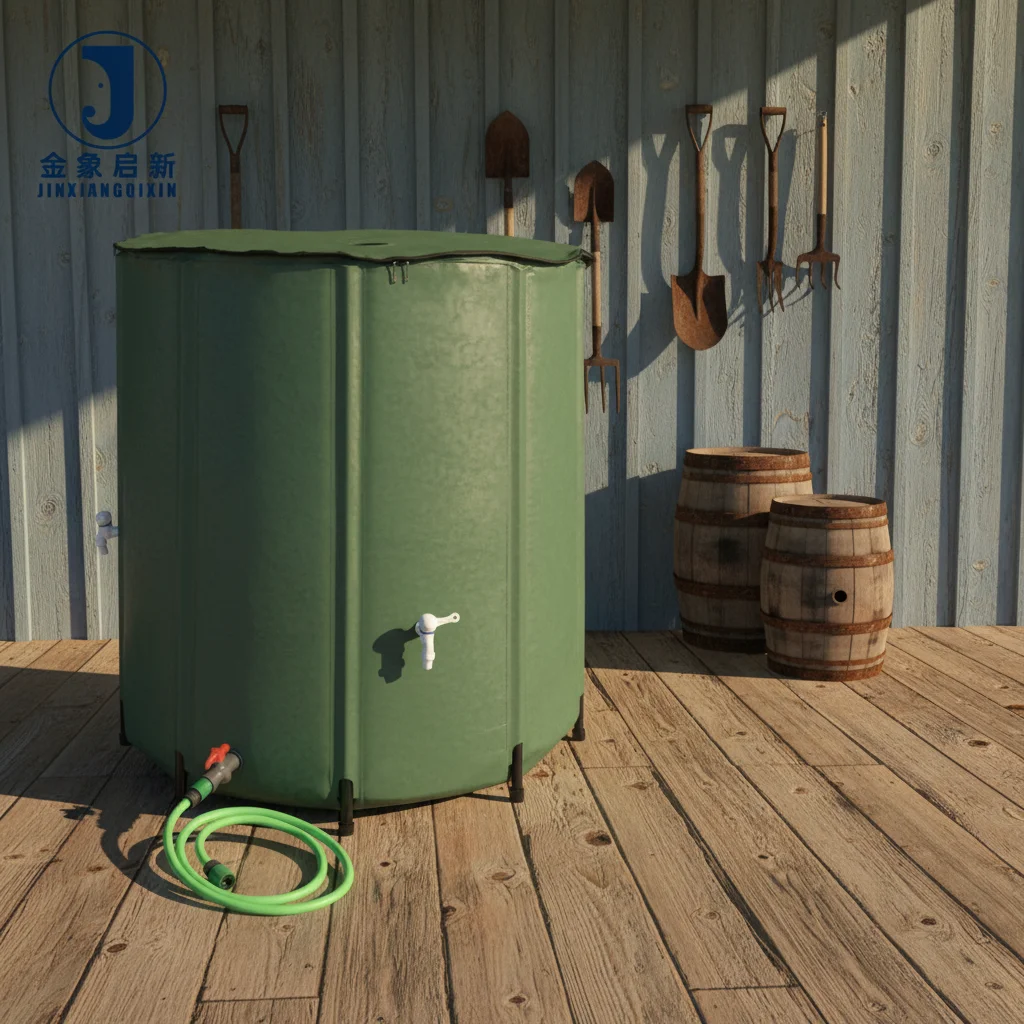
Structural Rigidity on Demand — PVC support rod framework holds the 750L barrel upright under full load, yet folds flat for seasonal storage or site relocation.
Technical Specifications
| Parameter | Value |
|---|---|
| Product Type | Collapsible PVC Rain Water Tank |
| Material | PVC Mesh Cloth (500D/1000D base fabric) |
| Support Structure | PVC Support Rod |
| Capacity Options | 200L / 380L / 500L / 750L |
| Coating | PVC — waterproof, tear-resistant, abrasion-resistant |
| Treatment Claims | Anti-UV, flame retardant, anti-mildew, anti-static, anti-bacteria (grades and test basis not stated — confirm required certifications before ordering) |
| Assembly State | Collapsible / foldable with rod support |
| Standards Referenced | ISO, CE (company-level certification) |
Application Suitability
| Application | Exposure & Requirement |
|---|---|
| Garden rainwater harvesting | Continuous UV exposure, algae and mildew risk, seasonal deployment and storage |
| Agricultural irrigation reserve | Outdoor weathering, repeated fill-drain cycles, contact with soil and organic matter |
| Construction site water storage | Dust and debris abrasion, rough ground contact, temporary deployment across project phases |
| Transport fleet yard collection | Proximity to vehicle wash bays, chemical runoff exposure, space-constrained yard layouts |
Why Generic-Size Rain Barrels Fail Transport and Site Operators
A collapsible PVC rain water tank must match your deployment footprint, not the other way around.
Fleet yards and construction sites operate within tight spatial constraints. When a rain barrel arrives in a standard diameter that conflicts with a wash bay drain line or a scaffold base plate layout, the unit either sits idle or forces a costly site rearrangement. Sizing errors compound across multiple units — a yard ordering ten barrels for truck wash water recycling cannot absorb the footprint miscalculation of even one. [NEED_CITE: spatial planning constraints for on-site water harvesting infrastructure]
Deploying Collapsible Water Storage Where Rigid Tanks Cannot Reach
The collapsible PVC rain water tank addresses a gap that rigid polyethylene or steel barrels leave open: deployment in locations where permanent infrastructure is impractical. A transport fleet operator running seasonal truck washing can position the tank at a temporary bay, then collapse and store it when the wash operation moves. Construction contractors working phased sites relocate the unit between zones without crane or forklift support.
Fabric Integrity Under Repeated Fold-Unfold Cycles
Each deployment cycle subjects the PVC mesh cloth to creasing stress at the fold lines and abrasion where the fabric contacts the support rod pockets. The 500D/1000D base fabric selection targets resistance to tear propagation at these stress concentrations. Heat-welded seams at the base and outlet fittings must maintain coating adhesion through repeated flexing — a failure point that [NEED_CITE: tensile and tear test methods for coated fabrics per ISO 1421] becomes visible only after multiple seasons of use.
What Denier and Coating Weight Mean for Water Containment
The 500D/1000D PVC mesh cloth specification refers to the yarn denier of the base fabric — the mass per unit length of the polyester yarns woven into the scrim. Higher denier yarns resist puncture from sharp ground debris and resist tear initiation when the barrel is dragged across rough surfaces. The PVC coating encapsulates this scrim, providing waterproofing and determining the fabric’s overall GSM. Together, denier and coating weight govern how the barrel withstands hydrostatic pressure at full 750L capacity without seam distortion or base bulging. Buyers evaluating collapsible PVC rain water tank options should request the GSM breakdown separating base fabric weight from coating weight, as the ratio affects both flexibility during folding and rigidity when deployed.
The Cost of Overlooking Treatment Documentation
Buyers who accept anti-UV or flame retardant claims without test reports face two distinct failures. In outdoor water storage, UV degradation manifests as surface chalking and loss of coating adhesion — the barrel becomes brittle at fold lines and splits during the next deployment. On construction sites where hot work occurs near water storage, a flame retardant barrel lacking certification documentation may fail site safety audits, forcing replacement at the contractor’s expense. These outcomes trace directly to procurement decisions made at the quotation stage. [NEED_CITE: fire classification standards for temporary site materials]
Why Sourcing This Barrel Here Makes Sense
The manufacturing team applies nearly 30 years of coated fabric process control to a product category where most suppliers treat rain barrels as commodity goods. Three full production lines and 36 sets of professional equipment support bulk capacity for fleet or contractor orders without sacrificing weld consistency across units. The 10-person R&D team handles custom capacity sizing, allowing buyers to specify barrel dimensions that match their exact site footprint or trailer bed. Dedicated QA/QC inspection at every production stage catches seam adhesion and rod pocket reinforcement issues before units leave the factory.
Documentation & Verification
- Material specification sheet stating base fabric denier, coating weight and GSM for the exact barrel capacity ordered
- Anti-UV and flame retardant test reports supplied where applicable — confirm grade requirements for your market
- Pre-shipment inspection record covering heat-welded seam integrity and PVC support rod pocket reinforcement
- Dimensional cut-sheet verifying deployed-state measurements against quoted capacity rating
Fabrication, Handling & Storage
- Heat-weld seams at outlet fittings using temperature and dwell time parameters matched to the PVC coating weight to prevent delamination
- Inspect PVC support rod pockets for reinforced stitching or welding at stress points before first deployment
- Store collapsed barrels in dry, shaded conditions to prevent mildew formation on folded PVC mesh cloth surfaces
- Avoid dragging the barrel base across sharp aggregate — position on level ground or a protective mat before filling
- Clean interior with mild detergent; avoid solvents that degrade the PVC coating and anti-bacteria treatment layer
What to Include in Your Inquiry
Specify the deployment environment — garden, agricultural, construction or fleet yard — along with the exposure conditions the barrel will face, including direct sun duration and proximity to chemical or fuel handling areas. State the capacity required per unit and the total quantity across your project or season. Confirm whether your site or market requires documented flame retardant or anti-UV grades, and indicate if custom sizing is needed to fit a specific footprint. Request a sample unit if you intend to validate dimensions and weld quality before committing to a bulk order.
Frequently Asked Questions
Q: How is the PVC support rod secured against wind load and accidental collapse?
A: The PVC support rod inserts into reinforced fabric pockets engineered to distribute lateral wind load across the barrel circumference. At the 750L capacity, the rod framework maintains structural rigidity under full hydrostatic load. For high-wind deployment sites, confirm the rod diameter and pocket reinforcement specification with the engineering team before ordering.
Q: What anti-UV test basis supports the outdoor exposure claim?
A: The PVC mesh cloth receives anti-UV treatment during coating, but the specific test standard and exposure duration rating are not stated in the base specification. Request the UV test report documenting the method and results before placing orders for barrels intended for continuous outdoor deployment.
Q: Can the barrel be custom-sized to fit a specific trailer bed or site footprint?
A: Yes. The R&D team develops custom capacity and dimension samples based on your deployment footprint requirements. Provide the maximum allowable diameter and height, and the target capacity in litres. Sample approval precedes bulk production to verify fit.
Q: How do you verify fabric denier and coating adhesion upon delivery?
A: The pre-shipment inspection record documents base fabric denier verification and coating weight measurement against the quoted specification. Upon receipt, buyers can cross-check the material specification sheet supplied with the shipment documentation against physical sample characteristics.