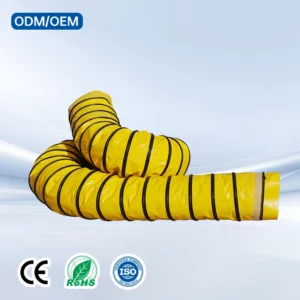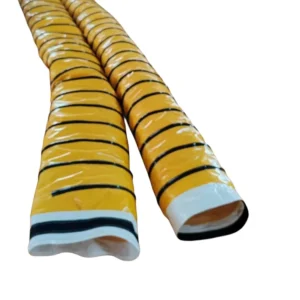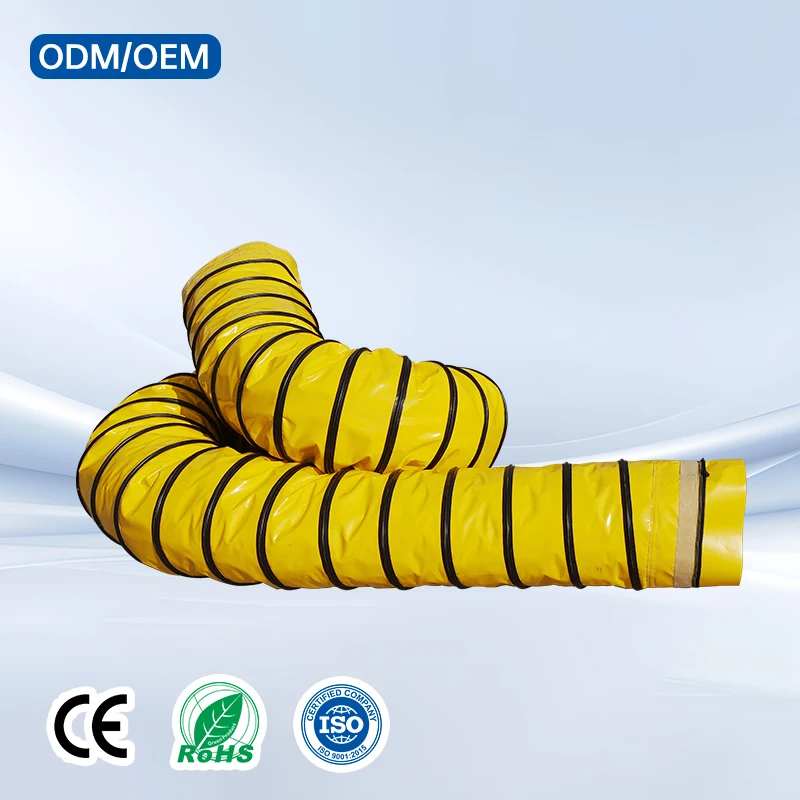
Coated Fabric Process Control — Three full production lines maintain strict adhesion and coating consistency across every PCA hose batch we ship.
Technical Specifications
| Parameter | Value |
|---|---|
| Product Type | Air Conditioning Hose |
| Material | PVC coated cloth with fabric-reinforced layer and aluminum foil bubble film insulation |
| Temperature Range | -30°C to 150°C |
| Connection Method | Zipper and Velcro link |
| Outer Layer Coloring | Yellow-black alternating protective coloring |
| Key Features | Mildew resistance, water resistance, high strength, strong tension, heat resistance |
| Logo Customization | Supported, MOQ 100 |
| Outer Packaging Customization | Supported, MOQ 100 |
| Pattern Customization | Supported, MOQ 100 |
| Flame Retardant | Available in flame retardant grades — confirm the grade required for your aviation market |
| Anti-Static | Available on request — confirm anti-static requirements for your ground support equipment specification |
| Standards | ISO and CE certified facility |
Application Suitability
| Application | Exposure & Requirement |
|---|---|
| Airport apron PCA unit to aircraft cabin connection | Continuous thermal cycling between heated and cooled airflow, outdoor UV and weather exposure, mechanical abrasion from ground handling equipment |
| Aviation MRO facility ducting replacement | Frequent assembly and disassembly cycles, compatibility with multiple aircraft interface sizes, resistance to hangar chemicals and jet fuel vapours |
| Airport infrastructure pre-conditioned air distribution | Extended static deployment under apron jet bridges, long-term mildew and moisture resistance, compliance with ground support safety visibility standards |
Why Certification Gaps in Aviation Air Ducts Cost More Than the Hose Itself
Every PCA hose deployed on the apron must carry documentation that matches the site’s fire and safety specification — not just a claim on the quotation.
Ground support equipment managers regularly discover that the ventilation duct delivered to the tarmac lacks the fire-retardant or anti-static certification their airport compliance framework demands [NEED_CITE: airport ground support equipment fire safety regulations]. When an Aircraft PCA Hose manufacturer cannot produce a test report matching the specified grade, the hose sits in storage while the procurement team sources a replacement. Meanwhile, the PCA unit runs without ducting, passenger comfort drops, and flight turnaround schedules slip. The cost of one delayed departure dwarfs the unit price of the hose by a wide margin.
Material Layering That Handles Apron Temperature Extremes
The PVC coated cloth outer shell provides water and mildew resistance essential for outdoor apron deployment, while the fabric-reinforced layer adds tensile strength to withstand the pulling forces during connection and repositioning. Between these structural layers, the aluminum foil bubble film insulation manages the thermal transfer across the -30°C to 150°C operating range. This multi-layer construction means an Aircraft PCA Hose manufacturer can deliver a single duct that transmits both pre-conditioned cold air during summer operations and heated air during winter ground handling without material changeover.
Rapid Deployment Connections for Turnaround Efficiency
The zipper and Velcro link system allows ground crew to connect and disconnect the duct from the PCA unit and aircraft interface without tools or specialised training. This matters on busy aprons where turnaround windows are measured in minutes. The yellow-black alternating outer colouring provides high-visibility marking that aligns with ground support safety protocols, reducing trip and snag hazards around mobile equipment [NEED_CITE: IATA ground operations safety guidance for apron equipment visibility]. Each hose section can be detached individually for inspection or replacement without dismantling the entire duct run.
Insulation Performance and Temperature Boundary Behaviour
The -30°C to 150°C range defines the operational envelope where the aluminum foil bubble film maintains its insulating properties and the PVC coating remains flexible without becoming brittle or softening excessively. At the cold extreme, the PVC must resist cracking under flex load — a common failure point for unreinforced coatings. At the hot extreme, the fabric-reinforced layer prevents the PVC from stretching or deforming under internal air pressure. The aluminum foil layer reflects radiant heat, reducing the thermal gradient across the duct wall and preventing condensation on the outer surface when transmitting cooled air in humid apron conditions. The interplay between these three layers determines whether the duct maintains its cross-section shape under positive pressure.
The Hidden Cost of Specifying Without Verification
Buyers who approve a PCA hose based on quoted material descriptions alone — without requesting the pre-shipment inspection record or the specific flame retardant test report — risk receiving ducting that passes visual inspection but fails compliance audit once deployed [NEED_CITE: aviation ground equipment compliance verification standards]. A duct without confirmed anti-static properties can accumulate charge in dry climates, creating discharge risk near fuel operations. Colour inconsistency between batches forces visible mismatches when replacement sections are spliced into existing duct runs. Weld failures at the zipper junction, where flexing concentrates during connection, separate the hose from its fitting mid-operation and interrupt the air supply to the aircraft cabin.
Why Procurement Teams Source PCA Ducting Here
The ten-person R&D team handles material selection, custom diameter sizing, and pattern printing in-house, developing samples within days rather than weeks for non-standard aircraft interface dimensions. Three full production lines and 36 sets of professional equipment support batch volume without splitting orders across subcontractors. Every roll of coated fabric passes dedicated QA/QC at each production stage, with 100 percent inspection before dispatch — not sampling. The coating process control built over nearly 30 years of PVC and PE fabric production ensures that the GSM stated on the quotation matches what arrives on the dock. ISO and CE facility certification underpins the documentation package accompanying every shipment.
Documentation & Verification
- Material specification sheet confirming PVC coating weight, aluminum foil insulation layer, and fabric-reinforced structure
- Temperature range test record covering -30°C to 150°C operating envelope
- Flame retardant grade test report matching your aviation market requirement where applicable
- Pre-shipment inspection record with 100 percent inspection before dispatch
- ISO and CE certificates included with shipment documentation package
- Roll packing list and certificate of origin for customs clearance
Fabrication, Handling & Storage
- Zipper and Velcro junctions require alignment before pressurising the duct to prevent seam separation at connection points
- Store rolled hoses in dry conditions to protect the aluminum foil insulation layer from moisture ingress
- Avoid dragging the PVC coated outer shell across abrasive apron surfaces during deployment to prevent coating scuff
- Clean with mild detergent only — solvents degrade the PVC coating and compromise mildew resistance treatment
- Inspect Velcro surfaces for debris accumulation after each apron use cycle to maintain connection integrity
- Allow duct sections to reach ambient temperature before unrolling in cold weather to prevent PVC stiffening damage
What We Need From Your Enquiry
To size and specify the correct PCA hose for your ground support operation, provide the aircraft types you service and the PCA unit interface dimensions on your apron. Confirm whether your airport authority mandates a specific flame retardant grade or anti-static classification for ground equipment ducting. Let us know your required duct length, any custom diameter needs, and whether you need OEM logo or pattern branding at MOQ 100.
Frequently Asked Questions
Q: What flame-retardant or anti-static certifications can you provide for aviation PCA hose compliance?
A: We provide flame retardant test reports and anti-static certifications matching the grade your airport authority or aviation regulator requires. Because aviation standards vary by region and airport, confirm the specific classification your site mandates so we can supply the correct test documentation with your shipment.
Q: How do you verify material composition and insulation performance before shipment?
A: Every production batch undergoes 100 percent pre-shipment inspection covering coating weight verification, aluminum foil insulation layer integrity, and zipper-Velcro connection function. We supply a material specification sheet and inspection record confirming the PVC coated cloth structure meets your agreed temperature range of -30°C to 150°C.
Q: What is the process for OEM customization of logo, color, and packaging on PCA hoses?
A: We support logo, pattern, and outer packaging customization each at MOQ 100. Our R&D team develops samples within days for your approval, covering color matching to your branding specification, printed logo placement, and custom packaging format before production begins.
Q: How are custom diameters and lengths handled for non-standard aircraft interface sizes?
A: Provide the exact interface diameter and required duct length from your PCA unit to the aircraft connection point. Our R&D team evaluates the sizing against our production capability and develops a sample for fitment testing before committing to batch production, ensuring compatibility with your specific ground support equipment configuration.
Q: What after-sales support is available for PCA hose installation and field repair?
A: We provide guidance on connection alignment, Velcro maintenance, and storage practices specific to the PVC coated and aluminum foil insulated construction. If a zipper junction or Velcro link requires field attention, we advise on the appropriate repair approach to restore duct integrity without compromising the insulation layer or temperature rating.