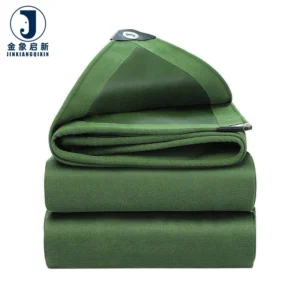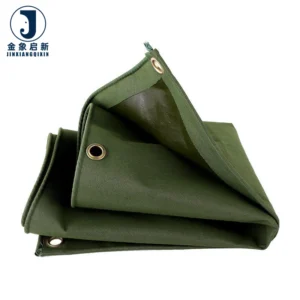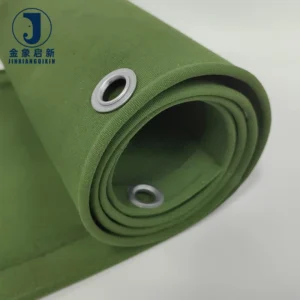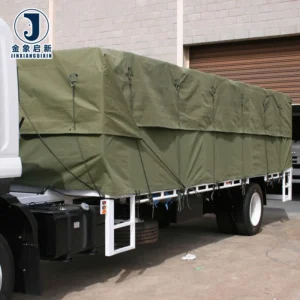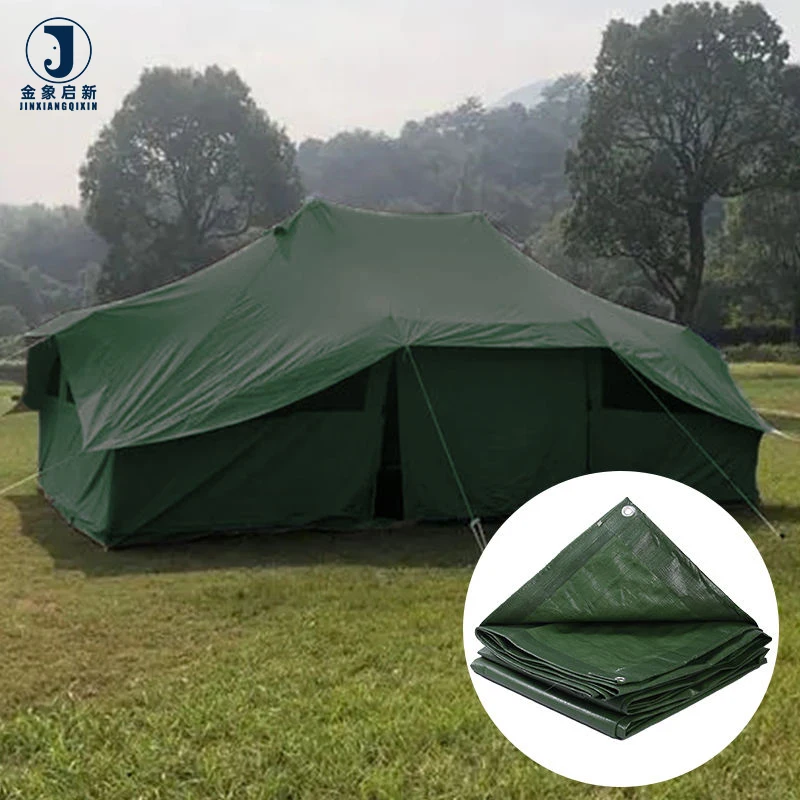
Custom Dimensional Accuracy — Every PE tarpaulin truck cover is cut to the exact trailer model dimensions you provide, eliminating the gap and flap failures that generic-size covers cause on moving loads.
Technical Specifications
| Parameter | Value |
|---|---|
| Product Type | PE Tarpaulin |
| Material | HDPE woven fabric with LDPE coating on both sides |
| Mesh Count | 6×6 to 16×16 (select grade based on load exposure) |
| Weight Range | 50 g/m² to 300 g/m² (confirm required GSM for your application) |
| Available Colors | Blue, Orange, White, Black, Grey, Yellow, Green, Red, or custom color |
| Sheet Sizes | 2×3, 3×4, 3×5, 4×5, 5×6, 6×8, 10×10, 10×12, 12×14, or custom dimensions |
| Roll Size | 100 m per roll or as required |
| Edge Construction | PP rope hemmed edges on all sides |
| Corner Reinforcement | Black plastic triangle inserts at every corner |
| Eyelets | Rustproof aluminum, spaced at 1 m or 1.5 m intervals, or per specification |
| Special Treatment | Fire resistant and UV protection available — confirm the grade required for your market |
| Custom Print | Logos or company information can be added on the tarpaulin surface |
| Certification | ISO and CE |
Application Suitability
| Application | Exposure & Requirement |
|---|---|
| Flatbed and curtain-side trailer cargo covers | Continuous wind flap, road abrasion at contact points, UV exposure during transit, tie-down strap tension at eyelets |
| Construction material transport | Dust and moisture ingress, load shift during braking, forklift contact damage risk |
| Agricultural bulk stock covering | Rain exposure during long-haul, organic moisture and condensation under the tarp, frequent removal and re-fitting |
| Equipment transport on low-loaders | Oversized dimensions requiring custom cut, high wind load at highway speed, edge abrasion against metal frames |
Why a Generic-Size PE Tarpaulin Truck Cover Fails Before the Fabric Does
A cover that does not match the trailer footprint creates failure points that no amount of material strength can compensate for.
When a truck cover is cut to a standard sheet size rather than the actual trailer bed, the excess fabric flaps in crosswinds, generating cyclic fatigue at the eyelet and hem line. Conversely, a cover that is too small stretches across the load, concentrating tension at the corners where the plastic triangle inserts sit. In both scenarios, the cover fails at the reinforcement points long before the HDPE woven base reaches its tensile limit [NEED_CITE: tensile and tear test methods for coated fabrics per ISO 1421]. Fleet operators replacing covers multiple times per year often trace the problem back to dimensional mismatch, not material grade.
Sizing the Cover to the Trailer, Not the Other Way Around
A PE tarpaulin truck cover ordered to your specific trailer model dimensions removes the excess fabric that catches wind and the tension that tears corners. Each sheet is cut with the trailer bed length, width, and drop height in mind, allowing the PP rope hem to sit flush against the load edge. This approach also determines the correct eyelet spacing — a 1 m interval suits heavy strap tie-down systems, while a 1.5 m interval works for bungee and rope securing on lighter loads.
Reinforcement Where the Load Flexes Most
Truck and trailer loads shift during braking, cornering, and acceleration. The corners and tie-down points absorb the highest concentration of mechanical stress. Black plastic triangle inserts at every corner distribute strap tension across a wider area of the LDPE-coated surface, preventing the aluminum eyelet from pulling through the HDPE weave. The PP rope running inside the hem adds a continuous load path along the edge, so tension from a single strap is shared across the entire hemmed side rather than concentrated at one grommet [NEED_CITE: edge reinforcement failure analysis in transport tarpaulins].
Reading Mesh Count and Coating Weight Together
The mesh count of the HDPE woven base — available from 6×6 to 16×16 — determines how tightly the yarns are interlocked before the LDPE coating is applied. A higher mesh count produces a denser fabric that resists tear propagation, because a puncture must break more yarn intersections to spread. However, mesh count alone does not define the cover’s field performance. The LDPE coating weight on each side fills the weave gaps and determines waterproofness, abrasion resistance at contact points, and the surface available for heat welding. A 14×14 mesh with a light coat may tear more easily at a weld seam than a 10×10 mesh with a heavier, well-bonded coating. Selecting the right combination depends on the specific transport conditions the cover will face.
The Hidden Cost of Colour Variation Across a Fleet Order
When a fleet orders multiple truck covers in the same colour and the rolls come from different production batches, visible shade differences appear once the covers are deployed side by side at a loading dock. This is not a cosmetic concern alone — colour variation often signals inconsistent coating thickness or pigment dispersion, which can correlate with differences in UV protection performance across the batch. Procurement teams that specify colour reference numbers and require pre-shipment roll inspection avoid this problem by catching variation before dispatch rather than after installation [NEED_CITE: coating consistency standards for batch-matched tarpaulin orders].
Why Transport Fleets Source PE Tarpaulin Truck Covers Here
Every cover is cut to the trailer model you specify, not pulled from a generic size chart, so the hem sits flush and the eyelets align with your tie-down rail.
Double-sided LDPE coating on an HDPE woven base provides abrasion resistance at the contact points where the cover meets the load and the trailer frame.
Rustproof aluminum eyelets at configurable spacing match your existing strap and bungee systems without requiring adapter hardware.
The 10-person R&D team develops a sample cut to your exact dimensions within days, so you can verify fit and reinforcement placement before committing to a production run.
Dedicated QA inspection at every production stage with full pre-shipment checking ensures the GSM, colour, and eyelet spacing match the agreed specification.
Documentation & Verification
- Material specification sheet confirming mesh count, coating type, and colour reference per cover
- GSM verification per roll measured against the quoted weight before dispatch
- UV and fire-resistant test reports supplied where special treatment grades are specified
- Roll packing list and certificate of origin included with each shipment
- Pre-shipment inspection record documenting eyelet spacing and reinforcement placement
Fabrication, Handling & Storage
- PP rope hemmed edges require a minimum 25 mm fold allowance to maintain full rope encapsulation during sewing or heat welding
- Aluminum eyelets at 1 m spacing distribute tie-down load evenly across the LDPE-coated hem line
- Black plastic triangle corner inserts must be aligned with the eyelet axis to prevent off-axis strap pull tearing the HDPE weave
- Rolls stored flat on pallets to prevent permanent crease marks through the double-sided LDPE coating
- Custom-printed logos should be positioned clear of high-abrasion zones where the cover contacts trailer side rails
What to Include in Your Inquiry
Specify the trailer make, model, and bed dimensions — length, width, and drop height — so the cover is patterned to fit. Indicate your tie-down system type and preferred eyelet spacing. If your market requires fire-resistant or UV-treated grades, state the applicable standard so the correct treatment is applied and documented. Confirm whether you need finished sheets with hem and eyelets or roll stock for your own fabrication line.
Frequently Asked Questions
Q: How do I provide trailer dimensions for a custom-fit truck cover?
A: Send the trailer make, model, bed length, bed width, and the drop height from the bed surface to the tie-down rail. If the trailer has a curved or tapered rear, include a diagram with the narrowest width measurement. This data allows the pattern to be cut so the PP rope hem sits flush and the aluminum eyelets align with your securing points.
Q: How is GSM verified on arrival to match the quoted specification?
A: Each roll is weighed and measured before dispatch, and a pre-shipment inspection record is included with the shipment. On arrival, you can verify GSM by cutting a measured sample from the roll edge and weighing it on a calibrated scale. Any discrepancy against the specification sheet should be reported with the inspection record reference.
Q: What eyelet spacing and reinforcement options are available for heavy-duty tie-down?
A: Rustproof aluminum eyelets are available at 1 m or 1.5 m intervals, or at a custom spacing you specify. Each corner is reinforced with a black plastic triangl*ll edges. For extreme tie-down loads, an additional reinforced strip can be added at high-stress points.
Q: How is batch colour consistency maintained across multiple covers in one order?
A: All covers within a single order are produced from the same coating batch using a confirmed colour reference. Rolls are inspected side by side before cutting to detect any shade variation. The colour reference is recorded on the material specification sheet so reorders can be matched to the original production run.
Q: What UV or fire-resistant test documentation is supplied with treated covers?
A: Where UV protection or fire-resistant treatment is specified, the applicable test report is included with the dispatch documentation. The report identifies the test method, the grade achieved, and the production batch reference. Confirm the standard required for your market at inquiry stage so the correct treatment and documentation are prepared.