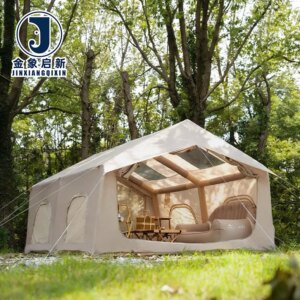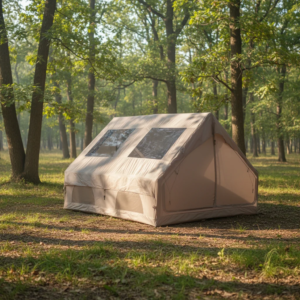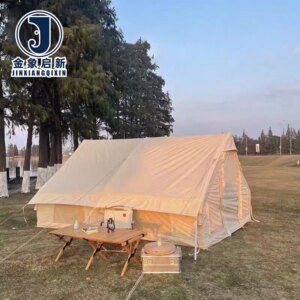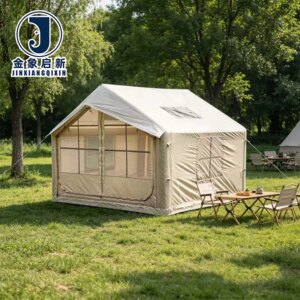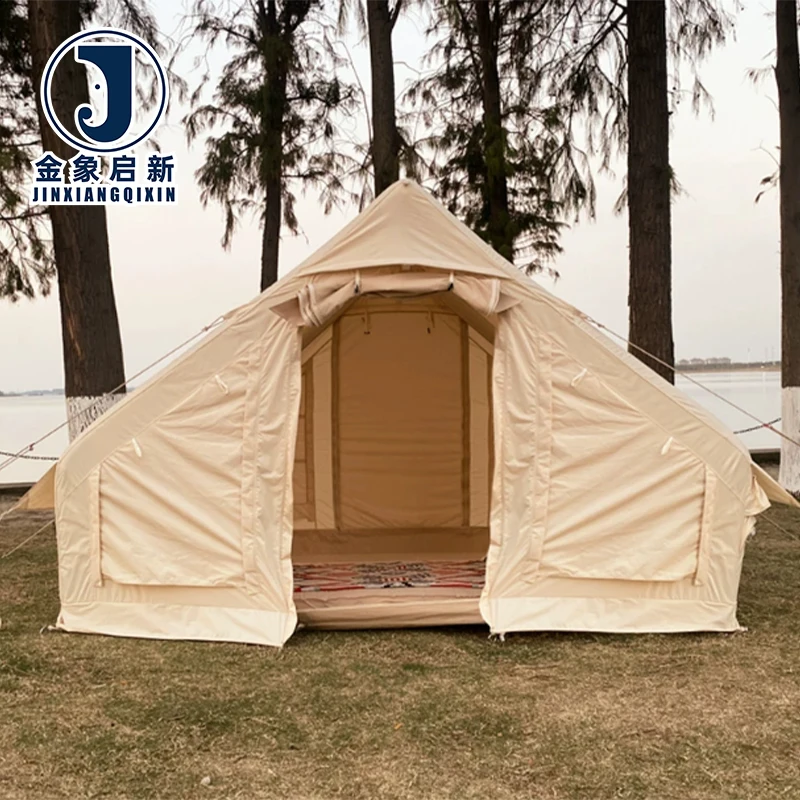
Deep Process Control Over Coated Fabric — Inflatable tent structures demand material consistency that prevents seam failure under internal air pressure, achieved here through nearly 30 years of PVC coating expertise across 3 dedicated production lines.
Technical Specifications
| Parameter | Value |
|---|---|
| Product Type | PVC Inflatable Camping Tent |
| Core Material | PVC Waterproof Fabric |
| Construction | Single layer inflatable structure |
| Key Performance | Waterproof, UV-Resistant (test basis not stated in source), Quick Automatic Opening |
| Tear Strength | 120N (test standard not stated in source) |
| Customization | OEM & ODM — sample customization, pattern printing |
| Production Capacity | 3 full production lines, 36 sets of professional equipment |
| Quality System | Full-process inspection with dedicated QA & QC staff |
| Certifications | ISO9001, ISO14001, ISO45001, CE |
Application Suitability
| Application | Exposure & Requirement |
|---|---|
| Commercial outdoor equipment manufacturing | Repeated inflation cycles, internal air pressure stress on welded seams, outdoor UV and rain exposure |
| Event shelter systems | Rapid deployment frequency, public safety compliance, high-visibility branding on fabric surface |
| Outdoor gear production for professional camping | Lightweight portability balanced against structural rigidity, user-facing aesthetic consistency |
| Equipment rental businesses | High turnover use, abrasion from packing and transport, cleaning chemical exposure between rentals |
| Industrial temporary accommodation | Continuous inflation over extended periods, temperature fluctuation, wind load on inflated envelope |
Why UV Claims Without Test Data Undermine Inflatable Tent Procurement
A UV-resistant label means nothing unless the supplier provides the test standard and result behind it.
Commercial buyers sourcing inflatable tents for rental fleets or event operations often receive fabric described as UV-resistant with no supporting documentation. The inflatable structure sits fully exposed to direct sunlight for hours or days at a time. When the PVC coating degrades prematurely, the colour shifts, the surface becomes brittle, and the welded seams begin to separate under internal pressure. For a rental business replacing units mid-season or an event company dealing with a shelter that looks visibly aged next to newer stock, the cost extends far beyond the fabric itself. Buyers need to confirm which UV test standard applies to their market before placing a production order. [NEED_CITE: ISO 4892 methods for UV exposure testing of plastics and coated fabrics]
How Quick Automatic Opening Shapes Material Selection
The rapid inflation mechanism that defines a PVC inflatable tent manufacturer’s product performance places specific demands on the fabric. The material must be flexible enough to unfold and expand within seconds yet rigid enough to hold its structural form once pressurised. Single layer construction reduces overall weight, making the unit portable for event crews and campers, while still requiring sufficient tear resistance to handle the stress concentration at valve points and seam junctions. Our 10-technician R&D team works with buyers to match the fabric weight and coating formulation to the specific inflation system and structural geometry of each inflatable camping tent design.
Structural Integrity at Welded Seams Under Continuous Pressure
Every inflatable structure lives or dies at its welded seams. The internal air pressure exerts constant outward force, and any inconsistency in the PVC coating weight or base fabric adhesion becomes the failure point. When the coating does not bond uniformly to the base fabric, heat welding produces weak spots that separate before the surrounding material shows any sign of stress. Our production process includes in-process QA checks at every stage, specifically monitoring coating adhesion and weld seam integrity before the inflatable tent leaves the production line. This matters especially for rental operators whose units undergo hundreds of inflation and deflation cycles. [NEED_CITE: hot air welding parameters for PVC coated fabrics]
Understanding How Tear Resistance and Single Layer Construction Interact
Tear strength rated at 120N provides a baseline for evaluating how the inflatable camping tent fabric will behave when punctured or stressed at connection points. In a single layer inflatable construction, there is no secondary fabric layer to arrest a tear once it starts. The base fabric weave and the PVC coating must work together — the coating fills the gaps between yarns and distributes point loads across a wider area, while the base fabric provides the directional tensile resistance. Buyers evaluating material options should request the tear test method used to generate the 120N figure, because different test standards produce values that are not directly comparable. Understanding this relationship helps outdoor gear manufacturers specify the right balance between portability and damage tolerance for their intended use environment.
The Real Cost When Batch Colour Inconsistency Hits an Event Site
Colour variation between production rolls becomes immediately visible when multiple inflatable tents are deployed side by side at an outdoor event or exhibition. The buyer specified a single Pantone reference, but units from different production batches show noticeable shade differences once inflated and positioned together. This is not a cosmetic complaint — it damages the buyer’s brand positioning with their own clients and triggers return claims that disrupt event schedules. Consistent colour across a production run requires controlled pigment dosing and coating temperature stability throughout the entire batch. [NEED_CITE: colour consistency measurement methods for PVC coated textiles]
Why Procurement Teams Source Inflatable Tent Fabric Here
Coated fabric has been the sole focus of this manufacturing operation for nearly three decades, producing deep process knowledge that directly affects inflatable tent performance. Three full production lines with 36 sets of professional equipment provide the capacity to handle bulk orders without compressing lead times. The 10-person R&D team handles material selection, structural design input, and sample development specifically for inflatable applications. Every production batch undergoes full-process quality inspection by dedicated QA and QC staff, not random sampling at the end of the line. Pre-production samples are developed for buyer evaluation and design adjustment before mass production begins, reducing the risk of specification mismatches reaching the shipping container.
Documentation & Verification
- Material specification sheet stating GSM, base fabric construction, and coating weight for each inflatable tent batch
- UV resistance test results provided per batch — confirm the test standard required for your market
- ISO9001, ISO14001, ISO45001, and CE compliance records included with shipment documentation
- Pre-shipment inspection record covering weld seam integrity and colour consistency checks
- Certificate of origin and customs support documentation for cross-border inflatable tent shipments
Fabrication, Handling & Storage
- Heat welding parameters must be adjusted to the specific PVC coating weight used on each inflatable tent panel
- Store PVC inflatable tent fabric rolls vertically in a temperature-controlled environment to prevent permanent creasing at the core
- Avoid folding single layer inflatable construction at sharp angles, as repeated creasing at the same point weakens the coating bond
- Clean inflated surfaces with pH-neutral agents only — aggressive solvents attack the PVC waterproof coating and compromise UV-resistant treatment
- Repair minor punctures using compatible PVC adhesive patches applied to a clean, dry surface for reliable bonding
What We Need to Move Your Inquiry Forward
Provide the intended deployment environment and frequency of use for your inflatable camping tent product line, along with any fire safety or UV performance standards your end market requires. Specify whether you need roll stock for your own fabrication facility or fully assembled units with valve integration. Include your target colour references and any pattern printing requirements so our R&D team can prepare accurate pre-production samples.
Frequently Asked Questions
Q: How can I verify the UV resistance of the inflatable tent fabric before committing to a production order?
A: We provide batch-specific UV test data with each shipment. Before ordering, request a sample with the test report that corresponds to the specific coating formulation proposed for your inflatable camping tent. If your market requires a particular test standard, communicate this during the inquiry stage so we align the test method to your compliance needs before production begins.
Q: What OEM and ODM customization is available for inflatable tent dimensions and branding?
A: Our 10-person R&D team supports full customization including structural dimensions, pattern printing, and valve placement. The OEM and ODM process begins with sample customization where you evaluate material hand feel, inflation behaviour, and print quality. Adjustments are made based on your feedback before mass production starts on any of our 3 dedicated production lines.
Q: How do you control colour consistency across multiple inflatable tent production runs?
A: Each production batch uses controlled pigment dosing monitored through our full-process quality inspection system. We maintain coating temperature stability across all 36 sets of professional equipment to prevent shade drift. Buyers ordering repeat batches receive a pre-production colour reference sample for approval, ensuring visual consistency when multiple units are deployed together at commercial events.
Q: What sample development timeline should I plan for when specifying custom inflatable tent requirements?
A: Sample development follows our standard process: specification recommendation, material selection, and sample fabrication with in-process QA. We develop samples within days for custom requirements, allowing you to evaluate the PVC waterproof fabric performance, single layer construction behaviour during inflation, and print registration before authorizing the production run.
Q: How is welded seam integrity verified on inflatable structures?
A: Our dedicated QA and QC staff inspect welded seams at every production stage, not only at final inspection. The single layer inflatable construction concentrates stress at seam junctions, so we monitor coating adhesion and heat weld consistency throughout fabrication. Batch-specific quality inspection reports document seam performance results and ship with your inflatable camping tent order documentation.