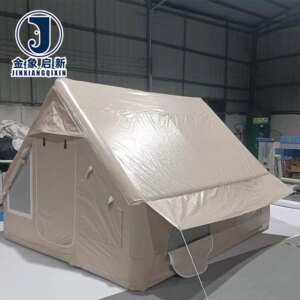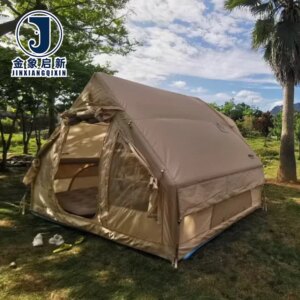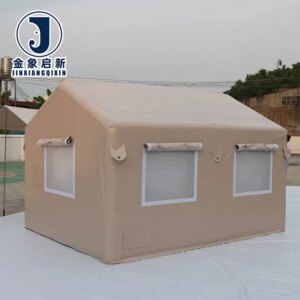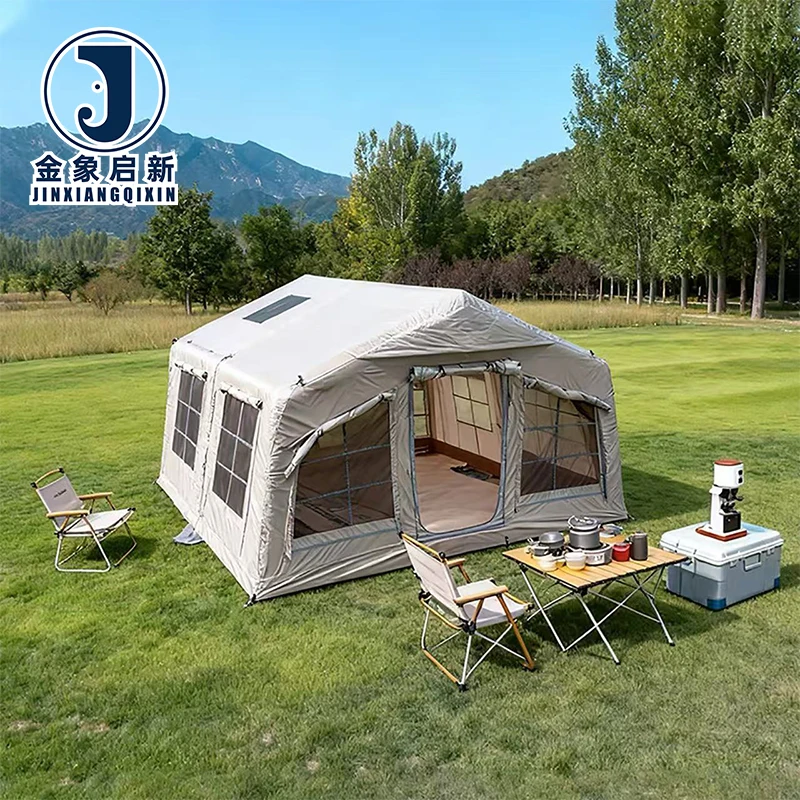
Proven Coating Adhesion Control — nearly 30 years of PVC tarpaulin production delivers stable coating weight and reliable seam integrity across every inflatable tent order.
Technical Specifications
| Parameter | Value |
|---|---|
| Product Type | Inflatable Tent |
| Core Material | PVC tarpaulin |
| Waterproof | Fully waterproof coated construction |
| UV Treatment | UV-resistant (test basis not stated) |
| Flame Retardant | Fire-retardant (grade not stated) |
| Anti-Static | Anti-static (standard not stated) |
| Tear Resistance | Tear-resistant (test standard not stated) |
| Customization | OEM & ODM — sample customization, pattern printing, material selection, product design |
| Quality Control | Full-process inspection with dedicated QA & QC staff |
| Certifications | ISO9001, ISO14001, ISO45001, CE |
Application Suitability
| Application | Exposure & Requirement |
|---|---|
| Glamping resort accommodation | Year-round weather exposure, guest comfort, aesthetic durability, repeated inflation cycles |
| Outdoor event temporary facilities | Rapid deployment, wind loading, UV and rain exposure, frequent assembly and teardown |
| Construction site shelters | Abrasive ground contact, dust and debris, equipment storage protection, fire safety compliance |
Why Stated Fire-Retardant Claims Fail at Site Inspection
An inflatable tent without a verifiable fire-retardant grade is a compliance risk the moment the inspector arrives.
Buyers regularly receive inflatable tent fabric described as fire-retardant, only to discover the test report references a standard that does not apply in their jurisdiction. Event organizers and construction contractors face shutdown orders when the material certificate does not match local fire codes. [NEED_CITE: fire classification standards for temporary structures vary by jurisdiction] The gap between a supplier’s claim and the grade actually required on-site is where project delays originate.
Covering the Moving Load: Fabric Demands on Inflatable Structures
An Inflatable Tent for truck and transport logistics must withstand repeated inflation cycles, flexing at welded seams, and sustained wind pressure. The PVC tarpaulin core material resists puncture and abrasion that lighter fabrics cannot survive in exposed staging areas. Every seam on an inflatable structure carries load during pressurization, making coating adhesion and weld integrity critical to structural reliability.
Custom Sizing Before Commitment
Generic tent dimensions rarely match the footprint of a specific glamping platform or event layout. Our R&D team develops Inflatable Tent fabric for outdoor camp glamping samples to your exact dimensions before mass production begins. Pattern printing and material selection are confirmed on the sample, so you approve colour, texture, and structural behaviour before the full order enters production. [NEED_CITE: dimensional accuracy requirements for inflatable membrane structures]
Reading the Material Beyond the Label
PVC tarpaulin performance depends on the relationship between base fabric denier, weave density, and coating weight. A higher coating weight alone does not guarantee tear resistance — the base fabric construction determines how a puncture propagates under stress. The coating method influences weld behaviour: knife-over-edge coating typically delivers stronger seam adhesion than laminated alternatives, directly affecting how inflatable tubes hold pressure at joint points. UV-resistant and fire-retardant treatments are available in different grades — confirm the grade required for your market before specifying. Surface finish selection, whether glossy or matte, affects both cleaning ease in hospitality settings and print adhesion for branded event structures.
The Cost of Overlooking Weld Behaviour at Flex Points
When welded seams on inflatable structures fail before the fabric itself does, the point of failure is almost always where the material flexes most — tube joints, valve surrounds, and anchor attachment zones. [NEED_CITE: coated fabric weld strength testing per ISO 1421] Specifying a material without confirming its heat-weld parameters against your production equipment leads to seam delamination under cyclic pressurization. Batch-to-batch coating variation compounds this problem: weld settings that worked on the previous shipment may not transfer directly, causing field failures that trace back to inconsistent coating weight rather than fabrication error.
Why Procurement Teams Source Inflatable Tent Fabric Here
Three full production lines and 36 sets of professional processing equipment maintain stable output for large-volume inflatable tent orders without sacrificing coating consistency. A 10-person R&D team handles material selection, pattern printing, and structural design, producing samples within days so you validate dimensions before committing to production volume. Dedicated QA and QC staff inspect every production stage, with 100% pre-shipment inspection catching dimensional drift and surface defects before dispatch. Custom width, colour, and print orders carry realistic minimums because the facility runs dedicated coating lines rather than shared equipment. Full documentation accompanies each batch, including material specification sheets and test reports for UV and fire-retardant grades where applicable.
Documentation & Verification
- Material specification sheet stating PVC tarpaulin base fabric, coating type, and colour reference per roll
- Fire-retardant and anti-static test reports provided when grade is specified at order placement
- Pre-shipment inspection record confirming dimensional accuracy of every inflatable tent panel
- Batch quality inspection report accompanying each shipment with traceable order documentation
- ISO9001, ISO14001, ISO45001, and CE certificates included in shipment documentation package
Fabrication, Handling & Storage
- Confirm heat-weld temperature and dwell time against the specific PVC tarpaulin coating weight before production
- Reinforce valve and anchor attachment zones with additional PVC tarpaulin layers to distribute cyclic inflation stress
- Store rolls flat in climate-controlled conditions to prevent creasing that weakens the coating at fold lines
- Use compatible PVC-based cleaners only — solvent-based products degrade the surface coating and print adhesion
- Allow PVC tarpaulin to acclimate to ambient temperature before unrolling in cold conditions to avoid coating micro-cracking
What to Include in Your Enquiry
Provide the intended application environment, including wind exposure, inflation pressure requirements, and any fire safety or anti-static compliance standards your local jurisdiction mandates. Specify required dimensions, colour or print needs, and whether you require finished panels or roll stock for in-house fabrication. [NEED_CITE: material specification best practices for inflatable fabric procurement] Confirm whether sample approval is needed before production to validate material behaviour under your specific inflation system.
Frequently Asked Questions
Q: How are fire-retardant and anti-static grades verified for my target market’s safety standards?
A: Fire-retardant and anti-static treatments are available in multiple grades. Specify your local jurisdiction’s required standard at enquiry stage, and we provide the corresponding test report with your shipment. If your market requires a specific certification, our team confirms whether the available grade meets that threshold before order confirmation.
Q: What UV treatment test basis supports the outdoor service life claim?
A: UV-resistant treatment is applied during the PVC coating process to protect against solar degradation. The specific test basis for UV performance depends on the grade selected. Request the applicable test report during sampling so you can verify the treatment level matches your expected outdoor exposure duration and climate conditions.
Q: How is batch-to-batch color and material consistency controlled across large orders?
A: Every production run passes through dedicated QA and QC inspection with 100% pre-shipment verification. Colour reference is documented on the material specification sheet, and coating weight is monitored at each stage. For multi-batch orders, we maintain consistent PVC tarpaulin formulation and processing parameters to minimize roll-to-roll variation.
Q: What customization options are available for dimensions, pattern printing, and structural design?
A: OEM and ODM services cover sample customization, pattern printing, material selection, and full product design. Our 10-person R&D team develops samples to your exact specifications before mass production. Confirm dimensions, print artwork, and structural requirements at enquiry stage to receive a sample for approval prior to order commitment.
Q: How do you handle welded seam integrity at flex and stress points on inflatable structures?
A: Welded seams on inflatable structures experience cyclic stress during pressurization and deflation. We confirm PVC tarpaulin coating compatibility with standard heat-weld equipment and recommend reinforcement strategies at high-stress zones. Sample production allows you to validate weld parameters and seam strength before full-scale manufacturing begins.