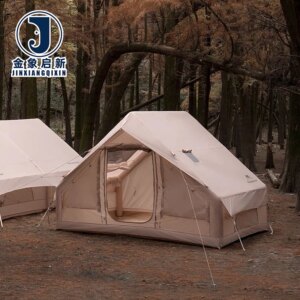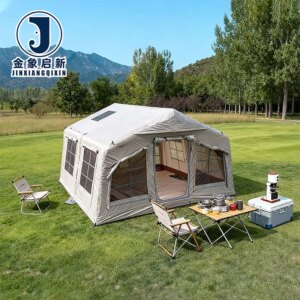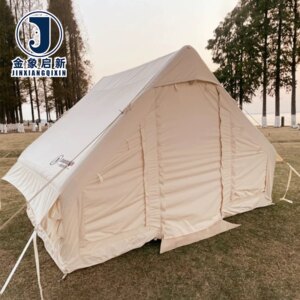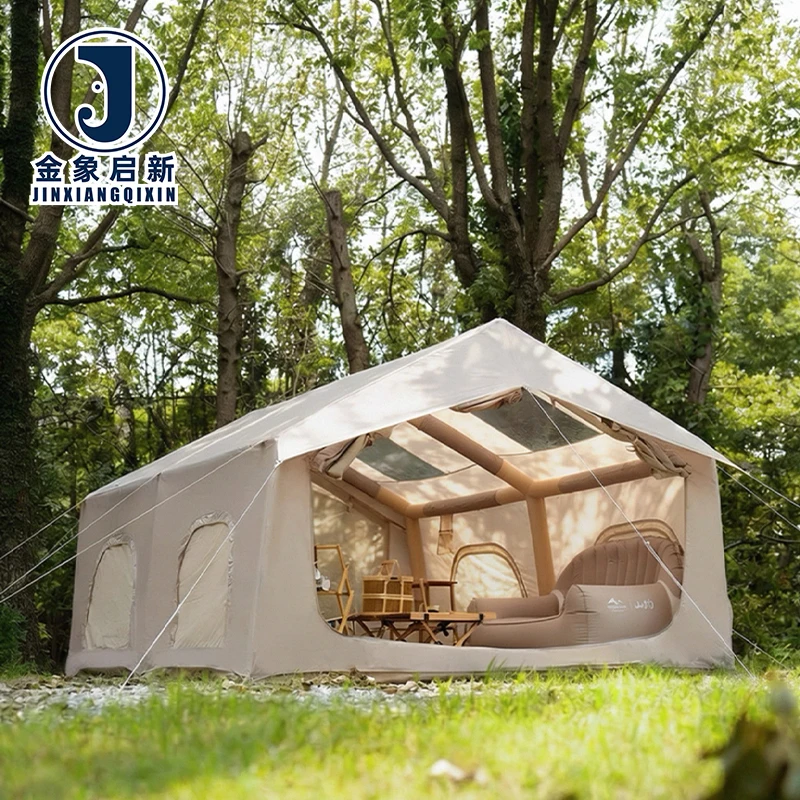
Rapid deployment capability — inflatable tents engineered for fleet operators who need verified material performance and quick automatic opening systems for field operations.
Technical Specifications
| Parameter | Value |
|---|---|
| Product Type | Inflatable Tent |
| Core Material | PVC tarpaulin |
| Construction | Single layer |
| Product Form | 2-3 Person Quick Automatic Opening |
| Waterproof | Yes (grade not stated in source) |
| UV Treatment | Yes (test basis not stated in source) |
| Flame Retardant | Yes (grade not stated in source) |
| Anti-Static | Yes (surface resistance or standard not stated in source) |
| Tear Resistance | Yes (test standard not stated in source) |
| Customization | OEM & ODM, sample customization, pattern printing |
| Certifications | ISO9001, ISO14001, ISO45001, CE |
Application Suitability
| Application | Exposure & Requirement |
|---|---|
| Construction site temporary shelter | Continuous UV exposure, rain, wind loading, dust and abrasion from site activity |
| Outdoor event logistics staging | Rapid deployment and teardown cycles, public safety compliance, weather variability |
| Mobile field operations for transport fleets | Roadside deployment, vehicle proximity, repeated inflation and packing cycles |
| Emergency response support | Unpredictable terrain, immediate weather protection need, multi-team coordination |
| Industrial storage facilities | Semi-permanent outdoor placement, UV and moisture exposure, fire safety requirements |
| Temporary workspace solutions | Personnel occupancy, ventilation needs, thermal and moisture management |
What Happens When "Fire-Retardant" Has No Grade Behind It
A site inspector asks for your tent’s flame-retardant classification and you hand over a brochure instead of a test certificate — the Inflatable Tent for truck and transport deployment gets rejected before it leaves the yard.
Fire-retardant performance is only meaningful when tied to a recognised standard and a documented test result.
Buyers specifying inflatable structures for construction sites, mining camps or transport staging areas routinely encounter suppliers who declare fire-retardant treatment without naming the grade or standard it was tested against. The result is a product that cannot pass site safety audits, forcing last-minute replacements and project delays. [NEED_CITE: flame retardant classification systems for temporary industrial structures] The same gap applies to anti-static claims — without a stated surface resistance value or test method, compliance officers in sensitive environments will not accept the material on site.
Covering a Moving Workforce with Verified Material
Transport fleets and equipment builders need temporary shelter that performs under the same conditions their vehicles endure — roadside deployment on uneven ground, repeated inflation cycles, and exposure to fuel vapours and road chemicals. This Inflatable Tent for truck and transport applications uses PVC tarpaulin as its core material, selected for waterproof integrity and mechanical durability across these field conditions.
The single-layer construction balances portability against the protection threshold that worksite environments demand. When a fleet operator needs to stage a maintenance crew away from the depot, the tent must deploy fast and hold up through the job without requiring specialist installation skills.
Deployment Speed and the Quick Automatic Opening System
The quick automatic opening mechanism is engineered to reduce the number of personnel needed to erect the structure, a critical factor when a two-person transport crew needs shelter without pulling additional staff off the road. Every minute spent assembling temporary shelter is a minute lost from the primary transport task.
This system pairs with the PVC tarpaulin material’s inherent flexibility, allowing the structure to inflate into its operational form without rigid frame components that could bend, crack or require tool-based assembly in the field. [NEED_CITE: rapid deployment requirements for mobile field operations in transport logistics]
Understanding How Material Properties Define Shelter Performance
The PVC tarpaulin core provides a continuous waterproof barrier through its coated construction, where the polymer layer fully encapsulates the base fabric to prevent water ingress at the fibre level. This coating approach is fundamental to maintaining integrity when the tent surface is subjected to pooling water or driven rain during extended outdoor deployment.
UV treatment applied to the outer surface is intended to slow polymer degradation from solar exposure, though the specific test basis and performance grade should be confirmed against the climate and duration of your intended deployment. Flame-retardant treatment is incorporated into the material, but the applicable grade must be verified to match the fire safety requirements of your target market and site classification. [NEED_CITE: UV degradation and flame retardant test methods for PVC coated fabrics per ISO standards]
Anti-static properties are included in the material specification, relevant for environments where static discharge poses a risk around flammable materials or sensitive electronic equipment — again, the surface resistance value and test standard should be requested to confirm suitability. Tear resistance is claimed, supporting the structural longevity of the tent through repeated deployment and packing cycles where fold lines and stress points concentrate mechanical load.
The Cost of Getting the Specification Wrong
Ordering an inflatable tent based on a generic description and discovering on arrival that the material cannot pass your site’s fire safety inspection means the entire unit is unusable for its intended purpose. The project timeline stalls while a replacement is sourced, and the original purchase becomes dead inventory. [NEED_CITE: site compliance rejection rates for temporary industrial structures]
Colour variation between units in the same order becomes visible when multiple tents are deployed side by side at an event or staging area, undermining the professional appearance that commercial operators require. Material that is lighter than the specification stated on the quotation will flex and abrade at rates the buyer did not plan for, leading to premature failure at stress points and seam junctions. Welded seams that fail before the fabric itself are often the result of incorrect heat or pressure settings during production — the point where the load flexes most is exactly where a poorly executed weld will open first.
Why Source This Inflatable Tent Here
Three full production lines and 36 sets of professional processing equipment support consistent output volume, meaning your Inflatable Tent for truck and transport requirements can be fulfilled at commercial quantities without extended queue times. The 10-person R&D team handles custom sizing, pattern printing and sample development, allowing transport equipment builders to specify tents that match their vehicle dimensions and branding requirements.
Dedicated QA and QC staff conduct 100% inspection before shipment, catching material inconsistencies and construction defects before they reach your receiving dock. The manufacturing facility holds ISO9001, ISO14001, ISO45001 and CE certifications, providing documented assurance that production processes and environmental management systems have been independently audited. Samples are developed within days for custom requirements, enabling pre-production evaluation before committing to a full order.
Documentation & Verification
- Material specification sheet stating PVC tarpaulin grade, coating type and applicable treatments
- Test report for UV and flame-retardant grades where applicable to your market requirements
- ISO and CE certificates confirming certified manufacturing and quality management systems
- Pre-shipment inspection record documenting 100% quality check before dispatch
- Roll and unit packing list with item counts, weights and customisation parameters confirmed
Fabrication, Handling & Storage
- Heat-weld seams at manufacturer-recommended temperature and pressure settings to ensure bond strength matches the PVC tarpaulin base material
- Store inflated or folded units in dry, shaded conditions to prevent UV exposure from degrading coating integrity before deployment
- Clean surfaces with mild detergent compatible with PVC coatings to avoid damaging flame-retardant or anti-static treatment layers
- Inspect welded seams and inflation valves after each packing cycle, as repeated folding concentrates stress at these junctions
- Avoid stacking heavy objects on packed tents during transport to prevent permanent creasing of the single-layer PVC tarpaulin construction
Requesting a Specification That Fits Your Operation
Tell us the deployment environment your fleet or project operates in — the climate, ground conditions and duration of each use cycle. Specify any fire-retardant or anti-static classification your site or target market requires, so we can confirm whether the available grades match your compliance obligations.
If you need custom dimensions, colour matching or pattern printing for branding, share your vehicle model references or graphic files so we can develop a sample for your evaluation before production begins.
Frequently Asked Questions
Q: What customization options are available for PVC inflatable tents?
A: OEM and ODM services cover custom sizing, colour selection, pattern printing and sample development. The R&D team works from your vehicle model references or dimensional drawings to produce a unit that matches your fleet’s deployment requirements. Samples are typically developed within days so you can evaluate material and construction before committing to full production.
Q: How is fire-retardant and anti-static compliance documented?
A: Flame-retardant and anti-static treatments are applied during production, and the applicable test reports can be provided to verify performance against your site’s required standards. Request the specific grade and test method you need, and the documentation team will confirm whether the current formulation meets that classification and supply the corresponding certificate.
Q: Do you provide samples for pre-production evaluation?
A: Yes, samples are developed for custom requirements including size, colour and treatment specifications. This allows you to verify material feel, construction quality, weld integrity and inflation performance before authorising a full production run. Sample approval is a defined step in the sales process.
Q: How are waterproof integrity and structural stability tested before shipment?
A: Every unit undergoes 100% pre-shipment inspection by dedicated QA and QC staff. This covers material surface condition, welded seam integrity, inflation system function and waterproof performance verification. Inspection records are included with shipment documentation so you have a traceable quality record on arrival.