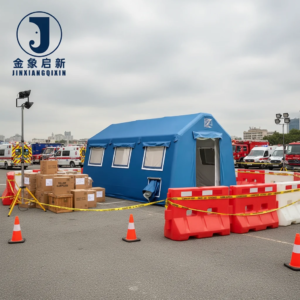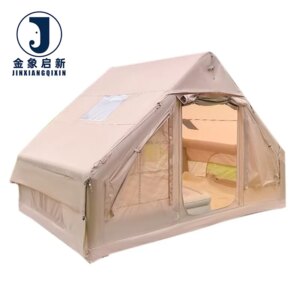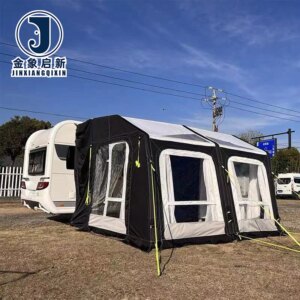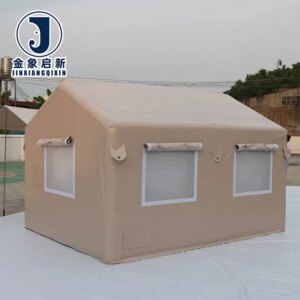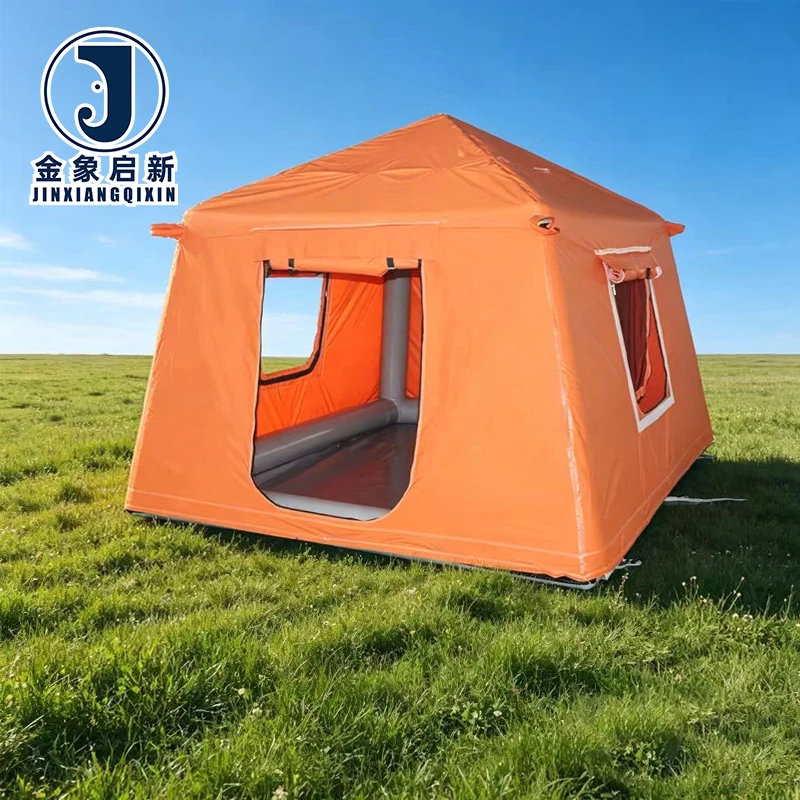
Coating Weight Verification — every roll of Quick Automatic Opening Portable Inflatable Camping Tent 420D Oxford Cloth undergoes in-line GSM verification against the stated specification before leaving our Jinan facility.
Technical Specifications
| Parameter | Value |
|---|---|
| Product Type | Inflatable Tent |
| Core Material | 420D Oxford Cloth |
| Structure | Single Layer Construction |
| Deployment Mechanism | Quick Automatic Opening (Inflatable) |
| Capacity | 5-8 Person |
| Season Rating | Four-Season Design |
| Waterproof Rating | 1000mm water column |
| Weight | ≤8kg |
| UV Protection | UPF 50+ (test basis not stated) |
| Tensile Strength | ≥300N/5cm (test standard not stated) |
| Seam Strength | ≥250N (test standard not stated) |
| Abrasion Resistance | ≥500 cycles (test standard not stated) |
| Deployment Cycle Test | 500+ cycles |
| Customization | OEM & ODM, sample customization, pattern printing |
| Standards | ISO9001, ISO14001, ISO45001, CE |
Application Suitability
| Application | Exposure & Requirement |
|---|---|
| Commercial camping operations | Repeated inflation/deflation, ground abrasion, prolonged sun exposure requiring UV-resistant fabric that retains structural integrity |
| Fleet field accommodation | Rapid deployment in transport yards, wind loading on inflatable beams, weather protection for crew rest areas |
| Industrial event shelters | High foot traffic around entry points, temporary staging in logistics hubs, four-season thermal performance |
| Outdoor gear private-label lines | Consistent fabric quality across production runs, pattern printing compatibility, OEM sizing flexibility |
Why Inflatable Tent for Truck and Transport Application Buyers Cannot Rely on Denier Alone
A 420D base fabric tells you thread thickness, not whether the inflatable tent for truck and transport application will survive its first season in a commercial transport yard.
Procurement teams often see "420D Oxford" on a quotation and assume the finished tent will handle the abrasion, UV exposure, and repeated deployment cycles their crews demand. In practice, denier only describes the individual yarn weight — the coating adhesion, seam welding quality, and fabric density determine whether the material holds pressure through hundreds of inflation cycles. [NEED_CITE: ISO 1421 tensile and tear test methods for coated fabrics]
How the 420D Oxford Base Fabric Performs Under Inflation Pressure
The single-layer 420D Oxford cloth used in this inflatable tent for truck and transport application provides a balance between pack weight and beam rigidity. When the inflatable tubes are pressurised, the base fabric must resist biaxial stress — tension running simultaneously along warp and weft. A lower-density weave would allow the coating to crack at the yarn intersections under sustained pressure, leading to slow leaks that are difficult to locate in the field.
The raw material thickness tolerance of ±0.1mm and density tolerance of ±5 threads/inch mean the fabric behaves predictably when cut and welded into beam patterns. Fabricators working with this material can set their heat-welding parameters once and maintain them across a production run, rather than adjusting for batch-to-batch variation in base cloth density.
What the Automatic Opening Mechanism Demands from the Fabric
Every deployment cycle subjects the tube seams and fabric-to-valve junctions to rapid pressure change. The automatic opening system in this unit has been tested through 500+ deployment cycles, which translates to roughly a full season of daily use in a commercial camping or transport yard operation. [NEED_CITE: accelerated cycle testing protocols for inflatable structures]
The seam strength rating of ≥250N ensures that welded joints at the tube bends — where stress concentrates during inflation — do not separate before the fabric itself reaches its limit. This matters particularly in four-season operation where cold-temperature deployment makes PVC and PU coatings stiffer and more prone to delamination at poorly welded seams.
Decoding the Specification Sheet for Inflatable Tent Fabric
The waterproof rating of 1000mm water column means the coated fabric can resist a static head of one metre of water before moisture penetrates — adequate for rainfall on a pitched tent but not equivalent to a pond liner or reservoir membrane. For commercial camping operators, this rating handles sustained downpours when combined with proper tent pitch angles that shed water rather than pool it.
The UPF 50+ UV treatment protects the Oxford cloth from photodegradation during extended outdoor exposure. UV stabiliser packages work by absorbing or scattering ultraviolet radiation before it breaks the polymer chains in the coating and fibre. Without documented treatment, Oxford cloth loses tensile strength measurably after a single season of direct sun — the fabric becomes brittle at fold lines and tears propagate from small punctures. Buyers should confirm the test basis for UV claims when specifying for markets with strict outdoor durability requirements. [NEED_CITE: UV degradation mechanisms in technical textiles]
The relationship between the 420D denier and the ≥300N/5cm tensile strength is not linear — a heavier denier yarn with loose weave density can yield lower tensile figures than a lighter denier with tight construction. What matters for inflatable structures is that the base cloth provides dimensional stability so the welded seams hold geometry under internal pressure.
The Hidden Cost of Skipping Fabric Verification Before Bulk Order
Transport operators who have sourced inflatable shelters based on quotation specs alone report the same recurring issue: the material that arrives does not match the weight, density, or coating thickness that was agreed. A tent that weighs less than specified usually means less coating compound was applied — which reduces waterproof performance and accelerates UV degradation. [NEED_CITE: coating weight verification methods for technical fabrics]
Seam failure is the second consequence. When the base fabric is lighter than quoted, heat-welding parameters set for the original specification burn through the thinner material or fail to achieve full adhesion. The result is seams that pass the factory pressure test but fail in the field after a handful of deployment cycles, typically at the tube junctions where flex concentrates.
Colour inconsistency across rolls in the same order creates a visible problem when multiple tents are pitched side by side at a commercial site or event. Batch-matched production with documented dye lots prevents this, but only when the manufacturer runs in-line colour checks rather than relying on end-of-run visual inspection.
Why Procurement Teams Source This Inflatable Tent Fabric Here
Three full production lines and 36 sets of processing equipment allow this facility to run dedicated batches of 420D Oxford inflatable tent material without cross-contamination from heavier PVC tarpaulin grades. Dedicated lines mean the coating head settings remain optimised for the lighter Oxford cloth rather than being adjusted mid-run.
A 10-person R&D team handles pattern printing, custom sizing, and sample development in-house. For outdoor gear manufacturers building private-label inflatable tent lines, this means a single supplier manages fabric selection, printing, and cut-to-size fabrication — reducing the coordination burden across multiple vendors.
Every production stage includes QA checkpoints, with 100% inspection before shipment. For inflatable structures where a single pinhole in a welded seam can render the entire unit unusable, full inspection catches defects that statistical sampling would miss. Pre-production samples are developed within days for custom requirements, allowing buyers to validate material and construction before committing to a bulk order.
Documentation & Verification
- Material specification sheet stating 420D Oxford denier, coating type, and confirmed fabric weight
- Batch-specific test report for waterproof rating and UV protection level per shipment
- Pre-shipment inspection record covering seam integrity and inflation pressure retention
- ISO9001, ISO14001, ISO45001, and CE certificates included with export documentation
- Certificate of origin and customs support paperwork for destination market compliance
- Roll packing list with fabric weight verification against stated specification before dispatch
Fabrication, Handling & Storage
- Heat-weld tube seams at temperatures calibrated for single-layer 420D Oxford to avoid coating burn-through
- Store rolled fabric vertically to prevent permanent crease marks that weaken the coating at fold lines
- Deploy inflatable beams gradually in cold conditions — the Oxford coating stiffens and needs time to flex
- Use mild detergent for field cleaning; avoid solvent-based cleaners that strip the UPF 50+ coating treatment
- Repair minor punctures with compatible PU adhesive patches applied to clean, dry Oxford cloth surfaces
- Plan cutting layouts to maximise yield from standard roll widths and reduce welded seam count in finished tents
Requesting a Quotation for Inflatable Tent for Truck and Transport Application
Provide your target deployment environment, expected deployment frequency, and any fire-retardant or anti-static certification your site requires. Confirm whether you need finished inflatable tent units or 420D Oxford fabric by the roll for your own manufacturing line. Specify colour requirements, pattern printing needs, and whether you require pre-production samples before bulk commitment.
Frequently Asked Questions
Q: How do I verify the 420D Oxford cloth specification matches what was quoted?
A: Request the batch-specific material specification sheet before shipment, which documents denier, weave density, and coating weight for your production run. On receipt, compare the fabric weight per square metre against the stated value. Our facility includes weight verification per roll in the pre-shipment inspection record so discrepancies are caught before dispatch.
Q: Can you supply inflatable tent fabric by the roll for our own production line?
A: Yes. The 420D Oxford cloth is available as roll stock for fabricators integrating inflatable tent material into their own product lines. Confirm your required roll width, coating type, and any UV or flame-retardant treatment needed for your market. We provide samples developed within days so you can validate weld parameters and fabrication behaviour before ordering.
Q: What fire-retardant certifications are available for commercial tent applications?
A: Fire-retardant treatment is available in various grades — confirm the specific standard required for your destination market, such as NFPA 701, DIN 4102 B1, or local building code equivalents. We provide test reports for the applicable grade when specified at inquiry stage. Anti-static options are also available for site-specific compliance in mining or aviation environments.
Q: How does welded seam performance hold up during repeated inflation cycles?
A: The tube seams are heat-welded with a tested seam strength of ≥250N, designed to withstand flex concentration at tube junctions. The automatic opening mechanism has been tested through 500+ deployment cycles. Weld integrity is verified during our in-line QA process, and 100% pre-shipment inspection includes inflation pressure retention checks to confirm no seam leakage before packing.
Q: What documentation ships with each order for customs and compliance?
A: Each shipment includes a material specification sheet, ISO and CE certificates, pre-shipment inspection record, roll packing list, and certificate of origin. Batch-specific test reports for waterproof rating and UV protection accompany the shipment when applicable. Additional customs support documentation is provided based on your destination market requirements.