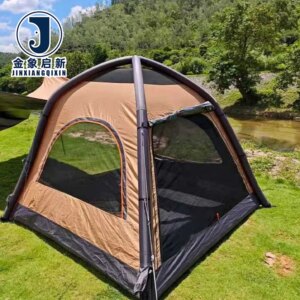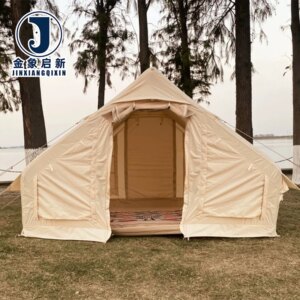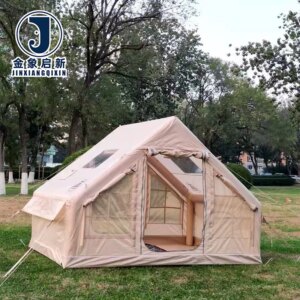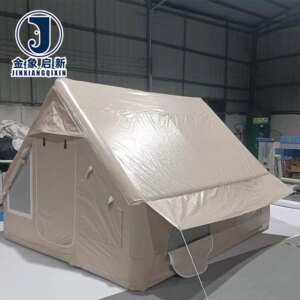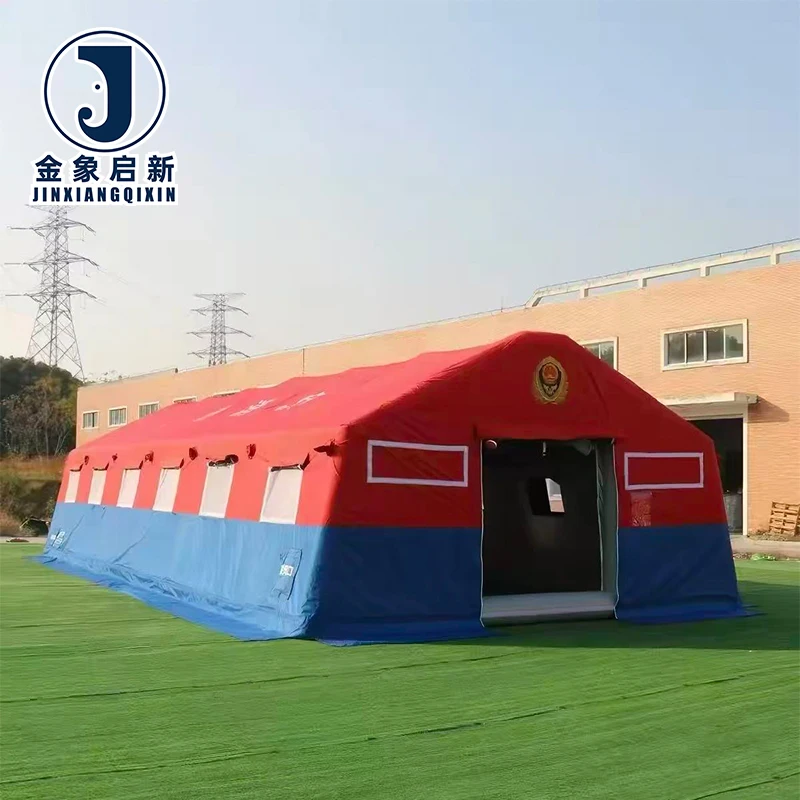
Production-Scale Custom Inflatable Tent Fabrication — backed by three full production lines, 36 sets of processing equipment, and dedicated QA/QC staff inspecting every unit before dispatch, ensuring rapid deployment shelters meet project specifications without compromise.
Technical Specifications
| Parameter | Value |
|---|---|
| Product Type | PVC Inflatable Tent |
| Core Material | PVC Tarpaulin |
| Key Performance | Waterproof, UV-resistant (test basis not stated in source), Tear-resistant |
| Product Form | Extended Type, Single Layer Construction |
| Certifications | ISO9001, ISO14001, ISO45001, CE |
| Production Facility | 9,180 m² with 3 full production lines |
| Processing Equipment | 36 sets of professional equipment |
| R&D Team | 10 technicians |
| Customization | OEM & ODM, sample customization, pattern printing |
| Quality Control | Full-process inspection with dedicated QA & QC staff |
Application Suitability
| Application | Exposure & Requirement |
|---|---|
| Disaster relief rapid deployment | Immediate weather exposure, repeated inflation cycles, transport abrasion during emergency logistics |
| Emergency command centers at infrastructure sites | Continuous four-season outdoor exposure, equipment protection, frequent crew ingress and egress |
| Temporary storage facilities on construction sites | Dust and debris ingress, ground moisture, UV exposure across extended project timelines |
| Mobile shelter units for logistics operations | Road transport vibration, repeated setup and teardown, wind load on inflated structure |
| Four-season outdoor temporary operations | Temperature fluctuation, rain and snow load on membrane, prolonged solar UV exposure |
Why Material Claims Without Test Data Create Deployment Risk
A PVC inflatable tent for transport and disaster relief must carry verifiable performance documentation — not just marketing adjectives.
When emergency management agencies or construction contractors procure inflatable shelters, they often receive material data sheets that list "UV-resistant" or "tear-resistant" without referencing a test standard or grade. This creates a dangerous gap between what the procurement specification requires and what the site compliance officer can actually verify during inspection. Inflatable structures deployed for disaster relief or industrial staging face continuous membrane stress at inflation points, and a fabric that degrades under UV exposure without documented test basis can fail precisely when shelter is most critical. [NEED_CITE: ISO 1421 tensile and tear test methods for coated fabrics]
Engineered for Rapid Inflation and Structural Membrane Integrity
The PVC inflatable tent described here uses a single-layer extended construction that balances interior volume with transport efficiency. The PVC tarpaulin core delivers waterproof protection and tear-resistant performance, which matters when the membrane must hold inflation pressure across varying ambient temperatures. Quick automatic opening reduces the time from container to operational shelter, a critical factor when disaster response teams or construction site managers need coverage within hours rather than days.
Four-Season Exposure Demands More Than a Waterproof Label
Deploying a PVC inflatable tent for transport and disaster relief across different climate zones means the fabric faces freezing nights, high UV indices, and wind-driven rain in rapid succession. The four-season design intent addresses thermal cycling that causes lesser membranes to stiffen and crack at stress points. Each unit undergoes full-process inspection with dedicated QA and QC staff before leaving the production line, reducing the likelihood that a seam defect or coating inconsistency reaches the deployment site. [NEED_CITE: thermal cycling effects on PVC coated fabric flexibility]
How PVC Tarpaulin Construction Determines Field Performance
The relationship between base fabric density and coating weight defines how the inflatable membrane handles both inflation pressure and external abrasion. A PVC tarpaulin with inadequate coating adhesion will delaminate at folded creases after repeated setup and teardown cycles, while insufficient base fabric denier allows tear propagation from a single puncture. The tear-resistant performance of this material depends on the weave structure distributing load across multiple yarn intersections rather than concentrating stress at one point. Waterproof integrity in an inflatable structure also depends on seam construction — welded joints must match or exceed the membrane strength, otherwise the shelter fails at the seams long before the fabric itself degrades. UV-resistant treatment, where applicable, must be verified by a recognized test method to confirm that the coating additives will not exhaust prematurely under continuous solar exposure.
The Cost of Specifying Inflatable Shelters on Price Alone
When procurement decisions prioritize unit cost over material verification, the consequences surface at the worst possible moment. An inflatable tent with undocumented UV treatment may show membrane embrittlement and cracking after a single season of outdoor deployment, forcing an unplanned replacement that disrupts site operations. Batch-to-batch inconsistency in coating weight means the second order performs differently from the first, creating unpredictable service life across a fleet of shelters. [NEED_CITE: coating weight variation and premature membrane failure in field-deployed inflatable structures] Welded seams that were not inspected under inflation pressure during QC can separate during the first high-wind event, turning a command center into an exposed site within minutes.
Why Sourcing This PVC Inflatable Tent Through Jinxiang
Three full production lines and 36 sets of professional equipment provide the capacity to fulfill large-scale disaster relief procurement orders without subcontracting critical stages. The 10-technician R&D team handles custom sizing, pattern printing, and sample development, allowing buyers to validate fit and function before committing to bulk production. Full-process inspection with dedicated QA and QC staff means every inflatable tent is checked at each production stage, not just spot-sampled at the end. OEM and ODM customization supports project-specific dimensions and branding requirements, from fleet identification to site-specific color coding. ISO9001, ISO14001, ISO45001, and CE certifications provide the compliance documentation that industrial and emergency procurement officers require for audit trails.
Documentation & Verification
- Material specification sheet stating PVC tarpaulin base fabric, coating type, and color reference per order
- ISO9001, ISO14001, ISO45001, and CE certificates included with shipment documentation
- Pre-shipment inspection record confirming 100% unit inspection before dispatch
- Test data for UV-resistant and tear-resistant performance available upon request with applicable standards noted
- Certificate of origin and customs documentation support for international procurement
Fabrication, Handling & Storage
- Weld seams on the PVC tarpaulin membrane require controlled heat and dwell time to match base fabric tear strength
- Store inflated or deflated units flat to prevent permanent crease marks in the single-layer PVC construction
- Avoid dragging the PVC inflatable tent across abrasive surfaces during deployment to protect the coating layer
- Clean the waterproof PVC tarpaulin surface with mild detergent — avoid solvent-based cleaners that attack the coating
- Inspect inflation valve attachment points for coating adhesion after each extended storage period
- Repair minor membrane punctures with compatible PVC adhesive patches before re-inflation
What to Include in Your Inquiry
Provide your deployment scenario — disaster relief staging, construction site command center, or logistics shelter — along with the expected duration of outdoor exposure and climate conditions. Specify whether you require pattern printing for fleet or site identification, and confirm the dimensions needed for your operational layout. Indicate any compliance documentation your procurement process requires, such as specific ISO certificates or material test reports referencing recognized standards.
Frequently Asked Questions
Q: What custom sizing options and minimum order quantities apply to project-specific inflatable tent dimensions?
A: OEM and ODM customization covers dimensions, pattern printing, and application-specific features. The 10-technician R&D team develops samples within days for validation before mass production. Minimum order quantities depend on the level of customization and are confirmed during the quotation stage based on your project scope.
Q: How can I verify the UV-resistant treatment claim before committing to a bulk order?
A: UV-resistant performance is listed as a key feature; however, the specific test basis is not stated in the source documentation. Request test reports referencing applicable standards during the inquiry stage. Sample units can be evaluated under your local exposure conditions before production commitment.
Q: What is the sample approval process before mass production begins?
A: Samples are developed by the R&D team for custom sizing, pattern printing, and material validation. Once you approve the sample against your deployment requirements, mass production proceeds with full-process inspection at each stage and 100% pre-shipment inspection before dispatch.
Q: How is batch-to-batch consistency maintained across large-scale procurement orders?
A: Three full production lines with 36 sets of professional equipment and dedicated QA/QC staff at every production stage ensure consistent output. Pre-shipment inspection records and material specification sheets accompany each batch for traceability and compliance verification.
Q: What deployment conditions is the four-season design intended to cover?
A: The four-season designation addresses outdoor exposure across temperature fluctuations, rain, and UV conditions typical of industrial and disaster relief environments. Confirm your specific climate parameters and duration of deployment during the inquiry so the material specification can be matched to your operational requirements.