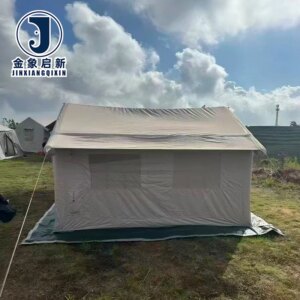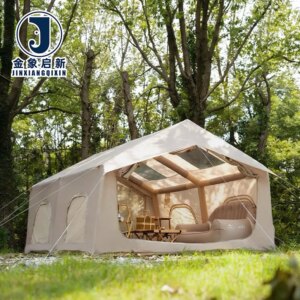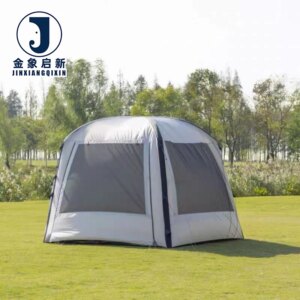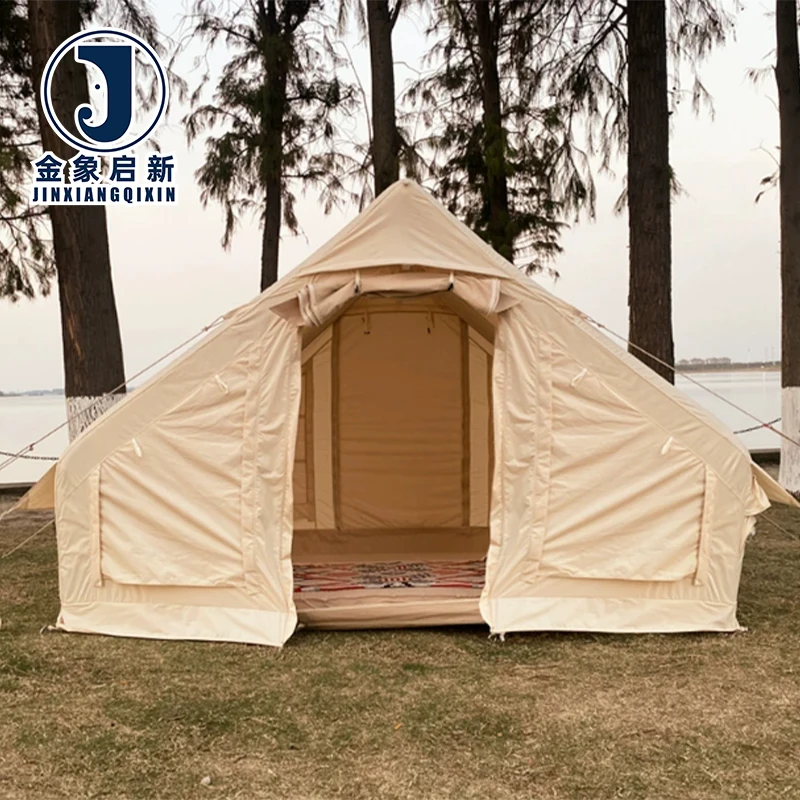
Coating Weight Control — Nearly 30 years of PVC coating process mastery ensures every inflatable tent fabric roll meets the stated weight and adhesion specification before it leaves the factory floor.
Technical Specifications
| Parameter | Value |
|---|---|
| Product Type | PVC Inflatable Tent |
| Core Material | PVC Tarpaulin |
| Product Form | Extended Type, Single Layer Construction |
| Key Performance | Waterproof, Windproof, Quick Automatic Opening, 4-Season Design |
| UV Treatment | Available with UV treatment — confirm test basis for your market |
| Flame Retardant Grade | Available in flame retardant grades — confirm the grade required for your market |
| Customization Service | OEM & ODM (sample customization, pattern printing, size adjustment, custom design modifications) |
| Quality Control | Full-process QA & QC with inflation testing before shipment |
| Certifications | ISO9001, ISO14001, ISO45001, CE |
Application Suitability
| Application | Exposure & Requirement |
|---|---|
| Emergency response command centers | Rapid deployment, continuous wind and rain exposure, high visibility in disaster zones |
| Temporary storage for relief supplies | Prolonged water contact, UV degradation risk, repeated inflation and deflation cycles |
| Equipment maintenance shelters in disaster zones | Abrasion from ground contact, debris impact, temperature fluctuation across seasons |
| Engineering team workspaces during recovery | Year-round weather exposure, need for stable internal climate, frequent relocation |
| Remote industrial field bases | Extended outdoor siting, wind load on inflated structure, transport and storage efficiency |
Why Certification Gaps Matter More Than Fabric Weight in Emergency Shelter Procurement
A PVC inflatable tent that lacks documented flame retardant or UV testing is a compliance liability before it ever inflates on site.
Buyers specifying shelter for disaster zones often focus on weight and thickness, yet the most costly failures come from undocumented treatment claims. When a site inspector asks for the fire classification certificate and the supplier cannot produce one, the entire batch is rejected regardless of how the fabric feels in hand. The same pattern repeats with UV stabilisation — without a test report tied to a recognised standard, there is no evidence the material will survive consecutive seasons of direct sun exposure [NEED_CITE: DIN 4102 fire classification for building materials].
Full Customisation from Fabric Selection to Finished Shelter
This PVC inflatable tent platform supports OEM and ODM development across sizing, pattern printing, and structural design modifications. A 10-technician R&D team handles material selection and sample development, validating every custom parameter before full-scale manufacturing begins. Buyers surveying options can request samples that reflect exact dimensions, print proofs, and colour references — eliminating the mismatch that occurs when generic stock is forced into a specialised emergency shelter brief.
Batch Consistency Across Repeat Orders
Colour variation between rolls is one of the most visible failures in multi-unit inflatable shelter deployments, apparent the moment panels are inflated side by side. Dedicated QA and QC staff inspect raw material batches before cutting, monitor coating weight throughout the run, and verify colour match against the approved reference. Each roll is traceable to its production batch, giving buyers the consistency data needed for large-scale relief or industrial shelter rollouts [NEED_CITE: tensile and tear test methods for coated fabrics per ISO 1421].
How Material Properties Translate to Field Performance
The PVC tarpaulin core delivers waterproof and windproof construction rated for four-season outdoor exposure. Single layer extended-type design keeps transport volume low while maintaining the internal air pressure required for structural rigidity. Quick automatic opening allows single-operator deployment in time-critical emergency scenarios, cutting setup to minutes rather than hours. The coating weight and base fabric density together determine how well the inflated structure resists puncture from debris and abrasion from repeated ground contact — neither parameter alone gives a reliable strength prediction. Buyers should request the material specification sheet to see the exact relationship between GSM, denier, and weave count for the grade selected.
The Hidden Cost of Specifying Without Verification
Shelter fabric that arrives lighter than the quoted GSM inflates to lower internal pressure, making the structure vulnerable to collapse under wind load. Coating adhesion that was not tested at production stage can fail at welded seams — often the first point of failure when the inflated tube flexes under load. Undocumented UV treatment claims lead to surface chalking and embrittlement within a single season, turning a reusable shelter into single-use waste. Each of these failures is preventable when the buyer insists on pre-shipment inspection records and test documentation before the order ships [NEED_CITE: pre-shipment inspection standards for coated technical textiles].
Procurement Advantages Built Into Every Order
Deep coating process control across nearly three decades of PVC tarpaulin production means the material weight and adhesion stated on the quote is the material you receive. Three full production lines with 36 sets of professional processing equipment support bulk inflatable tent orders without sacrificing lead-time reliability. The dedicated R&D team develops samples within days for custom sizing and pattern printing, so buyers approve physical proof before committing to full production. Every unit undergoes inflation testing and full-process QA before dispatch, backed by ISO9001, ISO14001, ISO45001, and CE documentation for cross-border compliance.
Documentation & Verification
- Material specification sheet stating base fabric, coating type, and GSM for the selected inflatable tent grade
- UV and flame retardant test reports matched to the grade applicable in your destination market
- Pre-shipment inflation test record confirming air retention and structural stability per unit
- ISO9001, ISO14001, ISO45001, and CE certificate copies included in the shipping documentation package
- Certificate of origin and customs support documents for international procurement clearance
Fabrication, Handling & Storage
- Heat-weld seams using temperature settings matched to the PVC tarpaulin coating weight to prevent delamination at flex points
- Reinforce all inflation valve openings and tie-down anchor points with additional PVC tarpaulin patches before final welding
- Store rolled inflatable tent fabric in a dry, shaded area to prevent surface marking from prolonged compression on the coating
- Avoid deploying the single layer structure on sharp or uneven ground without a protective groundsheet beneath the PVC tarpaulin base
- Clean the waterproof PVC tarpaulin surface with mild detergent only; solvent-based cleaners degrade the coating adhesion over time
Preparing Your Enquiry for Accurate Quotation
Share your intended deployment environment — climate zone, expected wind load, and duration of continuous inflation — so the R&D team can recommend the appropriate PVC tarpaulin grade and treatment. Specify required dimensions, pattern printing details, and colour references along with estimated annual volume. Confirm whether your destination market mandates a specific flame retardant classification or UV test standard so that compliant documentation is prepared before production.
Frequently Asked Questions
Q: What customisation options are available for sizing, pattern printing, and design modifications?
A: OEM and ODM services cover size adjustment, pattern printing, and structural design changes for specific industrial or emergency scenarios. The R&D team produces physical samples reflecting your exact specifications, allowing full validation of dimensions, print accuracy, and colour match before full-scale manufacturing of the PVC inflatable tent begins.
Q: How is colour and material consistency controlled across multiple production runs?
A: Every batch of PVC tarpaulin is inspected against the approved colour reference and coating weight specification before cutting begins. Dedicated QA and QC staff monitor each production stage, and every roll is traceable to its batch. This process prevents the visible panel mismatch that undermines large inflatable shelter deployments.
Q: What sample development steps are required before a full order is produced?
A: Buyers receive a physical sample built to their custom sizing, print proof, and material specification. The sample undergoes inflation testing to confirm structural performance. Once the buyer approves the sample in writing, the same parameters are locked for full-scale manufacturing of the PVC inflatable tent order.
Q: Which certifications and documents accompany each shipment for international compliance?
A: Every order ships with ISO9001, ISO14001, ISO45001, and CE certificate copies, a material specification sheet, pre-shipment inspection record, certificate of origin, and customs documentation. Flame retardant and UV test reports are included where the selected grade carries verified test results for your market.
Q: How is seam integrity and air retention verified before dispatch?
A: Each finished PVC inflatable tent is inflated to operating pressure and held under observation to confirm air retention and structural stability. Welded seams are inspected for adhesion and uniformity. Results are recorded in the pre-shipment inspection report that accompanies every batch.