Deep process control over coating weight and adhesion — verified through in-process QA and 100% pre-shipment inspection, ensuring every PVC pool cover roll meets the specified GSM and tensile integrity before dispatch.
Technical Specifications
| Parameter | Value |
|---|---|
| Product Type | PVC Coated Tarpaulin Pool Cover |
| Base Fabric | 500D-500D polyester |
| Coating Material | PVC & polyester |
| Construction | Integrated pressing, no stitching |
| Installation Options | Brass anchoring system, aluminium battens with ratchets, heavy-duty water tube loops |
| Water Resistance | Fully waterproof coated construction |
| Flame Retardant | Available in flame retardant grades — confirm the grade required for your market |
| Anti-UV Treatment | Available with anti-UV treatment — test basis available on request |
| Package | Roll packing, bale packing, carton |
Application Suitability
| Application | Exposure & Requirement |
|---|---|
| In-ground winter swimming pool cover | Prolonged water contact, UV exposure, snow and debris load, freeze-thaw cycles |
| Safety barrier for children and pets | Load-bearing tension across span, secure anchoring to deck, puncture resistance |
| Commercial and resort pool evaporation control | Constant sun exposure, chemical splash from treated water, frequent removal and reinstallation |
| Pool construction and maintenance contractor supply | Custom sizing to fit rectangular, round and freeform shapes, batch consistency across multiple covers |
Why Stitched Pool Covers Fail Before the Fabric Does
Generic pool covers tear at flex points and fail to seal against wind-driven debris — integrated pressing construction and multiple anchoring methods ensure the cover stays tight and intact across the season.
When a PVC pool cover for transport and safety is stitched rather than welded, the needle holes create thousands of micro-perforations along every seam. Under tension from ratchet systems or water tube weight, these perforations become the first failure points. The thread degrades under UV exposure long before the PVC coating does, and water wicks through the stitch channels even when the fabric surface remains intact. [NEED_CITE: tensile and tear test methods for coated fabrics per ISO 1421]
How Integrated Hot-Press Construction Eliminates the Weak Point
This PVC pool cover aftermarket supplier uses integrated pressing rather than stitching to join panels and reinforce edges. The PVC coating fuses directly through the polyester base fabric at the seam zone, creating a continuous bond that matches the tensile strength of the field material. No thread to degrade, no needle holes to propagate tears, and no water channel for moisture ingress.
Anchoring Systems Matched to Pool Deck Construction
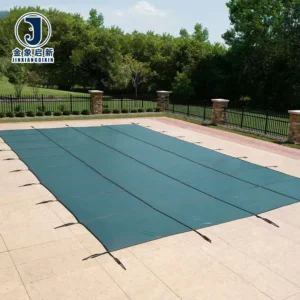
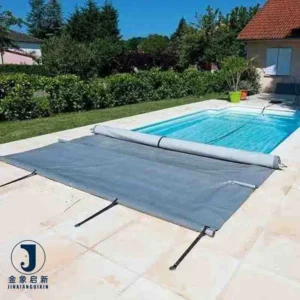
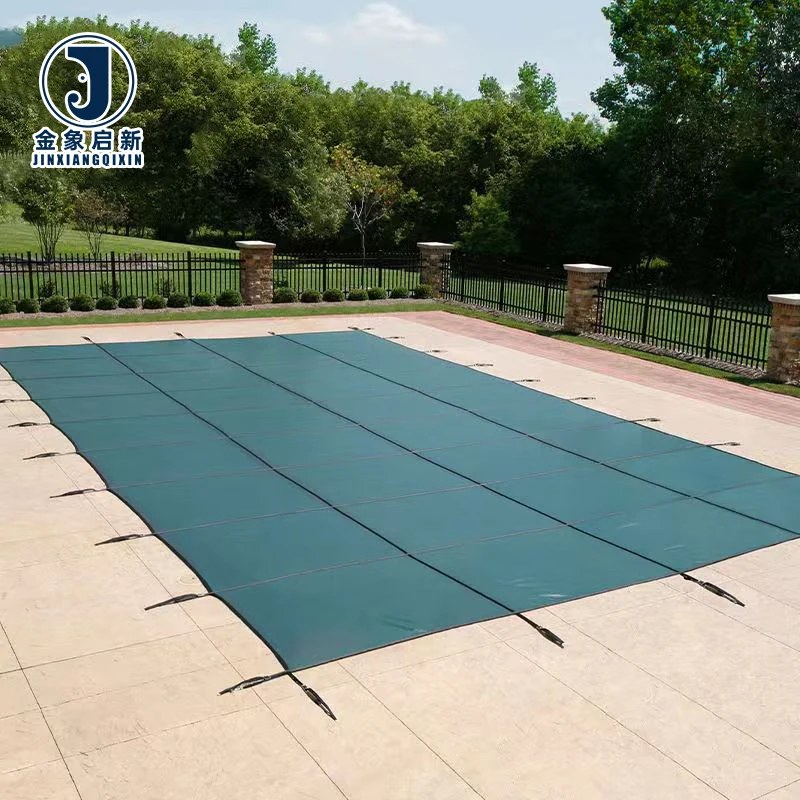
A PVC pool cover is only as secure as its anchoring system. Three installation methods address different deck materials and pool geometries. Brass anchors suit concrete surrounds where permanent fixings are acceptable. Aluminium battens with ratchet tensioning allow seasonal removal without damaging timber or composite decking. Heavy-duty water tube loops at regular intervals hold the perimeter down on irregular or freeform pool shapes where fixed anchors cannot follow the contour. [NEED_CITE: safety cover anchoring requirements for in-ground pools]
Reading the Base Fabric Denier Correctly
The 500D-500D polyester base fabric indicates that both warp and weft yarns carry the same denier. This balanced construction distributes load evenly in both directions, which matters when a pool cover spans a wide rectangular pool and tension is applied along the long axis. An unbalanced weave — heavier in one direction — would resist tension along the warp but allow the weft to distort, creating creases that collect standing water and accelerate coating breakdown at the fold lines. The double-sided PVC coating encapsulates this base, adding dimensional stability and full waterproof sealing.
What Happens When the Anchoring Method Does Not Match the Deck
A cover specified with brass anchors installed into a timber deck will pull through the wood under wind load or snow accumulation, leaving the cover partially detached and the deck damaged. A water tube system used on a perfectly rectangular pool will leave gaps at the corners where the tubes cannot maintain contact. These mismatches are not fabric failures — they are specification failures that manifest as cover displacement, debris ingress, and accelerated wear at the unsupported edges. [NEED_CITE: pool cover displacement causes related to anchoring selection]
Why This Cover Holds Up Under Seasonal Tension
The integrated pressing construction means that when ratchet systems pull the cover taut, the stress distributes across the full bonded seam rather than concentrating at stitch points. The 500D-500D base provides the structural backbone to resist deformation under sustained load, and the PVC coating maintains its flexibility through freeze-thaw cycles without becoming brittle.
Documentation & Verification
- Material specification sheet stating 500D-500D base fabric denier, PVC coating material and weight per square metre
- Pre-shipment inspection record confirming integrated pressing integrity across the full cover surface area
- UV and flame retardant test reports provided where applicable — request documentation matched to your market requirements
- Roll packing list and certificate of origin for customs clearance and import compliance
- Installation hardware compatibility sheet matching brass, batten or water tube systems to deck material
Fabrication, Handling & Storage
- Hot air welding repairs integrate with the PVC coating on the 500D-500D base, restoring waterproof continuity at puncture points
- Brass anchor holes should be reinforced with PVC patches before installation to prevent tear propagation at stress concentrations
- Store rolls on pallets in dry conditions to prevent compression creasing that transfers to the installed pool cover surface
- Unroll at ambient temperature — cold PVC coating on the 500D base stiffens and may crack if forced flat in freezing conditions
- Clean with mild detergent only; solvent-based cleaners degrade the PVC coating surface and compromise waterproof integrity
How to Specify Your Pool Cover Order
Provide the pool shape classification — rectangular, round, kidney or freeform — along with exact deck-to-deck measurements at multiple points. State which anchoring system matches your deck construction and whether UV or flame retardant treatment is required for your local compliance code. Indicate the quantity and whether covers are needed in a single colour or matched across multiple pools.
Frequently Asked Questions
Q: How is the base fabric denier and coating verified on arrival?
A: The material specification sheet provided with your order states the 500D-500D base fabric and PVC coating material. Request a pre-shipment inspection record that confirms these values against physical measurements taken before dispatch. For high-volume orders, independent lab testing can verify denier count and coating weight per ISO 1421 test methods.
Q: Which anchoring system is recommended for rectangular versus freeform pool shapes?
A: Brass anchors and aluminium battens with ratchets work well for rectangular pools where straight-line tension is uniform. Freeform and kidney-shaped pools benefit from heavy-duty water tube loops because the flexible perimeter follows curves without creating gaps. Confirm your deck material before selecting — timber decks suit battens over permanent brass fixings.
Q: Is the flame retardant treatment backed by a test certificate?
A: Flame retardant grades are available for this PVC pool cover, and test documentation can be supplied upon request. Confirm the specific grade required by your local fire safety code before placing the order, as requirements vary between residential, commercial and hospitality pool environments.
Q: How do I measure my pool correctly for a custom-fit cover?
A: Measure deck-to-deck at the widest and longest points, then take intermediate measurements every two metres along each side. For freeform pools, provide a scaled diagram or template. Note the position of any steps, ladders or obstructions that the cover must accommodate. Custom sizing eliminates the creases and gaps that compromise safety.
Q: What is the repair procedure if the PVC surface is punctured?
A: Clean and dry the damaged area, then apply a PVC-compatible repair patch using hot air welding to fuse the patch coating with the existing PVC layer on the 500D-500D base. This restores waterproof continuity at the puncture point. For tears near anchor points, reinforce the repair with an additional patch layer to resist concentrated stress.