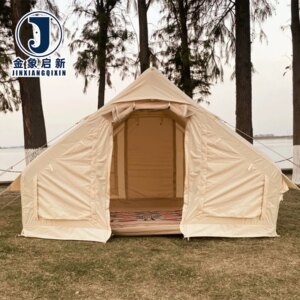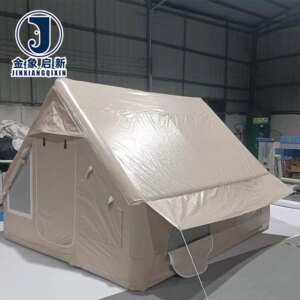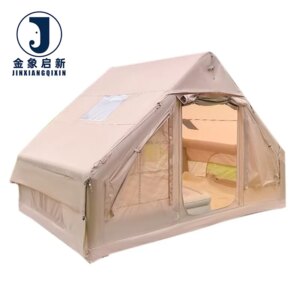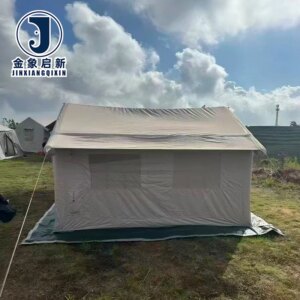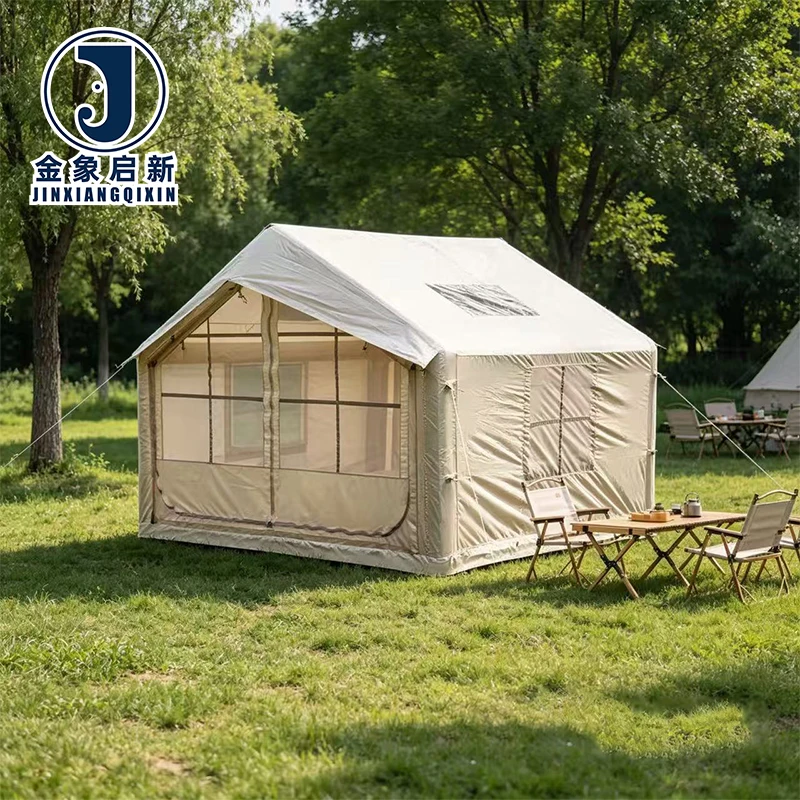
Deep process control — PVC coating weight and adhesion are monitored at every production stage, ensuring the PVC inflatable tent fabric meets consistent performance standards from roll to finished tent.
Technical Specifications
| Parameter | Value |
|---|---|
| Product Type | Inflatable Tent |
| Core Material | PVC tarpaulin |
| Capacity | 4-6 Person |
| Opening Mechanism | Quick Automatic Opening |
| Waterproof | Fully waterproof coated construction |
| UV Resistance | UV-resistant treatment — confirm the test basis required for your market |
| Fire Retardant | Fire-retardant grade available — confirm the grade required for your target market |
| Anti-Static | Anti-static treatment available — verify certification requirements with your compliance team |
| Tear Resistance | Tear-resistant base fabric — request batch-specific test data for load-bearing validation |
| Customization | OEM & ODM: sample customization, pattern printing, material selection, product design |
| Quality Standards | ISO9001, ISO14001, ISO45001, CE |
Application Suitability
| Application | Exposure & Requirement |
|---|---|
| Commercial event and exhibition setups | Repeated inflation cycles, crowd contact, variable weather, rapid deployment and tear-down |
| Temporary outdoor shelters at work sites | Wind loading, dust, UV exposure, fire safety compliance on regulated sites |
| Beach and coastal camping trips | Salt spray, sand abrasion, prolonged direct sunlight, moisture ingress at ground level |
| Outdoor equipment supplier product lines | Batch consistency across inventory, branded pattern printing, retail packaging fitment |
| Transport fleet roadside and loading bay shelters | Road spray, diesel particulate exposure, tie-down stress at anchor points, vehicle clearance constraints |
Why Coating Adhesion Matters More Than GSM for Inflatable Tents
Seam integrity under inflation pressure depends on how well the coating bonds to the base fabric, not just how heavy the fabric is.
Buyers often specify a target GSM and assume structural performance follows. In practice, inflatable tent seams carry concentrated stress each time the structure is inflated and deflated. If the coating does not adhere firmly to the woven base, the heat-welded joint delaminates long before the fabric itself tears. This failure pattern is common across suppliers who optimise for weight targets without controlling the coating-to-yarn bond [NEED_CITE: tensile and peel strength test methods for PVC coated fabrics]. When sourcing PVC inflatable tent fabric for transport and outdoor use, requesting peel strength data alongside GSM gives a far more accurate picture of how the tent will hold up through repeated setup cycles.
Inflation Stress and Seam Behaviour Under Real Conditions
Every inflation cycle places tension on welded joints where air beams meet the main body panels. PVC inflatable tent fabric for transport and outdoor use must maintain weld integrity not only when fully pressurised but also during partial deflation caused by temperature drops overnight. The base fabric weave density and coating penetration depth together determine whether the weld holds or begins to separate at the edges. Manufacturers who hot-air weld at incorrect temperatures risk burning through the coating layer or producing a joint that looks clean but lacks internal adhesion.
Rapid Deployment Demands on Fabric Flexibility
Quick automatic opening tents rely on the fabric folding compactly and then expanding without resistance. Stiff or over-coated material resists unfolding, slowing deployment and putting uneven strain on inflation valves and beam intersections. The PVC inflatable tent fabric must balance coating weight with pliability so that the packed tent releases smoothly and the air beams assume their intended geometry without kinking. This balance is achieved through controlled coating application and fabric calendering during production, not by simply selecting a lighter base cloth.
How Base Fabric Construction Determines Tear Propagation
The denier of the yarns and the density of the warp and weft threads control how a small puncture or cut behaves under wind load. A tightly woven base fabric arrests tear propagation at the next intersection, limiting damage to a small area. In loosely woven constructions, a single cut can run along the yarn path and compromise an entire air beam. For inflatable tents deployed in exposed coastal or high-altitude environments, tear resistance is not a single test value but a function of weave architecture interacting with coating thickness [NEED_CITE: tear strength evaluation per ISO 13937 for coated textiles].
Specification Trade-Offs That Affect Field Performance
Coating weight, base fabric density and surface finish all interact. A heavier coating improves waterproofing and abrasion resistance but increases packed weight and reduces fold flexibility. A matte surface finish reduces glare and improves print adhesion for branded tents but may require different welding parameters than a glossy finish. Fire-retardant and anti-static treatments alter the thermal behaviour of the PVC during heat welding, meaning fabrication settings must be adjusted per treatment combination. Understanding these trade-offs helps buyers specify the right PVC inflatable tent fabric for transport and outdoor use rather than defaulting to generic grades that underperform in one property to satisfy another.
The Hidden Cost of Inconsistent Batch Specification
When inflatable tents are produced across multiple batches, even small variations in coating weight or plasticiser content change how the fabric behaves during welding and inflation. A batch with slightly lower coating weight may weld faster but produce weaker seams. Colour shifts between batches become visible when tents from different production runs are deployed side by side at an event. These inconsistencies force buyers to re-qualify fabrication parameters with every delivery or risk field failures that trace back to material variation rather than manufacturing defects [NEED_CITE: batch-to-batch consistency challenges in PVC coated fabric production].
Why Sourcing Here Reduces Specification Risk
Coating weight and adhesion are controlled through dedicated in-process QA at every stage, not just final inspection. A 10-person R&D team develops custom samples within days, allowing buyers to validate inflation behaviour and weld strength before committing to volume. Three full production lines equipped with 36 sets of professional equipment handle both roll stock and finished tent fabrication under one roof. Pre-shipment inspection covers 100% of output, with documentation matching each roll or tent to its production batch. This structure eliminates the gap between sample approval and bulk delivery that causes most procurement disputes in coated fabric sourcing.
Documentation & Verification
- Material specification sheet stating coating weight, base fabric construction and treatment options for each batch
- Test reports for fire-retardant and UV claims provided with order-specific batch traceability
- Pre-shipment inspection record confirming dimensions, weld quality and visual consistency
- Roll packing list and certificate of origin included for customs clearance
- CE and ISO compliance documentation matching the certifications required by your target market
Fabrication, Handling & Storage
- Heat-weld PVC tarpaulin seams using temperature settings matched to the specific fire-retardant or anti-static treatment grade
- Reinforce anchor and tie-down points with additional PVC patches to distribute inflation and wind loads across the base fabric
- Store rolls horizontally in a dry environment to prevent creasing that affects inflation geometry and surface appearance
- Allow packed inflatable tents to acclimate before unfolding in cold conditions to avoid coating stiffness and crack risk
- Clean with mild detergent only; avoid solvent-based cleaners that degrade the PVC coating and compromise waterproof integrity
What to Include in Your Inquiry
Provide your intended deployment environment, including typical wind conditions and UV exposure levels. Specify any fire safety or anti-static compliance requirements for your target market. Confirm whether you need roll stock for your own fabrication or finished tents with custom sizing, pattern printing and branding. If colour consistency across multiple orders is critical, request a physical sample and production swatch for approval before volume commitment.
Frequently Asked Questions
Q: How is the fire-retardant grade verified and which compliance standards does it meet?
A: Fire-retardant grades are available for the PVC inflatable tent fabric, but the specific classification depends on your market requirements. Request a batch-specific test report that documents the grade and test standard used. Confirm with your local compliance authority which classification — such as B1, M2 or NFPA 701 — applies to temporary outdoor structures in your jurisdiction before placing a bulk order.
Q: What UV test basis supports the claimed outdoor exposure performance?
A: UV-resistant treatment is applied during coating, but the test basis must match your expected deployment duration and climate. Ask for the test method reference and exposure duration documented for your production batch. For tents deployed in high-altitude or coastal environments with intense year-round sun, request accelerated weathering data that corresponds to your real-world conditions before finalising material selection.
Q: How are custom dimensions and inflation patterns validated before mass production?
A: The R&D team develops a physical sample based on your dimension drawings and inflation structure requirements. This sample is inflated, deflated and inspected for seam behaviour, fold geometry and structural stability. Once you approve the sample, production parameters are locked and applied to the full order, ensuring bulk output matches the validated prototype.
Q: What reinforcement options are available for transport and wind-load scenarios?
A: The PVC tarpaulin base material supports additional patching and hem reinforcement at stress concentration points. For inflatable tents used at loading bays or exposed sites, specify reinforced edges and anchor point patches during the design stage. These reinforcements distribute load across a wider fabric area and reduce the risk of tear initiation at tie-down and valve attachment locations.
Q: How is batch-to-batch colour and coating consistency maintained across large orders?
A: Each production run follows controlled coating parameters with in-process QA checks at every stage. Colour reference samples are matched before production begins, and pre-shipment inspection verifies visual consistency across all rolls or tents in the order. For multi-batch procurement, request retained production swatches from each batch to confirm consistency before dispatch.