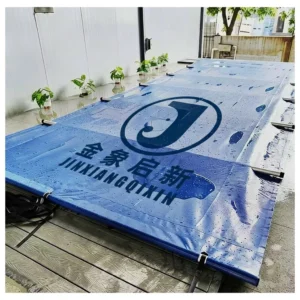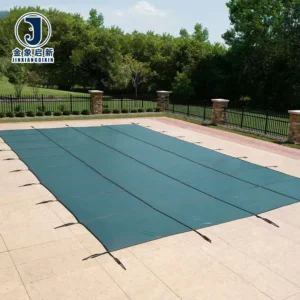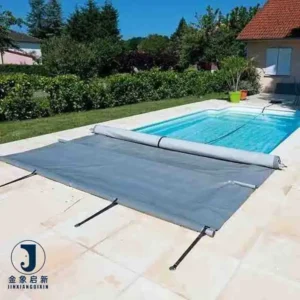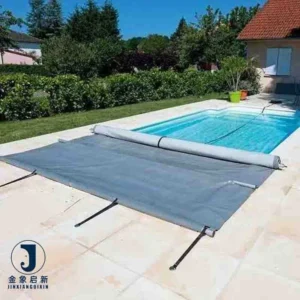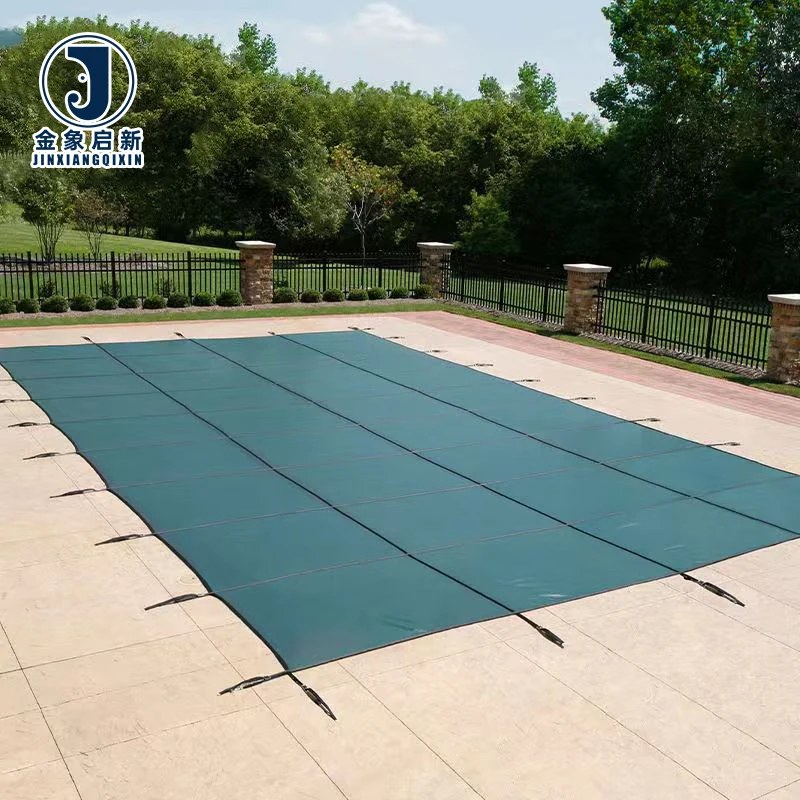
Custom Fitment Assurance — Three full production lines handle pool cover dimensions from standard rectangular to freeform shapes, with integrated pressing that eliminates stitching gaps for a secure fit over in-ground pools.
Technical Specifications
| Parameter | Value |
|---|---|
| Product Type | PVC Coated Tarpaulin Pool Cover |
| Base Fabric | 500D×500D Polyester |
| Coating | Double-Sided PVC |
| Coating Method | Integrated Pressing (No Stitching) |
| Flame Retardant | Available in flame retardant grades — confirm the grade required for your market |
| UV Treatment | Anti-UV treatment available — request test report for your climate zone |
| Waterproof | Fully waterproof coated construction |
| Surface Finish | Smooth, soft surface with leather-like texture |
| Color | Customizable |
| Printing | Custom brand printing available |
| Repair Method | Hot air welding |
| Installation Options | Brass anchors / Aluminium battens with stainless steel hardware / Water tube loops |
| Standards | ISO, CE |
Application Suitability
| Application | Exposure & Requirement |
|---|---|
| In-ground pool winterisation | Months of UV, rain, snow load, and freeze-thaw cycling requiring sustained tensile integrity |
| Child and pet safety barrier | Point-load bearing on the cover surface; anchoring system must resist pull-out under weight |
| Debris and leaf protection | Organic matter accumulation and standing water; surface must resist staining and allow drainage |
| Commercial and hospitality pools | High-visibility aesthetic requirement with batch-consistent colour across large or multiple pools |
| Evaporation reduction | Continuous water contact on the underside demanding full waterproof coating adhesion |
Why a Generic-Size PVC Pool Cover Fails Before the Season Ends
A pool cover that does not match your exact pool dimensions leaves edge gaps that defeat the purpose of covering.
I have seen contractors order off-the-shelf covers that sit loose at the coping, allowing wind to get underneath. Once air lifts the cover, water pools in the centre, debris blows in at the edges, and the safety barrier is compromised. The PVC pool cover aftermarket supplier you choose must cut to your pool’s measured shape — rectangular, kidney, or freeform — so the anchoring system pulls the fabric taut without creasing or slack zones. [NEED_CITE: tensile and tear test methods for coated fabrics per ISO 1421]
Covering a Static Load: How Pool Covers Differ from Transport Tarps
A truck side curtain flexes thousands of times per journey, demanding abrasion resistance at fold points. A PVC pool cover faces a different challenge: it must bear static loads — standing water, snow accumulation, or the point load of a child stepping onto the surface — without stretching or tearing at the anchor points. The 500D×500D polyester base fabric provides the tensile foundation for this load-bearing role, while the double-sided PVC coating distributes stress across the weave rather than concentrating it at individual yarn intersections.
Integrated Pressing and Why Stitched Seams Are a Liability
Every needle hole in a stitched seam is a potential water ingress point. Over a winter season, trapped moisture freezes and expands, forcing the stitch thread against the PVC coating until the fabric delaminates along the seam line. Our integrated pressing process bonds the PVC pool cover panels without perforating the material, so the cover can be pulled tight across the pool with continuous coated surface from edge to edge. This matters most at the perimeter where anchoring hardware applies concentrated tension. [NEED_CITE: coating adhesion and peel strength testing for PVC tarpaulin per ISO 2411]
Reading the Specs: What 500D Yarn and Coating Weight Mean in Practice
The denier count — 500D×500D — tells you the thickness of individual polyester yarns in both the warp and weft directions. Heavier denier yarns resist tear propagation: if the cover is punctured by a sharp branch or pool tool, the tear is less likely to run across the fabric. However, denier alone does not determine overall strength. The PVC coating weight on each side fills the weave gaps and bonds the yarns together, contributing to both tensile capacity and stiffness. A cover with heavy coating but light base fabric may crack at fold lines in cold weather; one with heavy base fabric but thin coating may abrade through to exposed yarn. The balance between base fabric and coating is what determines how the PVC pool cover handles real installation and removal cycles.
The Hidden Cost of Skipping Material Verification on Arrival
When a cover arrives lighter than the quoted specification, the problem rarely shows itself on day one. It appears in the second or third winter, when UV degradation and freeze-thaw cycles expose the deficit in coating weight. The PVC becomes brittle at fold lines, the surface chalks, and the base fabric becomes visible where the coating has worn thin. Batch colour variation between covers ordered for adjacent pools creates a visible mismatch that reflects poorly on the installer. These are not manufacturing defects — they are specification enforcement failures that a pre-shipment GSM check and colour comparison would have caught. [NEED_CITE: PVC coated fabric weathering and UV stability assessment methods]
Why Procurement Teams Source This PVC Pool Cover Here
Three full production lines and 36 sets of professional equipment support bulk orders without the extended lead times that single-line operations impose on custom-width runs. A 10-person R&D team develops samples within days for irregular pool shapes, custom colours, or branded printing, so you can confirm fit and appearance before committing to a full production run. Dedicated QA/QC at every production stage includes coating weight checks and 100% pre-shipment inspection, meaning the PVC pool cover that arrives matches the specification sheet you approved. Near 30 years of coated fabric process control translates into consistent coating adhesion roll after roll — critical when multiple covers in the same order must match in colour and weight.
Documentation & Verification
- Material spec sheet stating base fabric denier, coating method, and confirmed colour reference per order
- UV stability and flame retardant test reports supplied where applicable to the grade ordered
- Pre-shipment inspection record with GSM verification against the quoted specification
- Roll packing list identifying each cover by dimension and pool reference number
- Certificate of origin and customs documentation for cross-border shipment
Fabrication, Handling & Storage
- Hot air welding at recommended temperature settings ensures seam bonds match the integrated pressing construction
- Water tube loops spaced at regular intervals distribute perimeter tension evenly across the PVC coating
- Store rolls or folded covers flat in shaded conditions to prevent permanent crease marks in the PVC surface
- Clean with mild detergent and soft brush; avoid solvents that attack the PVC coating bond
- Field repairs on minor punctures are achievable with hot air welding and matching PVC patch material
- Unfold in moderate temperatures; cold PVC becomes stiff and may crack if forced open below freezing
What to Include in Your Inquiry
Provide your pool’s exact dimensions — length, width, and shape profile — along with the preferred anchoring method so the cover can be cut and finished to match your pool surround. Specify whether flame retardant certification or UV test documentation is required for your market’s compliance standards. Indicate the quantity, colour preference, and whether custom brand printing is needed on the cover surface so we can confirm lead time and minimums.
Frequently Asked Questions
Q: How do I measure my pool for a custom-fit PVC pool cover?
A: Measure the pool’s internal dimensions at the water line — length, width, and any radii on corners or curves. For irregular shapes, provide a dimensioned sketch or template. Include the coping width and note the pool surround material, as this determines which anchoring system — brass anchors, aluminium battens, or water tubes — will secure the PVC pool cover correctly.
Q: What anchoring systems work with this PVC coated cover?
A: Three systems are supported: brass anchors drilled into the pool deck for a flush perimeter fit; aluminium battens with stainless steel ratchets for above-ground securing; and heavy-duty water tube loops for a weighted-edge installation. The choice depends on your pool surround construction and local safety code requirements for barrier systems.
Q: Can the cover support the weight of a child or pet as a safety barrier?
A: The 500D×500D polyester base with double-sided PVC coating provides load-bearing capacity when pulled taut and anchored at all perimeter points. However, safety certification depends on the complete installed system — cover, anchoring hardware, and tension — meeting your local pool barrier standard. Confirm the required standard with your regulatory authority before specifying.
Q: Do you supply anchoring hardware with the cover?
A: Anchoring hardware can be included or specified separately depending on your preference. Brass anchors, aluminium batten assemblies, and water tube loops are all available. Specify your preferred system and the pool surround material at the inquiry stage so hardware quantities and fixing types match your PVC pool cover dimensions.
Q: What test reports come with flame retardant or anti-UV versions?
A: Where flame retardant or anti-UV grades are specified, test reports documenting the grade achieved are available. The specific test standard and grade must be confirmed at the quotation stage, as requirements vary by market. Request documentation early so the PVC pool cover production run includes the correct treatment formulation.