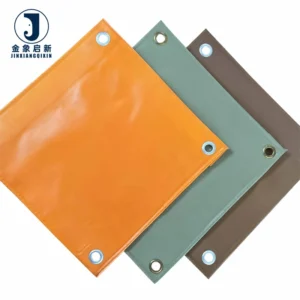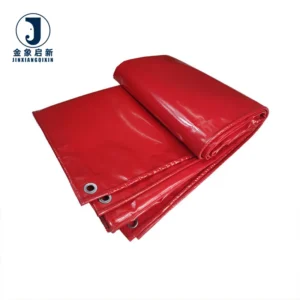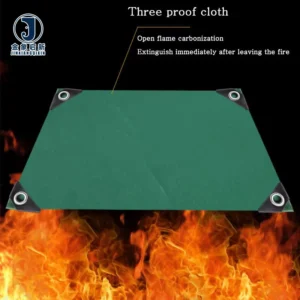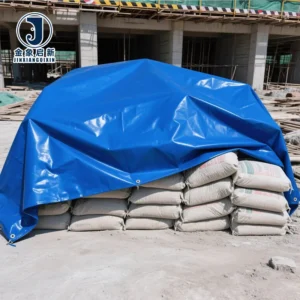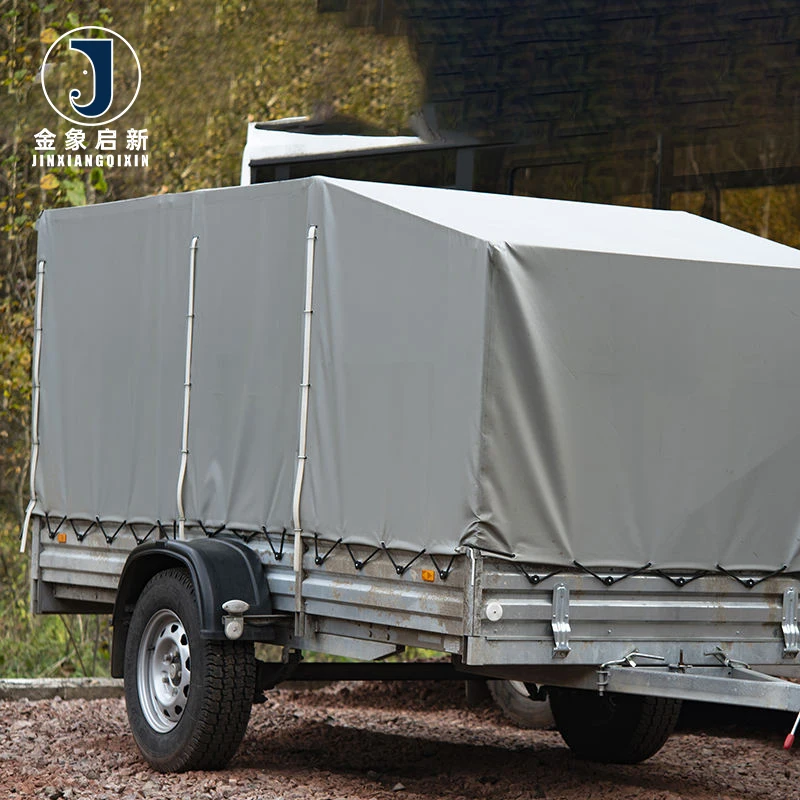
Hot Melt Coating Precision — Three full production lines maintain consistent PVC adhesion on high-toughness polyester base fabric, ensuring coating weight matches quotation specifications roll after roll.
Technical Specifications
| Parameter | Value |
|---|---|
| Product Type | PVC Coated Tarpaulin Roll / Flame Retardant Tarpaulin |
| Coating Material | PVC |
| Base Fabric | 100% high toughness polyester yarn |
| Coating Method | Lamination technology and hot melt coating technology |
| Weight (Medium-sized) | 400-500 g/m² |
| Total Thickness (Medium-sized) | 0.35-0.45 mm |
| Base Fabric Denier (Medium-sized) | 500D |
| Tensile Strength (Medium-sized, Warp/Weft) | 1500-2000 / 1200-1800 N/5cm |
| Weight (Heavy-duty) | 700-1000 g/m² |
| Total Thickness (Heavy-duty) | 0.70-1.0 mm |
| Base Fabric Denier (Heavy-duty) | 1000D |
| Tensile Strength (Heavy-duty, Warp/Weft) | 2000-2500 / 1800-2200 N/5cm |
| Weight (Super Heavy) | 1100-1500 g/m² |
| Total Thickness (Super Heavy) | 1.2-1.5 mm |
| Base Fabric Denier (Super Heavy) | 500D-2000D |
| Tensile Strength (Super Heavy, Warp/Weft) | 2500-3000 / 2200-2800 N/5cm |
| Flame Retardant Grade | B1 (per DIN 4102) |
| Special Treatments Available | Anti-static, Anti-mildew, Cold resistant, UV treatment |
| Customization | Custom printing, custom width and length, pattern printing |
| Certifications | ISO 9001, CE |
Application Suitability
| Application | Exposure & Requirement |
|---|---|
| Truck and trailer side curtains | Constant flexing during transit, road abrasion, wind load, tie-down tension at hem and eyelet zones |
| Warehouse and stockpile covers | Prolonged UV exposure, rain and snow, wind uplift, forklift contact abrasion |
| Construction site protection | Dust containment, debris impact, weather shielding, site safety compliance |
| Flatbed and low-loader load covers | Direct load contact, tie-down strap friction, aerodynamic drag at highway speed |
| Farm machinery and equipment covers | Outdoor storage, seasonal temperature swings, UV and moisture exposure |
Why Welded Seams Fail Before the Fabric Does on Moving Loads
Hot melt coating technology creates a molecular bond between PVC and polyester yarn that survives repeated flex cycles without delaminating at the weld line.
When a truck side curtain flaps in crosswind or a load shifts during braking, the highest stress concentrates at welded seams and tie-down points. Standard lamination can separate at these flex zones because the adhesive laye*ng forces PVC into the yarn structure, producing a weld zone that tears the base fabric before the seam parts. Fleet operators replacing covers repeatedly at the hem line are often fighting a coating adhesion problem, not a fabric strength problem [NEED_CITE: tensile and tear test methods for coated fabrics per ISO 1421].
Sizing Side Curtain Fabric to Trailer Profiles
A side curtain that does not match the trailer rail profile creates slack zones where wind gets underneath and flaps the fabric against the load. Every flap cycle fatigues the coating at the eyelet line. This PVC coated tarpaulin for truck and transport cover is cut to specific vehicle model dimensions rather than generic width-and-length multiples, which eliminates the excess material that causes flap fatigue and premature edge cracking. Curtain-sider operators specifying replacement fabric need to provide rail type, curtain drop height and buckle spacing so the hem reinforcement lands exactly where tie-down hardware engages.
Reinforcement Where Load Flex Concentrates Stress
Tie-down straps, D-rings and buckle hems see forces several times higher than the field of the fabric during transit. The hot melt coating adhesion on this material allows welded reinforcement patches to bond without creating a stiff zone that cracks in cold weather. Anti-static treatment reduces dust attraction on the outer surface, and cold resistant formulation prevents the PVC from becoming brittle at low ambient temperatures — both factors that extend service intervals for fleet vehicles operating across seasonal climate ranges [NEED_CITE: cold crack test standards for PVC coated polyester].
Reading GSM and Denier Together
A 610 g/m² fabric built on 500D yarn with dense weave will behave differently from a 610 g/m² fabric on 1000D yarn with open weave. Higher denier yarn resists tear propagation — once a puncture starts, the thicker filament arrests the tear from running down the panel. Coating weight fills the weave and determines surface abrasion resistance, weldability and waterproofing. Lamination technology produces a lighter, more flexible panel suited to applications where drape matters. Hot melt coating adds weight and thickness but delivers the peel strength needed where seams carry structural load. Selecting between the medium, heavy-duty and super heavy ranges depends on whether the dominant failure mode is surface wear, tear propagation or seam separation.
The Cost of Specifying Generic Size Instead of Model Fit
A cover cut to a round-number dimension rather than the actual trailer measurement creates two problems at once. Excess fabric flaps, which fatigues the coating at fold lines and abrades the printed surface against the load. Short fabric pulls tight across buckles, concentrating tensile load on a narrow band of eyelets that eventually tear through the hem. Fleet buyers who standardize on model-specific cut sizes report fewer warranty returns on seam and eyelet failures because the fabric is not fighting the hardware. Batch colour consistency across rolls also matters when multiple vehicles in a fleet are covered from the same production run — visible shade variation between adjacent trucks undermines corporate branding [NEED_CITE: colour fastness testing for PVC coated fabrics in outdoor fleet use].
What 30 Years of Coated Fabric Production Brings to Your Order
Deep process control over coating weight means the GSM stated on the quotation is the GSM that arrives at the dock — verified through in-process QA at every production stage. Three full production lines and 36 sets of professional equipment handle bulk roll orders with consistent throughput, so lead times hold even during peak demand. The 10-person R&D team develops samples within days for custom width, colour and print requirements, allowing buyers to confirm drape, weld behaviour and colour match before committing to production volume. 100% pre-shipment inspection covers coating adhesion, colour consistency and welded seam integrity on every roll before it leaves the facility. ISO 9001 and CE certified production provides the documentation trail that regulated transport and construction procurement requires.
Documentation & Verification
- Material specification sheet stating exact GSM, base fabric denier and PVC coating weight per roll
- B1 flame retardant test report per DIN 4102 shipped with order to confirm grade for site compliance
- Pre-shipment inspection record covering coating adhesion, colour consistency and seam integrity
- Roll packing list with individual roll weight and dimensions for customs and warehouse receiving
- Certificate of origin and customs documentation for cross-border shipment clearance
- UV and anti-static test reports available where treatment is specified for the order
Fabrication, Handling & Storage
- Hot melt coated surfaces require adjusted heat weld temperature to avoid scorching the PVC layer during seam fabrication
- Eyelet spacing should match buckle intervals on the trailer rail to distribute tie-down load across the reinforced hem zone
- Store rolls upright on pallets to prevent flat-spot deformation that shows as permanent crease lines after unrolling
- Unroll cold-weather stock in a heated area before fabrication to allow the cold resistant PVC to regain full flexibility
- Use PVC-compatible cleaners only — solvent-based products degrade the coating surface and compromise flame retardant treatment
- Cut panels should be welded rather than stitched where waterproofing is required, since needle holes bypass the coating layer
What to Include in Your Specification Enquiry
Provide the truck or trailer model, curtain rail profile and exact drop dimensions so the cut size matches the vehicle rather than a generic panel size. Specify the fire retardant grade required at the destination site — B1 per DIN 4102 is standard for this range, but local building codes or mining regulations may call for different classification. State annual volume and whether you need roll stock for your own fabrication or finished cut-to-size covers with eyelets and reinforced hems. Request a sample roll if colour match, weld behaviour or drape needs confirming before production commitment.
Frequently Asked Questions
Q: How is GSM verified before shipment so the roll weight matches the quotation?
A: Every roll goes through 100% pre-shipment inspection where coating weight is measured per square metre against the stated specification. The inspection record ships with the order. This catches under-weight coating that can occur when production speed is pushed too high, ensuring the PVC coated tarpaulin you receive carries the tensile and tear values you specified.
Q: What fire retardant documentation comes with the shipment for site compliance?
A: A B1 flame retardant test report per DIN 4102 is included with every order where the flame retardant treatment is specified. This report identifies the test standard, the grade achieved and the testing body. Warehouse and construction site inspectors require this documentation on file — a claim of flame retardancy without a supporting test report will not pass site safety audit.
Q: How do you match cut sizes to specific trailer models rather than generic dimensions?
A: Provide the trailer make, model year, curtain rail type and drop height. The pattern is developed from those measurements with hem reinforcement positioned to match the buckle and tie-down intervals on that specific rail profile. This eliminates the excess fabric that flaps in wind and the short fabric that over-stresses eyelets at full tension.
Q: Why do welded seams fail on some PVC tarpaulins but not others?
A: Seam failure traces back to coating adhesion method. Hot melt coating forces PVC into the polyester yarn structure, so the weld zone fuses coating and base fabric together. Lamination applies a separate adhesive layer that can delaminate under repeated flex. Side curtains on trucks endure constant vibration and load shift, making hot melt coated seams the more durable choice for transport applications.
Q: Can anti-static and UV treatments be verified with test reports?
A: Yes — where anti-static or UV treatment is specified on the order, the corresponding test report is supplied with the shipment. This confirms the treatment was applied at production and meets the stated performance level, rather than being claimed on the quotation without laboratory backing to support it.