Deep Coating Process Control — every roll of PVC coated tarpaulin we dispatch carries a pre-shipment inspection record that verifies GSM, base fabric denier and coating adhesion before it leaves the line.
Technical Specifications
| Parameter | Value |
|---|---|
| Product Type | PVC Coated Tarpaulin |
| Base Fabric | High-strength polyester mesh fabric |
| Coating Material | PVC |
| Coating Technology | Laminated technology & Hot-melt coating technology |
| Weight Options | 350gsm / 420g / 500gsm / 550gsm / 600gsm / 750gsm |
| Total Thickness | 0.32mm / 0.35mm / 0.4mm / 0.45mm / 0.5mm / 0.65mm |
| Roll Size | 2m width × 75m length / 2.1m width × 50m length |
| Finished Product Size | Custom cut-to-model dimensions or sold by inventory |
| Temperature Range | -70°C to +100°C |
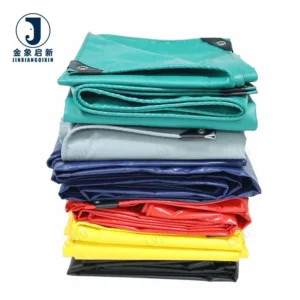
| Colour Options | Blue / Red / Yellow / Light blue / Grey (Customized) |
| Key Features | Cold crack resistance, anti-mildew, waterproof, colour fastness |
| Optional Treatments | Flame retardant (grade not stated), anti-static (grade not stated), sunproof (test basis not stated) |
| Standards | ISO 9001, CE |
Application Suitability
| Application | Exposure & Requirement |
|---|---|
| Flatbed and curtain-side trailer covers | Constant road vibration, flex-point abrasion at load edges, high-speed wind uplift, rain and grit impact |
| Box trailer roof and side panels | Prolonged UV exposure, thermal cycling from direct sun to cold night air, tension from ratchet straps |
| Long-haul transport rainproof covers | Multi-day weather exposure, repeated folding and unfolding at loading docks, contact with diesel and road salt |
| Cargo ship and dockyard covers | Salt-laden air, heavy moisture, mechanical abrasion from cargo handling equipment |
| Construction and scaffolding enclosure | Wind loading, debris impact, dust containment, site safety colour-coding requirements |
When a Generic Truck Cover Fails Before the First Year Ends
A PVC coated tarpaulin must be dimensioned to the exact trailer model, not cut from a standard sheet that leaves gaps under tension.
Fleet operators who replace side curtain or load covers repeatedly often find the failure point is not the fabric itself but the hem and eyelet zone where the cover meets the trailer frame. Generic sizing forces the material to stretch beyond its intended tension line, concentrating stress at the grommets. Every time the load shifts during braking or cornering, that stress point flexes. Over hundreds of cycles, the weld seam separating the hem reinforcement from the main panel cracks open. A cover cut to the specific trailer model eliminates that over-stretch and distributes the tie-down load across the full reinforced edge [NEED_CITE: tensile and tear test methods for coated fabrics per ISO 1421]. This is why we ask for the trailer make, model and year before confirming a cut-to-size order for any PVC coated tarpaulin.
How Trailer-Specific Sizing Changes Cover Longevity
When a transport fleet specifies PVC coated tarpaulin by the trailer model rather than by generic width and drop, the hem line sits exactly where the trailer rail provides support. The tie-down straps pull against a reinforced edge that is backed by the trailer structure, not suspended in air. This alignment reduces peel stress at the heat-welded seam and keeps the eyelet zone within its design load. The fabric flexes with the load instead of fighting against it.
Coating Adhesion and What It Means for Welded Seams
Hot-melt coating technology bonds the PVC layer to the polyester mesh under sustained heat and pressure, producing adhesion that survives the thermal cycle of a heat-weld seam. When the welder applies high-frequency energy along the join, the coating re-melts and fuses with the adjoining panel. If the base adhesion between coating and mesh is weak, the weld holds but the coating peels away from the fabric on either side of the seam [NEED_CITE: coating adhesion peel test per ISO 2411]. Laminated and hot-melt coating processes both deliver strong bond values, which is why welded seams on this PVC knife-coated fabric typically outlast the surrounding material under normal flex conditions.
Reading GSM and Thickness Together
Weight per square metre and total thickness describe different aspects of the same construction. A heavier GSM can come from a denser base fabric, a thicker coating, or both. The base fabric denier and mesh count determine tensile and tear strength, while the coating thickness governs abrasion resistance and waterproof integrity. Selecting a PVC coated tarpaulin grade requires matching both to the expected load and trip profile: a long-haul flatbed running through northern winter routes needs cold crack resistance and a heavier coating to resist road grit, while a regional delivery curtain-side may prioritise lighter weight for manual handling at each stop.
The Hidden Cost of Specifying on Price Per Square Metre Alone
Buyers who award a PVC coated tarpaulin order on the lowest GSM-adjusted price often discover the gap during the first winter. A lighter coating may meet the quoted weight but leaves the base fabric closer to the surface, so abrasion from tie-down straps cuts through to the mesh within months. A lower-denier base fabric saves cost on the purchase order but tears propagate faster once a nick occurs at a loading dock edge [NEED_CITE: tear propagation resistance per ISO 13937]. Batch-to-batch colour variation also becomes visible when two rolls from different production runs are installed side by side on the same trailer. These costs do not appear on the quotation — they appear on the replacement order.
Why Transport Fleets Source This Fabric Here
Three full production lines and 36 sets of professional equipment mean custom-width rolls and cut-to-model covers run on dedicated capacity, not squeezed between unrelated orders.
A 10-person R&D team develops samples within days when a fleet needs a specific colour match, reinforcement layout or printed branding for a new trailer build programme.
Dedicated QA/QC runs at every production stage, with 100% pre-shipment inspection ensuring the GSM, colour and weld quality match the confirmed sample.
Laminated and hot-melt coating technologies are both available in-house, allowing the correct bond method to be selected for the end-use rather than limited to whatever one coating line can produce.
Nearly 30 years of focus on coated fabric gives process control over coating weight and adhesion that translates directly into predictable weld-seam performance on the finished truck cover.
Documentation & Verification
- Material specification sheet stating exact GSM, base fabric construction and coating weight for each roll
- Pre-shipment inspection record confirming weight, colour and dimensional accuracy before dispatch
- Test report for flame retardant grades supplied where the specified treatment applies
- Test report for anti-UV performance supplied where the specified treatment applies
- ISO 9001 and CE certificates included with shipping documentation
- Roll packing list with individual roll IDs traceable to production batch
Fabrication, Handling & Storage
- Heat-weld seams at recommended temperature settings matched to the chosen coating technology for full adhesion
- Reinforce eyelet zones with an additional PVC patch layer to distribute tie-down strap load
- Store rolls upright on pallets to prevent flat spots and permanent creasing across the 2m or 2.1m width
- Allow cold-stored rolls to reach ambient temperature before unrolling to avoid coating crack at -70°C rated limit
- Use non-solvent cleaners on the PVC surface to preserve anti-mildew treatment integrity
- Plan cut layouts on roll stock to minimise off-cuts and welded joins across the trailer panel
Before You Request a Quote
Provide the trailer make, model and year for any cut-to-size PVC coated tarpaulin order, along with the operating climate and whether the cover will be manually handled or mechanically deployed. Specify any flame retardant or anti-static grade required by the destination market so the correct treatment and matching test report can be included. Confirm the colour reference and whether you need finished covers with eyelets and hems or roll stock only.
Frequently Asked Questions
Q: How is GSM verified on arrival and what documentation confirms the weight?
A: Every shipment includes a material specification sheet stating the exact GSM ordered, along with a pre-shipment inspection record that documents the measured weight per roll before dispatch. You can cross-check the roll label against these documents on receipt. If you require independent third-party weight verification, we can arrange sampling for your nominated lab.
Q: Can the tarpaulin be cut to fit a specific trailer model rather than a generic size?
A: Yes. Provide the trailer make, model and year, and the cover is dimensioned to that specific body shape. This eliminates edge gaps and ensures tie-down points align with the trailer rail. We also supply roll stock in standard 2m and 2.1m widths for buyers who fabricate covers in-house.
Q: How is colour consistency maintained across multiple rolls in the same order?
A: All rolls within a single order are produced from the same coating batch against a confirmed colour reference. The pre-shipment inspection includes a side-by-side colour check before packing. If your order spans multiple production runs, we flag this before dispatch and provide panel samples for your approval.
Q: What test evidence is provided for flame retardant and anti-UV claims?
A: Where a flame retardant or anti-UV treatment is specified, a test report covering the applicable grade is supplied with the shipment. We do not make performance claims without supporting documentation. Confirm the grade required for your destination market at inquiry stage so the correct treatment is applied and tested.
Q: Do you supply finished truck covers or only fabric by the roll?
A: Both options are available. Finished covers are cut to your trailer model with welded hems, reinforcement patches and eyelets at your specified spacing. Roll stock is supplied in standard or custom widths for buyers who handle their own fabrication. Sample development is available for either format before bulk production.