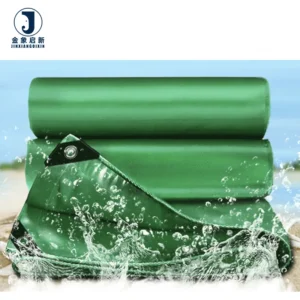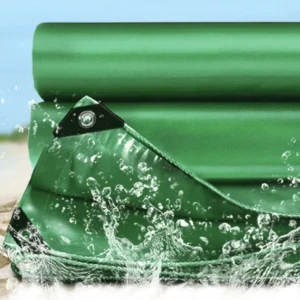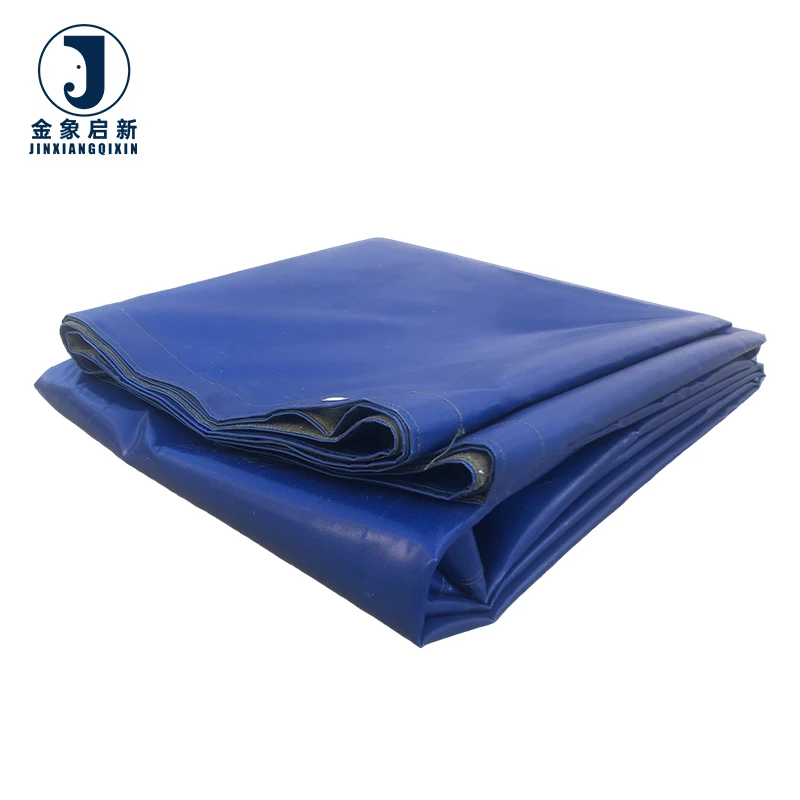
Heat-Welded Seam Integrity — high-frequency heat-combined joining process tested at high-stress flex zones keeps truck cover joins intact under repeated road vibration.
Technical Specifications
| Parameter | Value |
|---|---|
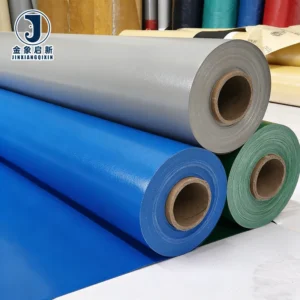
| Product Type | PVC Coated Tarpaulin Roll |
| Weight | 500gsm |
| Base Fabric Denier | 1000D |
| Coating Method | Laminated |
| Coating Material | PVC |
| Waterproof Rating | ≥20KPa |
| Flame Retardant | ≤10 seconds (grade not stated — confirm required standard) |
| Low-Temperature Flexibility | -30°C (no fracture) |
| Anti-Mildew | Yes (stated, no standard cited) |
| Corrosion Resistance | Acid, alkali, brine |
| Seaming Method | High-frequency heat combined |
| Water Absorption | Almost none, quick drying |
| Colour | Grey (other colours available on request) |
| Product Format | Roll, per meter |
| Standards | ISO, CE certified production facility |
Application Suitability
| Application | Exposure & Requirement |
|---|---|
| Truck side curtain | Constant flexing at load points, road abrasion, UV and weather exposure, tie-down stress at eyelets |
| Trailer top cover | Water pooling, wind uplift, high-frequency vibration, thermal expansion and contraction |
| Flatbed load cover | Road splash, debris impact, securement strap abrasion, repeated folding and unfolding |
| Tipper truck cover | Bulk material abrasion, hydraulic arm movement, dust and moisture ingress |
| Boat transport cover | Salt spray, hull contour flex, UV reflection from water, tie-down compression |
Why Heat-Sealed Seams Outperform Stitched Joins on PVC Coated Tarpaulin for Truck and Trailer Cover
Stitched seams create needle holes that let water through and concentrate stress where the fabric bends most.
When a truck cover flexes over a load during transit, the highest mechanical stress falls on the seam line. Stitched joins rely on thread tension holding perforated fabric together — and those perforations become crack initiation points once road vibration and weather cycling begin. Heat-welded seams fuse the PVC coating layers into a single continuous membrane, eliminating perforation paths and spreading load across the full weld width rather than through individual thread loops. [NEED_CITE: tensile and tear test methods for coated fabrics per ISO 1421]
Fleet operators replacing side curtains mid-season typically find that failure starts not in the body fabric but along the stitched hem or panel join. A welded seam on a PVC coated tarpaulin for truck and trailer cover maintains water-tight integrity because there is no thread to rot, no needle hole to wick moisture, and no stitch channel to collect road grime.
How Laminated Construction Affects Fabrication and On-Road Performance
The laminated coating process bonds the PVC layers to the 1000D base fabric under heat and pressure, creating a structure where coating weight and base fabric denier work together to determine how the material handles repeated folding, heat-seaming and road stress. For fleet operators and transport equipment builders, the practical consequence is that laminated PVC coated tarpaulin for truck and trailer cover applications responds well to high-frequency welding — the PVC layers melt and fuse predictably without delaminating from the base weave.
This matters when fabricating side curtains that need long continuous welds along panel joins, or when building one-piece top covers where a seam failure would expose an entire load. The 500gsm weight keeps roll weight manageable for workshop handling while the 1000D denier provides the tensile backbone needed for tie-down points and corner reinforcements.
Matching Roll Dimensions to Specific Trailer Models
Generic-sized truck covers rarely sit flush against a trailer body, leaving gaps where wind gets underneath and water runs in at the edges. Cutting PVC coated tarpaulin for truck and trailer cover applications from roll stock to exact vehicle dimensions eliminates those gaps and reduces the number of field adjustments needed after fitment. [NEED_CITE: DIN EN 12195 load restraint standards for commercial transport covers]
Transport equipment builders specifying material for new-build trailer bodies benefit from ordering cut-to-model panels rather than standard rectangles — fewer offcuts, less waste, and a finished cover that follows the trailer profile without excess fabric flapping in crosswinds. The roll format at per-meter supply supports both single-vehicle custom jobs and fleet-scale production runs without forcing buyers into fixed cut-size minimums.
What the 500gsm and 1000D Combination Means in Practice
The 500gsm weight on a 1000D base fabric sits in a range that balances fabrication ease with mechanical durability for transport covers. The denier of the base yarn determines how much force the woven structure can absorb before individual yarns break, while the total GSM reflects both that base fabric and the PVC coating mass applied to each side. A lighter coating on the same 1000D base would reduce waterproofing and abrasion protection; a heavier coating on a lower denier would add weight without proportional strength gain.
The laminated process used here bonds coating to fabric in a single pass, which typically produces more uniform coating thickness compared to multi-pass methods. For truck and trailer covers that face daily folding at the same crease lines, uniform coating thickness means those fold points age at a consistent rate rather than wearing through at a thin spot first. The verified low-temperature flexibility to -30°C without fracture confirms the plasticiser system remains functional on cold-climate routes, preventing the brittle cracking that appears when PVC compounds stiffen below their rated range.
The Hidden Cost of Specifying by GSM Without Verification
A quotation stating 500gsm does not guarantee the rolls on arrival actually weigh 500gsm. Lighter coating applied during production saves material cost at the factory but shifts the failure burden to the end user — thinner PVC layers wear through faster at abrasion points, waterproofing degrades sooner, and the base fabric becomes exposed to UV and moisture at an earlier stage. [NEED_CITE: coating weight verification methods for PVC tarpaulin per ISO 3801]
For fleet operators, the consequence is a truck cover that looks correct on installation but begins showing base fabric exposure at high-wear zones within months rather than seasons. Batch-to-batch GSM drift across rolls in the same container also creates visible colour and surface variation once panels from different rolls are installed side by side on adjacent vehicles — a problem that only becomes apparent after the covers are already fitted and the fleet is on the road.
Why Source Your PVC Tarpaulin Roll Here
Three full coating production lines running dedicated PVC runs mean capacity is available for fleet-scale orders without compromising individual roll inspection. Every roll passes through QA checkpoints at coating, winding and packing stages rather than relying on a single final-ship check.
A 10-person R&D team handles custom width, colour matching and panel sizing specific to individual trailer models — not just standard roll widths from stock. Material specification sheets are issued per order stating base fabric denier, coating method, GSM and test data so that what was quoted is what arrives.
Samples are developed within days for custom colour or sizing requirements, allowing fabricators to validate weld settings and fitment before committing to full production volume. Pre-shipment inspection records travel with every dispatch, documenting roll-by-roll weight verification and visual grading.
Documentation & Verification
- Material specification sheet listing 1000D base, laminated PVC coating, and verified 500gsm weight
- Weight verification per roll against the stated 500gsm before dispatch
- Low-temperature flexibility test data confirming performance to -30°C
- Waterproof rating test record showing ≥20KPa result
- Pre-shipment inspection record included with roll packing list
- ISO and CE certificates covering the production facility
Fabrication, Handling & Storage
- Use high-frequency welding at settings calibrated for 500gsm laminated PVC to avoid coating burn-through or incomplete fusion
- Allow laminated PVC rolls to acclimatise to workshop temperature before unrolling to prevent crease marks from cold stiffening
- Store rolls upright on end caps in a dry area to prevent edge compression damage on the 1000D base fabric
- Clean fabricated covers with mild detergent — the PVC laminated surface tolerates standard cleaners but not solvent-based degreasers
- Plan panel cutting layout across roll width to minimise offcuts and keep weld joins away from highest-flex zones
- Reinforce tie-down and eyelet zones with additional PVC patches welded over the 500gsm base to spread point loads
What to Include in Your Enquiry
Provide the specific truck or trailer model dimensions, including side curtain drop length and top cover span, so cut-to-fit panels can be calculated against available roll widths. State the operating climate and route conditions — particularly low-temperature exposure — to confirm the -30°C flexibility rating meets your fleet’s requirements.
Indicate whether you need rolls supplied by the meter for in-house fabrication or pre-cut panels with welded hems and eyelet placement matched to your trailer hardware. If flame retardant compliance is required for your market, specify the standard and grade so the correct material variant can be quoted.
Frequently Asked Questions
Q: How is GSM verified on delivery to match the quoted 500gsm specification?
A: Every roll is weighed during pre-shipment inspection and compared against the 500gsm specification stated on your quotation. The inspection record travels with your dispatch documentation, showing measured weight per roll so you can confirm on arrival that no material shortfall exists before fabrication begins.
Q: Can truck covers be cut to fit specific trailer models rather than generic sizes?
A: Yes. Provide the exact trailer model dimensions — side curtain drop, top cover width and length, front and rear profile shapes — and panels are cut from roll stock to match. This eliminates the gaps and excess fabric that generic sizes create, giving a flush fit that reduces wind ingress and water channelling.
Q: What is the low-temperature performance limit for cold-route transport?
A: The material is verified flexible to -30°C without fracture, meaning the PVC coating retains its plasticity and does not crack when folded or subjected to road vibration at that temperature. Confirm your route’s minimum operating temperature against this threshold to ensure year-round reliability.
Q: How do heat-welded seams compare to stitched seams at load flex points?
A: Heat-welded seams fuse the PVC coating into a continuous membrane with no needle holes and no thread under tension. At flex points where the cover bends over the load during transit, welded joins distribute stress across the full weld width while stitched joins concentrate stress at individual perforations, making welds more resistant to crack propagation.
Q: What roll widths and lengths are available for fleet-scale fabrication?
A: Rolls are supplied per meter with custom width options available to match your trailer panel layout. For fleet-scale orders, specify the required roll width and total meterage so production can be scheduled on a single coating run, ensuring colour and GSM consistency across all rolls in the batch.