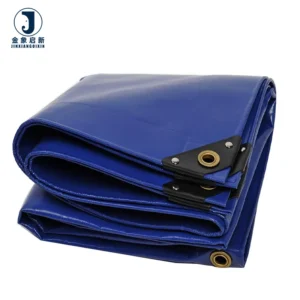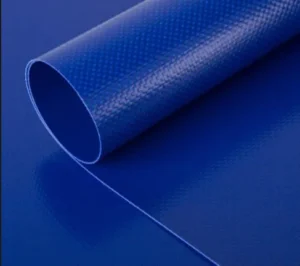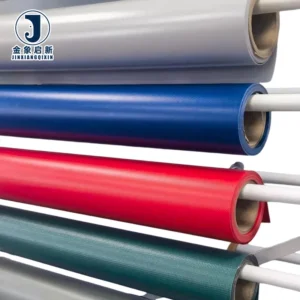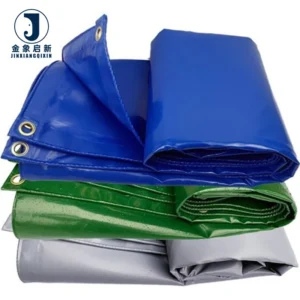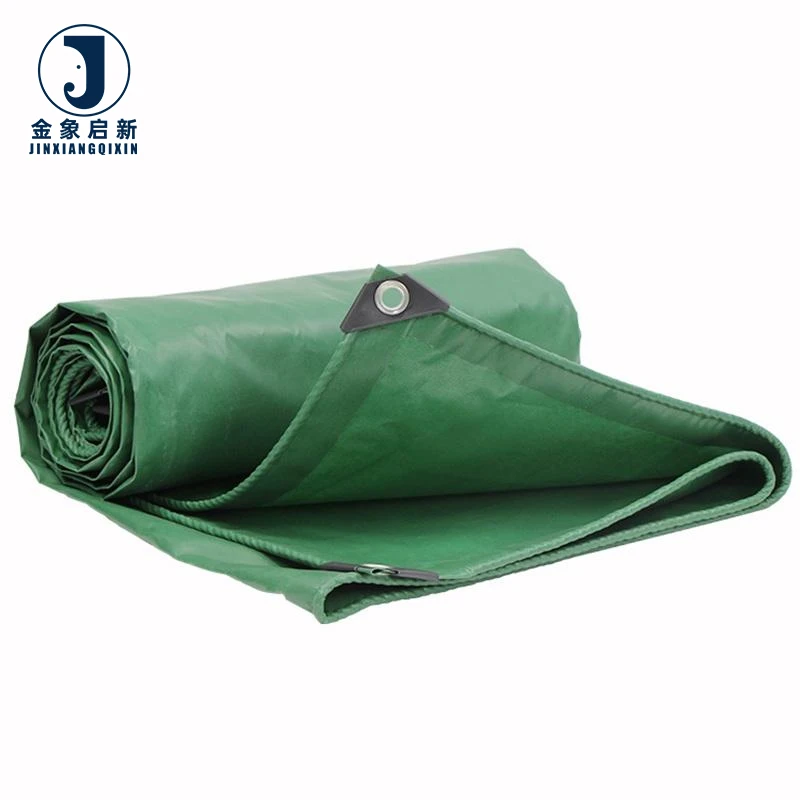
Hot-Melt Adhesion — PVC layers bonded to high-tenacity polyester mesh through hot-melt coating keep seams intact under the constant flex and road vibration that truck covers endure.
Technical Specifications
| Parameter | Value |
|---|---|
| Product Type | PVC Coated Tarpaulin Roll |
| Material | PVC + High-strength polyester mesh fabric |
| Coating Method | Laminated technology & Hot-melt Coating technology |
| Weight (GSM) | 350gsm / 420gsm / 500gsm / 550gsm / 600gsm / 750gsm |
| Total Thickness | 0.32mm / 0.35mm / 0.4mm / 0.45mm / 0.5mm / 0.65mm |
| Surface Finish | Glossy or Matt |
| Color Options | Blue / Red / Yellow / Light blue / Grey (Customized) |
| Roll Size | 2m width × 75m length / 2.1m width × 50m length |
| Key Features | Cold crack resistance, Anti-mildew, Anti-static treatment (standard not stated), Waterproof, Sunproof (test basis not stated), Color fastness |
| Standards | ISO, CE (certificates available — confirm specific test documentation for your market) |
Application Suitability
| Application | Exposure & Requirement |
|---|---|
| Truck side curtain fabric | Constant flexing at tie-down points, road debris abrasion, UV and weather exposure across seasons |
| Trailer top and rear covers | Wind load at highway speed, water ingress prevention, thermal cycling from sun to cold night |
| Cargo ship awning and hatch covers | Salt-laden atmosphere, prolonged sun exposure, mechanical stress during loading and stowage |
| Custom-fit truck tarpaulin | Exact dimension match to trailer model, reinforced hems at high-tension corners, colour match across fleet |
Why Adhesion Strength Decides How Long a Truck Cover Actually Lasts
A truck cover rarely fails in the middle of the panel — it fails where the weld meets the flex point.
Fleet operators replacing covers every season often find the fabric itself is still intact, but the welded seams have peeled apart at the stress concentrations near tie-down straps and corner hems. Laminated and hot-melt coating methods bond the PVC skin to the polyester base at a molecular level, so the seam holds as long as the surrounding fabric. When adhesion is weak, the delamination starts small and spreads with every load cycle until the cover splits open on the highway. [NEED_CITE: peel strength test methods for coated fabrics per ISO 2411]
Coating Technology That Holds Under Dynamic Load
The hot-melt coating process forces molten PVC into the weave of the high-strength polyester mesh rather than simply laying it on top. This creates a mechanical lock between coating and base yarn that resists separation when the PVC Tarpaulin Roll for Truck and Transport is fabricated into side curtains or top covers. The laminated technology adds an additional bonding layer for grades where extra peel strength is needed at welded seams.
Surface Finish and Fleet Aesthetics on the Road
Glossy and matt finishes serve different purposes depending on fleet visibility requirements and operating conditions. A glossy surface sheds road grime more readily during rain and wash-down, keeping branding readable over long haul distances. A matt finish reduces glare for drivers operating alongside the trailer and hides surface scuffing from loading bay contact. Both finishes maintain colour fastness across the service life of the cover under normal road exposure conditions. [NEED_CITE: color fastness testing for PVC coated polyester under artificial weathering per ISO 105]
Reading the Specs Beyond the GSM Number
Weight alone tells you how much material is in the roll, but not how that material is distributed between base fabric and coating. A heavier GSM achieved by adding coating thickness without a denser polyester mesh may resist puncture but will not gain proportional tear or tensile strength. The high-tenacity polyester yarns in this PVC Tarpaulin Roll for Truck and Transport carry the structural load, while the PVC coating provides waterproofing and environmental protection. Thickness values from 0.32mm to 0.65mm across the available GSM range reflect different ratios of base fabric density to coating weight, each suited to different load and exposure conditions. Choosing between glossy and matt surface finish also affects how the material behaves during fabrication — glossy surfaces can be more slippery under presser feet during sewing, while matt surfaces grip more consistently.
The Cost of Specifying the Wrong Roll for Fabrication
When a fleet operator orders roll stock based on price per kilogram rather than adhesion performance, the fabricated covers may pass visual inspection but fail within months at the weld lines where flex concentrates. Colour variation between rolls in the same order becomes visible once multiple panels are hung side by side on a trailer, forcing a full re-order to achieve uniform fleet appearance. Anti-static treatment specified for dust-sensitive cargo environments may not be supported by documentation, leaving the buyer unable to prove compliance during site audits. These failures are not material defects — they are specification mismatches that compound into costly replacements. [NEED_CITE: common failure modes in fabricated PVC truck covers at weld and hem junctions]
Why This Roll Stock Fits Fleet Fabrication Workflows
Three full production lines and 36 sets of professional equipment support bulk roll output with consistent coating weight and colour across the run, which matters when a fleet order spans dozens of rolls that must match. A 10-person R&D team develops samples within days for custom width, colour or print requirements, letting you verify appearance and handling before committing to a container load. Dedicated QA/QC inspects every production stage, catching GSM drift and surface defects before rolls are packed, reducing the risk of receiving material that does not match the quotation. The hot-melt and laminated coating processes produce roll stock that fabricates cleanly on standard high-frequency welding equipment, holding tear strength at the weld rather than losing it. Pre-shipment inspection records document the exact GSM and appearance of each roll, giving your receiving team something to verify against.
Documentation & Verification
- Weight verification per roll against the stated GSM before dispatch
- Colour reference sheet matching the agreed Pantone or RAL code for the order
- Material specification sheet stating base fabric denier and coating composition
- ISO and CE certificates included with shipment documentation pack
- Roll packing list with individual roll weights and dimensions for customs clearance
- UV or anti-static test report provided where the treatment grade is confirmed at order stage
Fabrication, Handling & Storage
- Hot-melt coated rolls weld consistently on high-frequency equipment without pre-heating across the 350gsm to 750gsm range
- Allow matt finish rolls to acclimate to workshop temperature before welding to avoid condensation at the seam
- Store rolls upright on pallets to prevent flat spots that distort the polyester mesh weave pattern
- Use sharp rotary blades when cutting 0.5mm and 0.65mm thickness grades to avoid fraying the base yarn
- Glossy surface rolls should be handled with clean cotton gloves to prevent fingerprint transfer before fabrication
- Reinforce hem folds with additional welding tape at tie-down strap anchor points on heavy-duty 600gsm and 750gsm grades
What We Need to Quote Your Roll Order Accurately
Share the trailer models or cover dimensions you are fabricating for, along with the GSM grade and surface finish your fleet or customer specifies. If your end-use environment requires anti-static or fire-retardant treatment, tell us the standard or grade your market demands so we can confirm availability and supply supporting documentation. Let us know the roll width and length that fits your cutting table, and whether you need custom colour matched to a specific reference.
Frequently Asked Questions
Q: How is GSM verified on arrival against the quotation, and what documentation accompanies each roll shipment?
A: Each roll is weighed and measured during pre-shipment inspection to confirm the actual GSM matches the quoted grade. A material specification sheet and roll packing list ship with the order, listing individual roll weights, dimensions, and coating details. You can cross-check these on arrival using a scale and micrometer against the documented values.
Q: How do you control colour consistency across multiple rolls in a single bulk order?
A: Rolls in the same production run use a single coating batch mixed to the agreed colour reference, reducing batch-to-batch variation. QA/QC compares each roll against the approved sample under standard lighting before packing. For large fleet orders, we can supply all rolls from one continuous run to maximise visual uniformity.
Q: What roll widths and lengths are available, and how does container loading work by roll count?
A: Standard roll sizes are 2m × 75m and 2.1m × 50m, with custom widths available on request. Rolls are packed upright on pallets for container loading. The roll packing list provided at dispatch details exact roll count, total weight, and pallet configuration so your logistics team can plan receiving and storage.
Q: What eyelet spacing and hem reinforcement options are available for truck cover fabrication from this roll stock?
A: As roll stock, eyelet spacing and hem reinforcement are handled during your fabrication stage. The hot-melt coating technology provides strong weld adhesion, so hem folds and reinforcement patches bond reliably on standard high-frequency welding equipment. We can advise on suitable welding parameters for your chosen GSM grade.
Q: How are custom colours and branding prints handled in terms of sampling, minimums and lead time?
A: Custom colours are matched to your Pantone or RAL reference and developed as a sample roll within days for approval before bulk production. Minimum order quantities and lead times depend on the GSM grade and roll width specified. Share your colour reference and required volume to receive a sample development timeline and quotation.