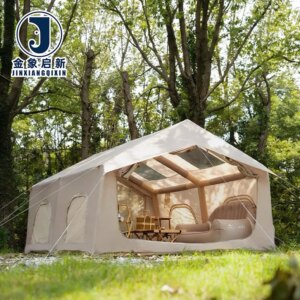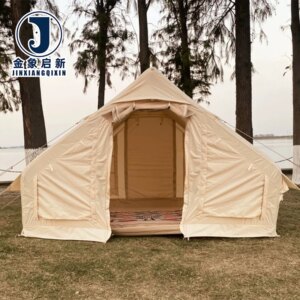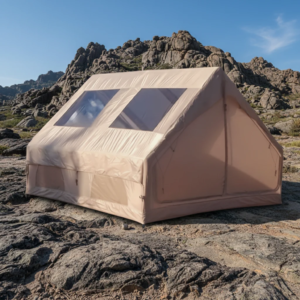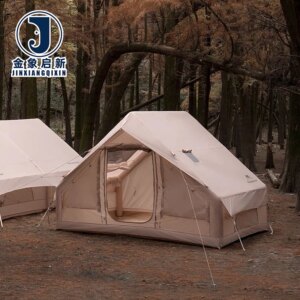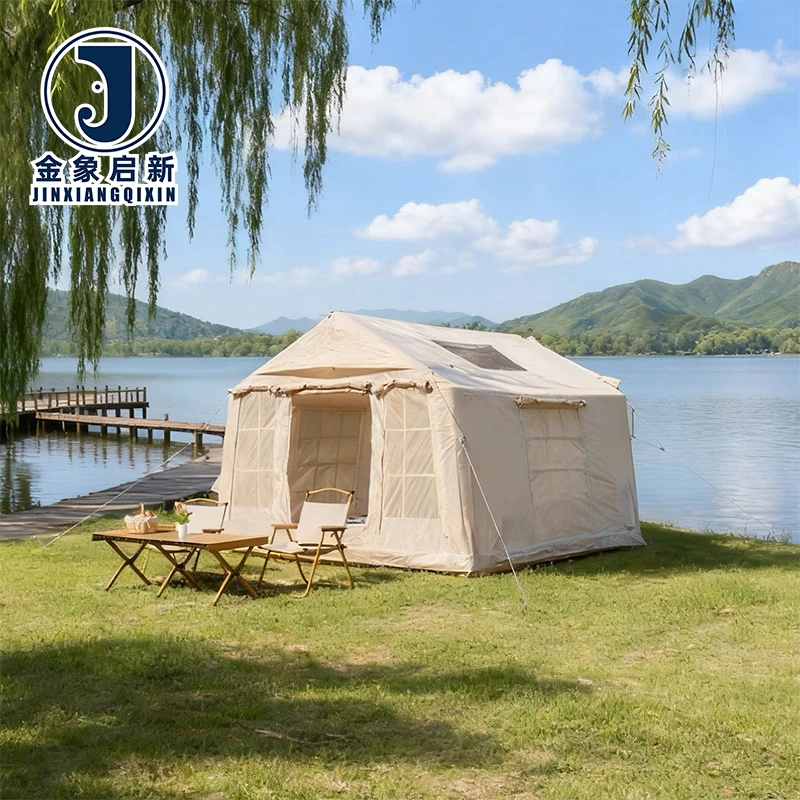
Precision-Coated Inflatable Fabric — nearly 30 years of PVC knife-coating process control applied to inflatable camping tent structures, ensuring consistent wall thickness and seam integrity across every production batch.
Technical Specifications
| Parameter | Value |
|---|---|
| Product Type | Inflatable Camping Tent |
| Capacity | 6-8 Person |
| Core Material | PVC knife-coated tarpaulin |
| Material Thickness Range | 0.4–1.2 mm (customizable) |
| Thickness Tolerance | ±3% |
| Tear Resistance | ≥300 N (test basis not stated in source) |
| Waterproof Index | ≥5000 mm (test basis not stated in source) |
| Flame Retardant Grade | UL94 V-0 |
| UV Resistance | Anti-UV treated (extended outdoor exposure claimed — confirm test basis for your market) |
| Anti-Static | Available as key performance option (surface resistance standard not stated) |
| Coating Method | Knife coated |
| Certifications | ISO 9001, ISO 14001, ISO 45001, CE, UL94 V-0 |
| Customization | OEM & ODM — size, thickness, pattern printing, structural design |
Application Suitability
| Application | Exposure & Requirement |
|---|---|
| Commercial outdoor gear product lines | Repeated inflation/deflation cycles, retail packaging standards, brand-specific colour and print consistency |
| Expedition and industrial team shelters | High wind loading, abrasive ground contact, rapid deployment under adverse weather |
| Disaster response temporary housing | Continuous occupancy, fire safety compliance, waterproof integrity under sustained rain |
| Outdoor event and glamping operators | Frequent transport and setup, UV exposure over seasons, guest-facing appearance standards |
Why Coating Adhesion Matters More Than Thickness Alone
A tent wall can measure 0.9 mm and still delaminate at the seam if the coating bond to the base fabric is poorly controlled.
When sourcing an Inflatable Camping Tent manufacturer, many buyers focus on stated thickness or waterproof ratings without asking how the coating is bonded to the scrim. Knife-coated PVC penetrates the weave mechanically, but inconsistent paste viscosity or uneven doctor blade pressure produces weak spots that only reveal themselves after repeated pressurization cycles [NEED_CITE: knife coating adhesion test methods per ISO 2411]. We have inspected returned inflatable structures where the fabric itself remained intact while the coating peeled away at the heat-welded seams — the exact locations that flex most during inflation and deflation. Specifying thickness without verifying adhesion leaves a gap in your quality acceptance criteria.
How Inflatable Tent Fabric Differs From Standard Tarpaulin
An inflatable camping tent places demands on PVC fabric that a flat truck cover or pond liner never encounters. The material must hold internal air pressure continuously while the structure flexes under wind gusts and occupant movement. This means the base fabric weave and coating weight must work together — the scrim provides dimensional stability and tear resistance, while the PVC coating delivers airtightness and environmental protection. When you evaluate a Custom Inflatable Tent supplier, ask how their coating formulation balances flexibility at low temperatures against structural rigidity at operating pressure.
What Batch Consistency Means for Inflatable Structures
Inflatable tents are unforgiving of roll-to-roll variation. A thickness shift of even a small fraction of a millimetre changes how the fabric folds, how seams weld, and how the inflated tubes behave under load. Our in-line thickness monitoring runs every 15 minutes across the coating line, holding tolerance within ±3% [NEED_CITE: in-line caliper measurement standards for coated fabrics]. This consistency matters especially when a commercial outdoor gear manufacturer orders multiple production runs — your cutting templates and welding parameters stay valid from one batch to the next without recalibration.
Reading the Specification Sheet Beyond the Headline Numbers
The tear resistance value of ≥300 N tells you how the material resists propagation once a puncture or cut occurs, which is critical for inflatable tubes that operate under constant internal pressure. A small abrasion from rocky ground can escalate into a full split if the base fabric denier and weave density are insufficient. The waterproof rating of ≥5000 mm indicates the hydrostatic head the coating can withstand before water penetrates — relevant for prolonged rain exposure on multi-day expeditions. The UL94 V-0 flame retardant grade specifies that the material self-extinguishes within defined time limits after flame removal, a classification tested under controlled laboratory conditions. For UV resistance, the anti-UV treatment is stated to support extended outdoor service life, but the specific accelerated weathering standard or exposure hours should be confirmed against your destination market’s requirements. Knife coating, as opposed to lamination or calendering, produces a thicker, more uniform PVC layer that bonds deeply into the scrim — this translates to better peel strength at welded seams and longer functional life under repeated inflation cycles.
When Material Specification Gaps Become Field Failures
Buyers who accept a quotation based on thickness and waterproof claims alone often discover problems only after the inflatable tent reaches the end user. Coating weight that falls below the agreed specification reduces airtightness, forcing the pump to run longer and stressing seam welds. Flame retardant treatment without a verifiable test report can result in failed compliance inspections at trade shows or regulated campsites [NEED_CITE: UL94 V-0 testing protocol for flexible PVC materials]. Colour variation between rolls in the same shipment becomes visible once multiple tents are pitched side by side at an outdoor event. These are not cosmetic issues — they trigger warranty claims, batch returns, and lost distribution contracts.
What This Production Setup Delivers for Your Order
Three full production lines with 36 sets of processing equipment mean your inflatable tent fabric runs on dedicated coating capacity, not squeezed between unrelated product schedules. The 10-person R&D team develops pre-production samples within 7–10 days, letting you validate material hand-feel, weld behaviour, and colour accuracy before committing to full production. Every batch undergoes tensile strength and coating adhesion testing, with 24-hour air pressure retention checks on finished inflatable units before packaging. Custom width, pattern printing, and structural modifications are handled in-house rather than subcontracted, keeping lead times within 15–20 days for orders under 500 units.
Documentation & Verification
- Material specification sheet stating PVC grade, coating weight, and base fabric denier for each inflatable tent order
- UL94 V-0 flame retardant test report matched to the specific production batch
- Pre-shipment inspection record covering thickness, dimensional accuracy, and air pressure retention results
- Colour reference sheet with approved Pantone or RAL codes for printed and solid-colour inflatable tent runs
- ISO 9001, ISO 14001, ISO 45001, and CE certificates included in the shipping documentation package
Fabrication, Handling & Storage
- Heat welding parameters must be calibrated to the specific PVC coating thickness — confirm temperature and dwell time per batch
- Inflatable tube seams should be welded with overlap width matched to the 0.4–1.2 mm material thickness range
- Store rolled inflatable tent fabric upright on pallets to prevent flat-spot creasing in the knife-coated PVC layer
- Avoid folding inflated structures at temperatures below the PVC glass transition point to prevent coating micro-cracking
- Clean surfaces with neutral pH detergent only — solvent-based cleaners can degrade the anti-UV treatment layer
- Repair minor punctures with compatible PVC adhesive patches matched to the knife-coated surface chemistry
Before You Request a Quote
Tell us the intended end-use environment — expedition shelter, commercial glamping site, or disaster response deployment — along with the fire safety classification your destination market requires. Specify whether you need finished inflatable tents cut and welded to your design, or PVC coated fabric rolls for your own fabrication line. If pattern printing or brand colour matching is part of the project, share your artwork files and approved colour standards so we can build accurate pre-production samples.
Frequently Asked Questions
Q: What customization options and MOQ apply to inflatable tent orders?
A: We support OEM and ODM customization including material thickness selection from 0.4 to 1.2 mm, size adjustment, pattern printing, and structural tube design modifications. Minimum order quantities vary based on whether you are ordering finished inflatable units or PVC coated fabric rolls. Request a specification review so we can confirm the MOQ that applies to your specific configuration and production timeline.
Q: How does UL94 V-0 certification meet export market fire safety requirements?
A: The UL94 V-0 grade indicates the PVC fabric self-extinguishes within defined limits after flame removal, tested under standardized laboratory conditions. Many commercial campsite operators and event venues in North American and European markets reference UL94 classifications in their procurement specifications. We provide the corresponding test report with each batch — confirm whether your specific destination market requires additional local fire classification.
Q: How are pattern printing and colour matching handled during sample development?
A: Pre-production samples are developed within 7–10 days, incorporating your approved Pantone or RAL colour references and print artwork. We run colour proofs on the actual knife-coated PVC surface so you can evaluate ink adhesion and colour accuracy under the same conditions as mass production. Sample approval gates the full production run to ensure batch-to-batch colour consistency.
Q: What testing basis supports UV resistance claims for extended outdoor exposure?
A: The inflatable tent fabric receives anti-UV treatment during the knife-coating process, which the manufacturer states supports over three years of outdoor service life. The specific accelerated weathering standard or exposure duration behind this claim should be verified for your application — we can arrange third-party testing through SGS or Intertek upon request to document UV degradation performance against your target benchmark.
Q: What quality documentation is provided with each shipment for audit purposes?
A: Every batch ships with a material specification sheet, UL94 V-0 test report, pre-shipment inspection record covering thickness and pressure retention results, roll packing list, and certificate of origin. ISO 9001, ISO 14001, ISO 45001, and CE certificates are included in the documentation package. Additional third-party test reports from SGS or Intertek can be arranged before dispatch if your procurement process requires independent verification.