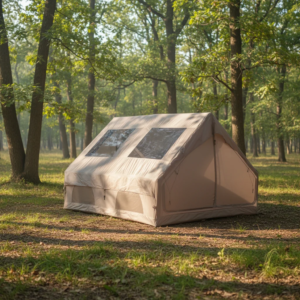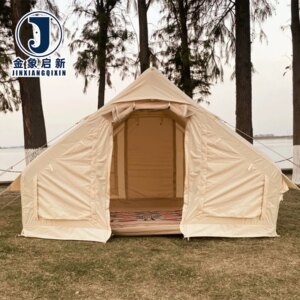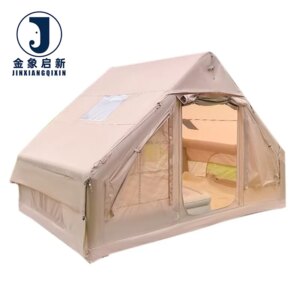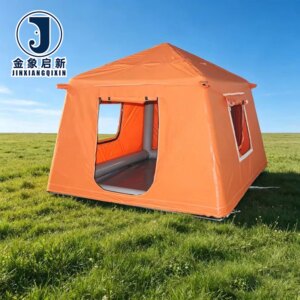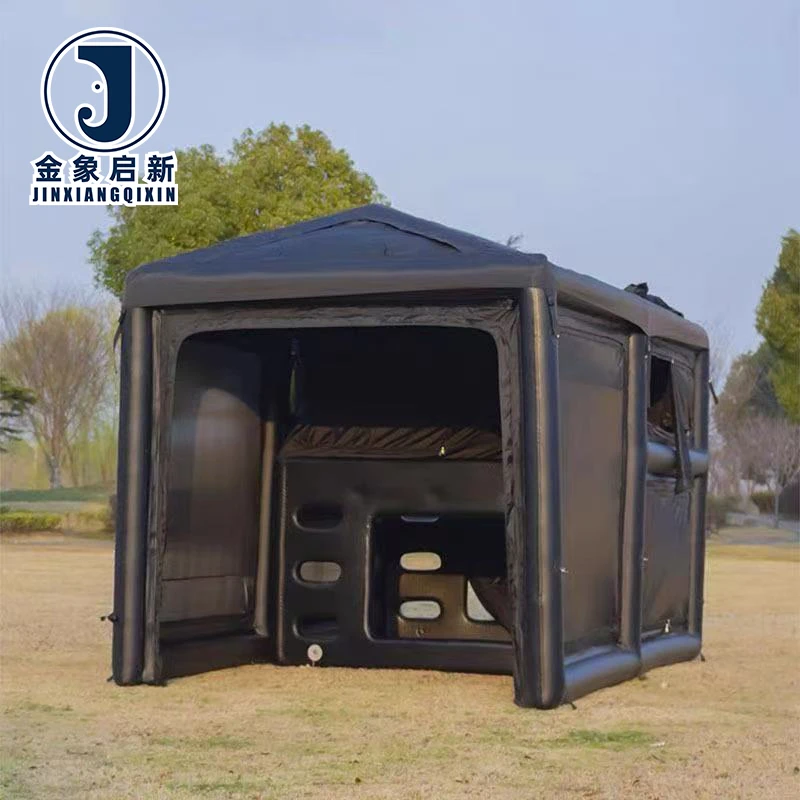
Deep Coating Process Control — consistent PVC knife-coated adhesion validated across every roll of inflatable tent fabric before it leaves the production floor.
Technical Specifications
| Parameter | Value |
|---|---|
| Product Type | Inflatable Tent Fabric |
| Core Material | PVC tarpaulin, knife-coated construction |
| Waterproof Rating | Hydrostatic head ≥ 5000mm |
| UV Treatment | UPF 50+ |
| Flame Retardant Grade | EN 13501-1 Class B |
| Tear Strength | ≥ 300N (test standard not stated) |
| Anti-Static Property | Surface resistance 10^6–10^9 Ω |
| Material Thickness | 0.4mm–1.2mm |
| Season Rating | Four seasons |
| Customization | OEM & ODM, sample customization, pattern printing |
| Certifications | ISO 9001, ISO 14001, ISO 45001, CE, EN 13501-1 |
Application Suitability
| Application | Exposure & Requirement |
|---|---|
| Truck-mounted commercial shelters | Repeated loading and unloading cycles, road vibration, abrasion at contact points, all-season weather during transit |
| Construction and mining staging tents | Heavy particulate exposure, wind-driven rain, site fire safety compliance, rapid deployment and teardown |
| Branded commercial camping product lines | Batch colour consistency across production runs, consumer-facing print quality, retail packaging presentation |
| Logistics staging enclosures | Forklift and equipment traffic nearby, UV exposure during extended outdoor storage, dust and moisture ingress prevention |
When Inflatable Tent Fabric Fails at the Flex Point
Seam failure on inflatable structures almost always starts where the fabric folds during transport and inflation, not on the flat panels.
Transport equipment builders and fleet operators deal with inflatable tent fabric that must survive being folded, strapped to a pallet, loaded onto a truck bed, transported over uneven roads, then inflated on-site — sometimes several times a week. The flex points created at each fold become stress concentrators. If the PVC coating adhesion to the base fabric is weak, the coating delaminates first, and the welded seam splits shortly after. Buyers who specify material based only on weight or thickness miss the real indicator: how well the coating bonds under cyclic mechanical stress [NEED_CITE: peel strength test methods for PVC coated fabrics]. The inflatable tent fabric for transport applications must hold its seam integrity through hundreds of inflation and deflation cycles without the weld line cracking.
Coating Adhesion Under Repeated Inflation Cycles
Inflatable tent fabric for transport operates under conditions that flat-sheet tarpaulin never encounters. Each inflation cycle stretches the material biaxially, and each deflation compresses it back. Over dozens of cycles, poor coating-to-substrate adhesion shows up as micro-cracks at the seam edges — invisible during a quick visual inspection but visible once the structure is pressurised. The PVC knife-coated construction used here forces coating material into the base fabric weave under controlled tension, producing a mechanical interlock that resists delamination far better than simple lamination. This matters especially at the valve surrounds and structural beam junctions, where localised stress is highest.
Why Anti-Static Treatment Matters on Industrial Sites
Construction sites, mining operations, and fuel-adjacent staging areas carry dust and particulate loads that accumulate on tent surfaces. When the inflatable tent fabric is packed, transported, and unpacked repeatedly, static charge builds across the membrane surface. An anti-static treatment achieving surface resistance of 10^6–10^9 Ω dissipates that charge safely, preventing dust attraction that accelerates surface abrasion and reducing spark risk in sensitive environments. For fleet operators deploying shelters near heavy machinery or electrical infrastructure, this is a compliance requirement, not an optional extra [NEED_CITE: anti-static classification for temporary structures on industrial sites].
Reading the Specifications That Actually Matter
The hydrostatic head rating of ≥ 5000mm tells you how much water pressure the fabric resists before leakage begins — relevant when rain pools on a partially inflated roof panel or when the structure sits on wet ground. Tear strength of ≥ 300N indicates how a puncture or cut propagates through the material; on an inflatable beam, a small tear can rapidly deflate an entire section, so this value directly affects failure consequence. The EN 13501-1 Class B fire-retardant grade aligns with European construction site and public event requirements, defining how the material contributes to fire load when tested as a building product. UPF 50+ UV treatment addresses the long-term degradation that sunlight causes to PVC polymers — without it, the coating becomes brittle and loses flexibility at the fold lines within a single season of continuous outdoor use. Thickness range from 0.4mm to 1.2mm covers applications from lightweight backpacking-grade camping tents to heavy-duty industrial enclosures; the correct grade depends on the inflation pressure and structural load your design requires.
The Hidden Cost of Underspecified Inflatable Structure Fabric
When a commercial outdoor equipment manufacturer selects inflatable tent fabric based on unit cost alone, the consequences surface in the field — not in the factory. A coating weight that is lighter than what the inflation pressure demands leads to beam sag, especially in high ambient temperatures where PVC softens. Batch-to-batch colour variation becomes visible when two tents from different production runs are deployed side by side at a commercial event or a construction camp [NEED_CITE: colour consistency standards for coated fabric batches]. Fire-retardant treatment that is claimed but not certified to EN 13501-1 Class B can result in site inspectors rejecting the entire temporary facility, causing project delays that far outweigh any material savings. Welded seams that fail before the fabric body does leave the structure partially collapsed, exposing whatever equipment or personnel it was meant to protect.
Why Source Inflatable Tent Fabric Through This Supply Chain
Three full production lines with 36 sets of professional coating and finishing equipment mean that bulk orders of inflatable tent fabric move through the facility without bottleneck, maintaining batch consistency across the entire run. The 10-person R&D team develops pre-production samples with custom sizing and pattern printing, allowing you to validate material behaviour on your specific inflatable beam geometry before committing to volume. Quality control includes a 24-hour sustained inflation pressure retention test on finished product, catching seam and valve leakage that a visual inspection would miss. Nearly 30 years of focused coated fabric production provides the process knowledge to adjust coating formulation when your application demands specific flexibility or rigidity at given temperatures. Every shipment carries the documentation your compliance team and customs broker require — no chasing for certificates after the container has sailed.
Documentation & Verification
- Material specification sheet stating PVC coating weight, base fabric denier, and thickness for each roll
- EN 13501-1 Class B test report matching the production batch number supplied
- Pre-shipment inspection record covering dimensional accuracy and inflation pressure retention results
- ISO 9001, ISO 14001, ISO 45001, and CE compliance certificates included in the shipping document set
- Certificate of origin prepared per destination country import requirements
Fabrication, Handling & Storage
- Heat-weld seams at temperatures matched to the specific PVC knife-coated thickness grade selected
- Reinforce valve and beam junction points with additional fabric layers to distribute inflation stress
- Store rolls vertically on pallets to prevent flat-spot deformation across the PVC coating surface
- Allow material to acclimatise before unfolding in cold conditions to avoid low-temperature coating crack
- Clean surfaces with non-solvent detergent to preserve the UPF 50+ and anti-static surface treatment
- Plan cutting layout to minimise cross-grain seams on inflatable beam panels for better tear resistance
Before You Send the Inquiry
Specify the inflation pressure your structural beams operate at, the lowest and highest ambient temperatures the tent will experience, and the fire-retardant grade your destination market mandates. Confirm whether you require rolls of inflatable tent fabric for your own fabrication line or finished cut-and-welded panels. Indicate your target colour references, any pattern printing or branding requirements, and the annual volume to allow accurate production scheduling.
Frequently Asked Questions
Q: How is the EN 13501-1 Class B fire-retardant grade verified for destination market compliance?
A: Each batch of inflatable tent fabric carries an EN 13501-1 Class B test report from an accredited laboratory, traceable to the production lot number. The report details the test specimen construction and classification outcome. For markets outside Europe, we can supply equivalent test data where cross-recognition agreements exist, and our documentation team prepares the specific format your local fire safety inspector requires.
Q: What seam reinforcement options are available at flex and inflation stress points?
A: Valve surrounds, beam junctions, and anchor points on inflatable tent fabric can receive additional PVC-coated reinforcement patches, heat-welded over the primary seam. The R&D team evaluates your structural design and recommends reinforcement placement based on inflation pressure and fold pattern. Pre-production samples with reinforcement applied are available for your own pressure cycle testing before bulk order confirmation.
Q: How is tear strength tested and reported for inflatable structure applications?
A: Tear strength is measured at ≥ 300N for this PVC tarpaulin range. The test result is included in the batch-specific quality control report shipped with your order. For inflatable structures where beam deflation from a single tear carries high consequence, we can recommend base fabric denier and weave density combinations that slow tear propagation across the coated surface.
Q: What customization is available for thickness, size, and pattern printing on bulk inflatable tent orders?
A: Material thickness is available from 0.4mm to 1.2mm, with OEM and ODM options including custom cut sizes, pattern printing for branding, and reinforced seam configurations. The 10-person R&D team produces samples within days for design validation. Pattern printing colour matching is confirmed against your reference before the production run begins, ensuring brand consistency across the full order quantity.
Q: How do you control batch-to-batch colour consistency across rolls for inflatable tent fabric?
A: Colour formulation is locked after sample approval and stored as a production reference for repeat orders. Each roll is inspected against this reference under controlled lighting during pre-shipment QC. Rolls within a single order are produced from the same coating batch where possible, minimising variation. For large orders spanning multiple production batches, we supply a colour variance report documenting the tolerance range across all rolls.