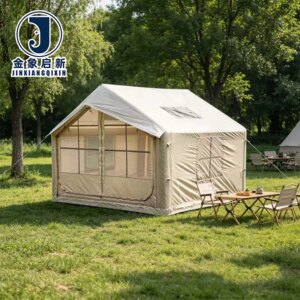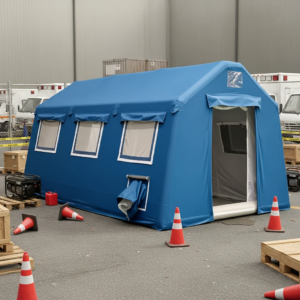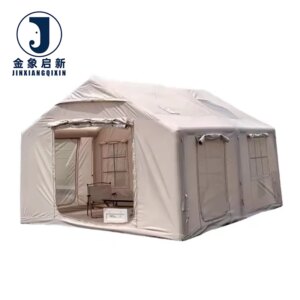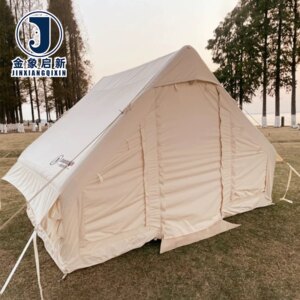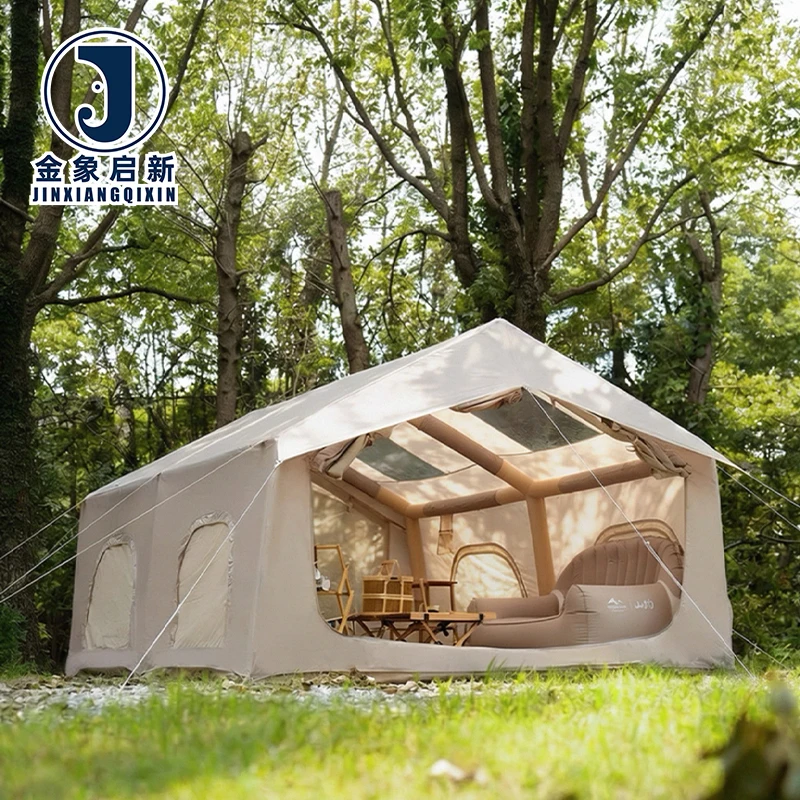
Rapid-deployment shelters — inflatable tent structures engineered for transport staging and emergency logistics, backed by in-process quality control across three production lines.
Technical Specifications
| Parameter | Value |
|---|---|
| Product Type | Inflatable Tent |
| Core Material | PVC Tarpaulin |
| Product Forms | Quick Automatic Opening, Four-Season Design, Single Layer Construction, Extended Type |
| Key Performance | Waterproof, Tear-Resistant, Foldable |
| UV Resistance | Available (test basis not stated in source — confirm grade required for your region) |
| Flame Retardant | Available upon request (grade not stated in source — confirm classification required for your site) |
| Anti-Static | Available upon request (standard not stated in source — confirm requirement before ordering) |
| Customization | OEM & ODM: sample customization, pattern printing, size adjustment, color customization |
| Sample Lead Time | 10–15 business days |
| Mass Production Lead Time | 45–60 days for customized orders |
| Standards & Certification | ISO 9001, ISO 14001, ISO 45001, CE |
Application Suitability
| Application | Exposure & Requirement |
|---|---|
| Temporary driver rest shelters at freight yards | Constant vehicle movement, dust, wind loading, repeated inflation cycles |
| Mobile equipment storage covers for fleet parking | Direct weather exposure, UV radiation, abrasion from loading operations |
| Emergency response staging tents on disaster relief routes | Rapid deployment requirement, uneven ground, unpredictable weather patterns |
| Logistics dispatch shelters at depot operations | High-traffic footfall, tie-down stress, daily temperature fluctuation |
Why "Quick Automatic Opening" Fails When the Fabric Cannot Hold Air Pressure
The inflation mechanism only works if the PVC tarpaulin maintains structural integrity under continuous internal pressure.
Fleet operators and emergency logistics contractors have experienced inflatable shelters that deploy quickly on day one but lose rigidity within hours. The root cause is rarely the air pump — it is the coated fabric failing to sustain the pressure differential across its surface. When the PVC tarpaulin base lacks consistent coating adhesion, micro-leaks develop along the heat-welded seams. The inflatable tent for truck and transport cover scenarios must resist not just puncture but sustained flex stress at every welded joint. [NEED_CITE: tensile and tear test methods for coated fabrics per ISO 1421]
Pressure Retention and Coating Adhesion Under Transport Conditions
Inflatable tent structures for logistics staging endure pressure cycles that static shelters never face. Each inflation and deflation stresses the PVC tarpaulin coating at the molecular level, testing the bond between the base fabric and the applied coating layer. Quick automatic opening systems generate rapid pressure changes that demand consistent coating weight distribution. When adhesion is uneven, the coating delaminates at stress concentration points — typically where panels join or where the structure meets the ground anchor line.
Sizing to the Operational Footprint, Not a Catalog Number
Most inflatable shelters are manufactured to generic dimensions that approximate common requirements. Transport operators know that a freight yard dispatch shelter must fit between parked trailers, while an emergency staging tent must cover specific equipment arrays. OEM size customization ensures the inflatable tent footprint matches the actual deployment zone. This eliminates the gap between shelter edge and cargo that wind exploits, and it prevents oversizing that creates slack surfaces vulnerable to water pooling and structural collapse during rain events.
Extended Type Configuration for Equipment-Dense Staging
Logistics and emergency response operations rarely need empty shelter space. The extended type configuration accommodates palletized goods, portable generators, and communication equipment within a single inflatable envelope. This consolidation reduces the number of separate structures required at a staging area, cutting deployment time and minimizing the total ground anchor points exposed to traffic and equipment movement. [NEED_CITE: wind load calculations for temporary inflatable structures]
Reading the Specification Sheet Beyond the GSM Number
GSM tells you the total weight of the coated fabric per square meter, but it does not reveal how that weight is distributed between base fabric and coating. A PVC tarpaulin with high GSM achieved through excessive coating thickness may resist puncture well but perform poorly in tear propagation — the coating cracks and the tear runs through the base weave. Conversely, a tightly woven base fabric with moderate coating weight delivers better tear resistance and flex endurance. For inflatable tent applications, the ratio of base fabric denier to coating thickness determines whether the structure withstands repeated inflation cycles without developing fatigue lines at fold points. Tear-resistant performance depends on this balance, not on total weight alone.
The Hidden Cost of Underspecified Inflatable Shelters for Fleet Operations
When an inflatable tent is specified purely on price and basic dimensions, failures surface at predictable points. Welded seams split under sustained air pressure because the heat-sealing temperature was calibrated for a different coating formulation. Fabric panels show visible colour variation between units in the same deployment, signalling inconsistent coating batches that also mean inconsistent UV protection across the fleet’s shelter inventory. Structures specified without confirmed flame retardant grades fail site safety inspections, forcing emergency replacement at the worst possible moment. [NEED_CITE: coating adhesion failure modes in PVC tarpaulin structures]
Why This Manufacturing Approach Matters for Inflatable Tent Procurement
Deep process control over coating weight and adhesion ensures that every meter of PVC tarpaulin used in your inflatable tent order carries the same structural properties — eliminating the weak-panel problem that causes field failures. Three full production lines and 36 sets of professional processing equipment support the volume consistency required when you are deploying shelters across multiple logistics sites simultaneously. A 10-person R&D team handles size customization, pattern printing, and sample development, delivering prototypes for your approval before mass production commits. Dedicated QA/QC at every production stage with 100% pre-shipment inspection means the inflatable tent for truck and transport cover you receive matches the specification sheet you approved — not a production-day approximation. ISO and CE certified manufacturing provides the compliance documentation your fleet operations or disaster relief contracts require.
Documentation & Verification
- Material specification sheet detailing PVC tarpaulin GSM, base fabric construction, and coating parameters for your inflatable tent order
- Test reports for UV resistance and flame retardant grades, referenced by batch number where applicable
- Pre-shipment inspection record with dimensional verification against your approved custom size drawing
- ISO 9001, ISO 14001, ISO 45001, and CE certification documentation supporting international fleet compliance
- Roll packing list and certificate of origin for customs clearance at destination port
Fabrication, Handling & Storage
- Heat-weld seams at manufacturer-recommended temperature settings matched to the PVC tarpaulin coating formulation to prevent delamination under inflation pressure
- Reinforce all anchor and tie-down attachment points with additional PVC tarpaulin patches to distribute load across the base fabric weave
- Store folded inflatable tent units in dry conditions away from direct sunlight to preserve coating flexibility between deployments
- Use mild detergent and soft brush for cleaning — avoid solvent-based products that degrade the PVC tarpaulin coating surface
- Inspect welded seams before each inflation cycle for early signs of coating separation or base fabric fatigue
Request a Specification Match for Your Deployment Scenario
Provide your intended application — freight yard shelter, emergency staging, or mobile equipment storage — along with the operational footprint dimensions you need covered. Specify any fire-retardant or anti-static classification your site safety requirements mandate. Confirm your colour reference and whether pattern printing or branding is required on the inflatable tent surface.
Frequently Asked Questions
Q: How is the inflatable tent sized to fit specific vehicle or trailer footprints rather than generic dimensions?
A: OEM size customization starts with your exact deployment measurements — distance between parked vehicles, equipment array dimensions, or staging zone boundaries. The R&D team produces a scaled drawing for your approval before cutting begins, ensuring the inflatable tent footprint eliminates coverage gaps without excess material that creates wind-catching slack surfaces.
Q: What UV and waterproof test evidence is provided with each batch shipment?
A: Each order ships with a material specification sheet and, where applicable, test reports for UV resistance referenced by batch number. UV treatment claims are backed by documented test results — confirm the specific performance level your regional climate and exposure duration require before placing your order.
Q: How are welded seams reinforced at flex points exposed to road and wind loading?
A: Heat-welded seams are the most common failure point in inflatable structures under sustained pressure. Our production process includes dedicated seam inspection at every stage, with 100% pre-shipment verification. Reinforcement patches are applied at high-stress junctions where inflation cycles concentrate flex load on the PVC tarpaulin coating bond.
Q: What is the sample development and lead time process for custom-sized inflatable tents?
A: Sample development takes 10–15 business days, allowing you to verify dimensions, opening mechanism performance, and material properties before full production. Mass production for customized inflatable tent orders requires 45–60 days. Submit your sizing and treatment requirements early to align delivery with your project timeline.