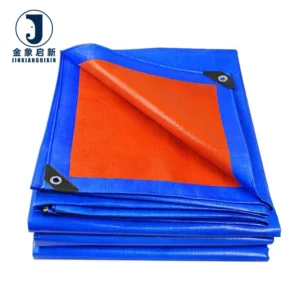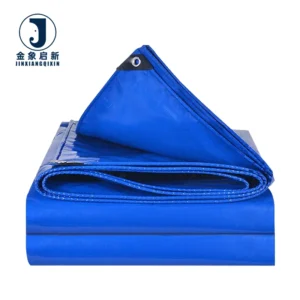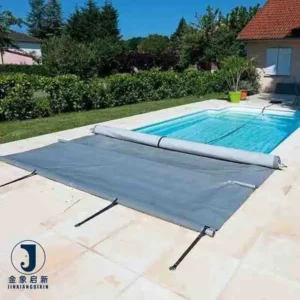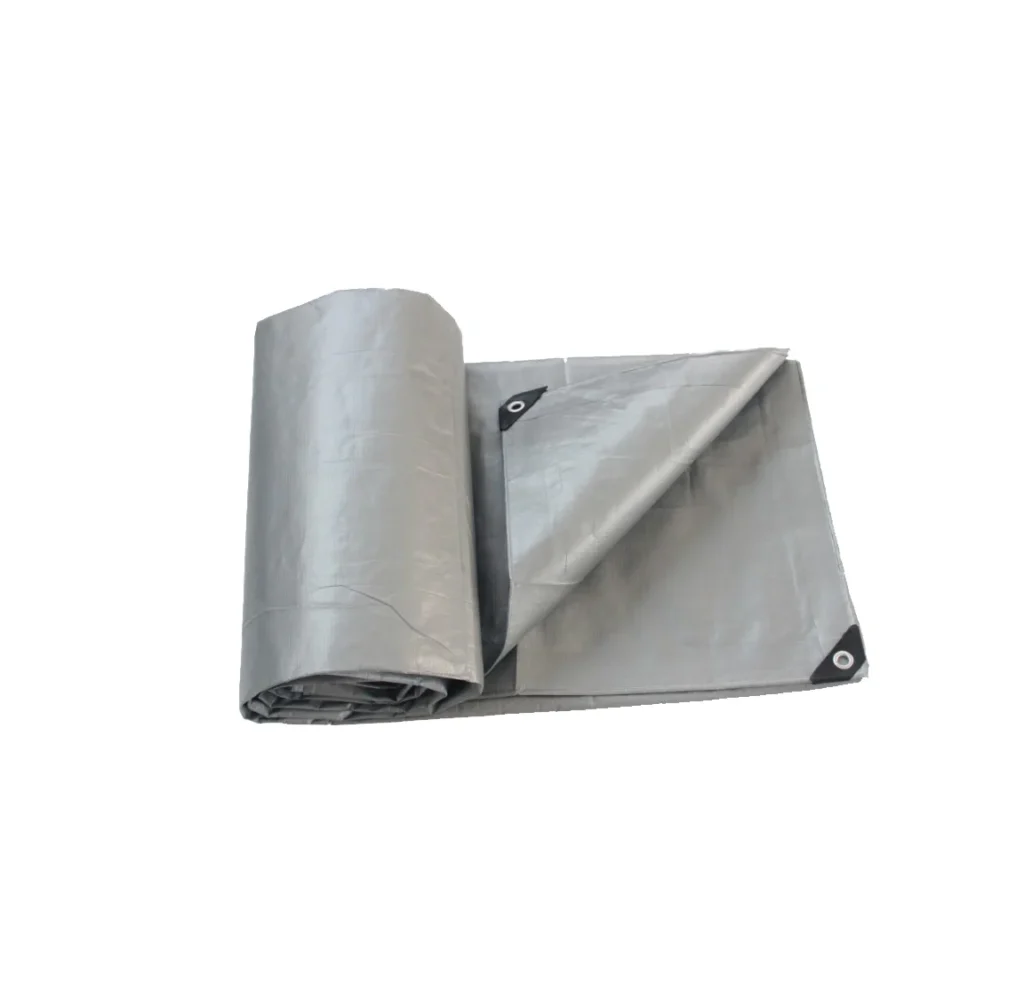
Proven Process Control — Nearly three decades focused on coated and laminated fabric means our PE tarpaulin production maintains consistent coating adhesion and weave density across every roll shipped for fleet and trailer applications.
Technical Specifications
| Parameter | Value |
|---|---|
| Product Type | PE Tarpaulin |
| Material | HDPE weaving with LDPE lamination on both sides |
| Weight Range | 50 g/m² ~ 220 g/m² (confirm the grade for your application) |
| Thickness | 0.2 mm – 0.4 mm / 8 mil – 16 mil |
| Weave Density Options | 6×6, 6×7, 7×7, 7×8, 8×8, 9×9, 8×10, 10×10, 12×12, 14×14, 14×16 |
| Roll Widths | 6 ft, 8 ft, 10 ft, 12 ft, 2 m, 4 m, 6 m |
| Roll Length | 100 yards, 100 meters, or custom |
| Finished Sizes | 2×2 m through 8×10 m (and imperial equivalents), custom dimensions available |
| Edge Reinforcement | PP rope in hem on all four edges |
| Eyelets | Galvanized, spaced every 3 ft or 1 m |
| Corner Reinforcement | Reinforced plastic corners |
| UV Treatment | Available — confirm UV test basis for your exposure requirements |
| Key Features | Waterproof, washable, tear resistant, mildew proof, anti-aging |
Application Suitability
| Application | Exposure & Requirement |
|---|---|
| Flatbed truck load covers | Highway-speed wind lift, tie-down abrasion at edges, rain and road spray |
| Curtain-side trailer fabric | Repeated flex cycles at fold points, contact with cargo edges, UV from parked exposure |
| Container top covers | Stacking friction, prolonged sun exposure at port yards, salt-laden coastal air |
| Boat and marine transport wraps | Water immersion during transit, UV reflection off water, tie-down strap tension |
| Construction equipment covers on transit | Abrasion from vibrating machinery components, gravel and debris impact |
Why Generic-Sized PE Tarpaulin Covers Fail on Moving Loads
A generic-size cover that does not match your trailer model leads to flapping, abrasion and load exposure at highway speed.
Model-specific cut dimensions eliminate the excess fabric that causes the most common PE tarpaulin failures on trucks and trailers.
When a PE Tarpaulin for truck and transport cover is cut to a standard rectangle rather than the actual trailer profile, the loose material flaps in the slipstream. That flapping concentrates stress at the eyelets and hem corners — the exact points where tie-down straps apply the highest tension. Over a long-haul route, the repeated flex cycle works the galvanized eyelets loose from the reinforced plastic corners, and water penetrates through the gaps [NEED_CITE: typical failure points for laminated tarpaulins under dynamic load conditions]. Fleet operators replacing covers often find the previous generic cover failed within months, not from fabric weakness, but from improper fitment creating uncontrolled movement against the cargo edges.
Trailer Fitment and the Tie-Down Interface
The connection between your PE tarpaulin cover and the trailer’s strap system determines real-world durability. Our reinforced hems with PP rope distribute tie-down load across the full edge rather than concentrating it at individual eyelet points. Galvanized eyelets placed at 3 ft or 1 m intervals align with standard trailer strap spacing, so each strap passes through or near an eyelet rather than pulling the unsupported fabric between anchor points. This spacing also accommodates different strap configurations across flatbed and curtain-side designs, reducing the need for field modifications after delivery.
Weave Density Selection for Route Conditions
Higher weave densities such as 12×12 or 14×14 provide the tear resistance needed for long-haul routes with sustained highway speeds and crosswind exposure. Lower densities like 8×8 or 8×10 suit short-distance distribution runs where the cover is removed and reinstalled frequently, and flexibility matters more than absolute tear strength. The HDPE weaving base provides structural integrity while the LDPE lamination on both sides delivers waterproofing — but the lamination cannot compensate for insufficient weave density when the load shifts under braking [NEED_CITE: relationship between weave density and tear propagation in laminated PE fabrics]. Matching density to route severity prevents premature failure without over-specifying material for lighter-duty runs.
How GSM and Weave Density Together Determine Cover Performance
GSM alone does not define how a PE tarpaulin performs on a truck. A 150 g/m² sheet at 8×8 weave behaves differently from a 150 g/m² sheet at 14×14 — the latter uses finer yarns packed more tightly, delivering higher tear resistance with the same total weight. For truck covers, the critical metric is how the fabric handles the concentrated stress at strap contact points and load edges, where higher mesh count distributes load across more yarn intersections. The LDPE lamination weight as a proportion of total GSM also affects flexibility: a heavier coating resists water better but stiffens the fabric, making it harder to fold and store on the trailer between uses. Thickness from 0.2 mm to 0.4 mm correlates with puncture resistance against sharp cargo edges, but the base fabric weave does more to stop a small puncture from propagating into a full tear. Selecting the right combination — confirming both GSM and weave density against your specific cargo and route — avoids paying for weight that does not contribute to the failure mode you are actually trying to prevent.
The Hidden Cost of Underspecified Transport Covers
Specifying a PE tarpaulin purely on price per roll or the lowest acceptable GSM creates downstream costs that do not appear on the purchase order. A cover that is too light for the route conditions fails at the hem reinforcement or eyelet pull-out points, leaving the load exposed mid-transit and forcing emergency re-wrapping at a roadside stop. Colour variation between rolls in the same shipment becomes visible once installed side by side on a fleet of trailers, creating an inconsistent appearance for branded vehicles [NEED_CITE: batch colour consistency standards for laminated tarpaulin production]. When the cover fails, the cargo damage claim typically exceeds the material cost of the cover itself — making the verification of actual GSM and weave density on arrival a critical receiving inspection step, not an optional one.
Why Source Your PE Transport Covers Through This Facility
Three full production lines and 36 sets of professional equipment support bulk roll and finished-cover orders with reliable on-time delivery for fleet-scale requirements.
A 10-person R&D team handles custom sizing matched to specific trailer models, colour matching for fleet branding, and sample development for new specifications before full production commitment.
Dedicated QA/QC at every production stage with 100% inspection before shipment catches GSM deviations and weave inconsistencies before they reach your dock.
Samples developed within days allow you to verify fabric hand, flexibility, and eyelet pull-out strength against your strap hardware before committing to a container order.
Deep process control over LDPE lamination weight and adhesion — built over nearly 30 years of coated and laminated fabric production — ensures consistent waterproofing across the full roll length.
Documentation & Verification
- Material specification sheet stating confirmed GSM, base fabric weave density, and LDPE coating weight per side
- UV treatment test documentation confirming the exposure rating applicable to your route climate
- Pre-shipment inspection record covering roll-to-roll colour consistency and eyelet spacing verification
- Roll packing list with individual roll weights for GSM reconciliation at receiving
- Certificate of origin and customs documentation for cross-border fleet procurement
- ISO and CE certificates covering the production management system
Fabrication, Handling & Storage
- Heat-seal PP rope into the hem at temperatures matched to the LDPE lamination melting point to avoid delamination at the reinforced edge
- Space galvanized eyelets at intervals matching your strap configuration to prevent unsupported fabric spans under tie-down tension
- Store PE tarpaulin rolls upright on end cores to prevent flat-spot creasing that weakens the LDPE coating layer
- Allow cold-stored rolls to reach ambient temperature before unrolling to avoid cracking the LDPE lamination at low temperatures
- Clean with mild detergent and soft brush — avoid solvent-based cleaners that attack the LDPE surface and reduce waterproofing
- Field-repair small punctures with LDPE-compatible adhesive patches applied to both laminated sides of the HDPE weave
What We Need to Specify Your PE Tarpaulin for Truck and Transport Cover
Provide the exact trailer make and model — or measured cover dimensions — so we can cut finished covers that match your vehicle profile without excess fabric creating flap-induced wear. Tell us your typical route conditions and tie-down strap spacing so we can recommend the appropriate weave density and eyelet interval. If you are ordering by the roll for in-house fabrication, confirm the width and length that minimises off-cuts against your production patterns. Let us know whether UV treatment documentation is required for your fleet compliance or insurance standards, and whether you need samples before committing to full production volume.
Frequently Asked Questions
Q: How do I measure my trailer for a correctly sized PE tarpaulin cover?
A: Measure the load bed length and width at the widest point, then add the drape distance from the bed edge down to where the cover should terminate on each side. Include any protrusions such as headboards or tail-gate hinges. We use these dimensions to pattern-cut the cover with PP rope hem reinforcement and place galvanized eyelets to match your existing strap anchor points, eliminating the excess material that causes flapping failures at speed.
Q: What GSM and weave density is recommended for long-haul truck covers?
A: For sustained highway-speed exposure with crosswind and tie-down tension, higher weave densities like 12×12 or 14×14 paired with a mid-to-upper GSM grade provide the tear resistance needed at strap contact points and load edges. The right balance depends on your specific cargo type and route severity. Request a sample in two candidate grades so your team can evaluate flexibility, weight, and eyelet pull-out resistance with your actual strap hardware.
Q: Can the eyelet spacing be customised to match my strap and tie-down layout?
A: Yes. Our standard spacing is every 3 ft or 1 m, but we can adjust intervals to align with your trailer’s strap anchor points. Correct alignment means each strap passes directly through or immediately adjacent to an eyelet, so the load transfers through the reinforced hem and galvanized eyelet rather than pulling on unsupported LDPE-laminated fabric between anchor points.
Q: What UV treatment level is available for sustained outdoor road exposure?
A: UV treatment is available for PE tarpaulin covers — the specific formulation and test basis should be confirmed against your expected exposure conditions and any fleet compliance requirements. We recommend providing your typical parking and route climate data so we can match the treatment to your actual UV exposure and supply supporting documentation with the shipment.
Q: How are roll orders packed and loaded for container shipment?
A: PE tarpaulin rolls are loaded by roll count and weight optimisation for the container type. A 20 ft container holds approximately 17 tons by roll, 12 tons by bale, or 9 tons by carton. A 40 ft HQ holds approximately 28 tons by bale or 20 tons by carton. We provide a detailed roll packing list with individual weights for GSM verification at your receiving dock.