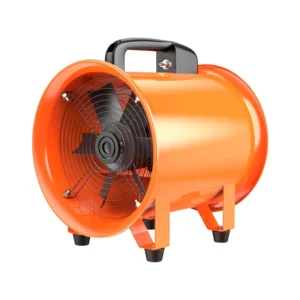
On-Demand Airflow Deployment — Eleven fan diameters from 200 mm to 900 mm ship from a single production line with dedicated pre-shipment motor and impeller inspection, letting you match duct size to confined-space volume without juggling multiple suppliers.
Technical Specifications
| Parameter | Value |
|---|---|
| Product Type | Handheld Axial Flow Fan (with Flexible Duct) |
| Size Options | 200 mm / 250 mm / 300 mm / 350 mm / 400 mm / 450 mm / 550 mm / 650 mm / 750 mm / 850 mm / 900 mm |
| Power Range | 250 W to 5500 W |
| Air Volume | 1300 m³/h to 28000 m³/h |
| Total Pressure | 140 Pa to 320 Pa |
| Voltage | 220 V / 380 V |
| Noise Level | 57 dB(A) to 88 dB(A) depending on model |
| Fan Type | Axial Flow, Handheld / Portable |
| Accessory | Flexible Duct Hose |
| RPM | 3000 RPM |
| Flame Retardant Grade | Grade not stated — confirm requirement with supplier |
| Anti-Static Certification | Not confirmed in source — request test documentation |
| Company Certifications | ISO, CE |
Application Suitability
| Application | Exposure & Requirement |
|---|---|
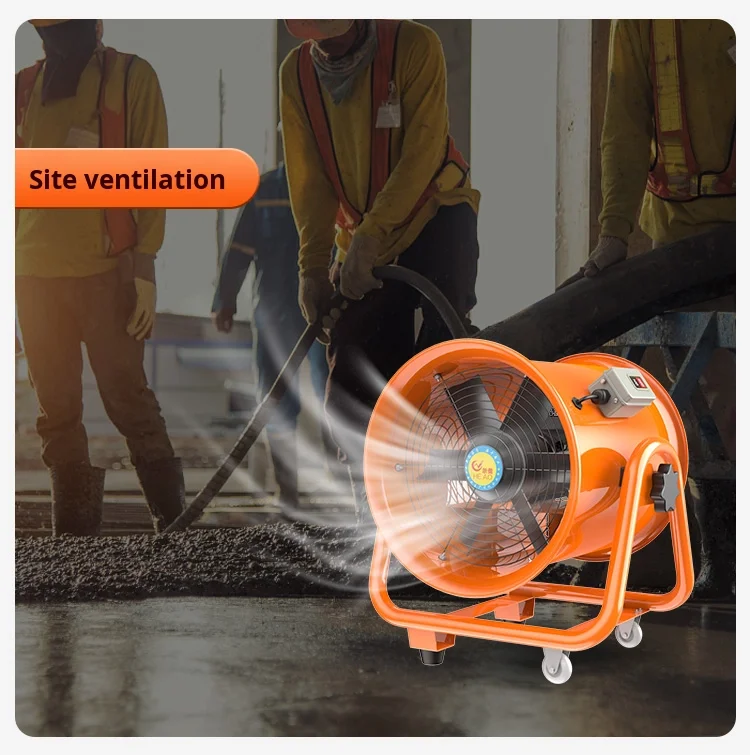
| Construction site exhaust | Dust-laden air, temporary duct runs across unfinished floors, generator or mains power availability |
| Confined space ventilation | Limited access openings, hazardous gas displacement, continuous duty until work permit closes |
| Factory floor fume extraction | Welding or coating vapour, sustained operation during shift hours, noise limits near assembly areas |
| Mining and tunnelling air movement | Long duct runs with pressure drop, high particulate load, site safety certification compliance |
Why Duct Pressure Drop Decides Fan Size Before Air Volume Does
Picking a portable axial flow fan by m³/h alone leads to undersized systems once duct friction is factored in.
A buyer specifying 5000 m³/h for a 30-metre flexible duct run may find the delivered airflow at the hood drops to a fraction of that figure because total pressure was not matched to duct length and bend count. Most jobsite ventilation failures trace back to this mismatch rather than motor quality. The fan must overcome static pressure losses across every metre of hose and each coupling joint [NEED_CITE: duct friction loss calculation methods for temporary ventilation per ASHRAE fundamentals]. When the Portable Axial Flow Fan for Construction and Mining Ventilation is selected using a system curve rather than a catalogue peak, the operator gets the airflow the safety plan actually demands.
Matching Duct Diameter to Fan Outlet Eliminates Connection Leaks
Flexible duct hose that is even slightly oversized relative to the fan outlet creates turbulence at the coupling, reducing effective airflow and increasing noise. The eleven available sizes from 200 mm to 900 mm allow exact diameter matching so the connection band seals cleanly. Secure clamping at the junction prevents hose separation under the vibration of continuous operation, which is the most common cause of unplanned downtime on active excavation sites.
Voltage Selection Across Single-Phase and Three-Phase Site Power
Construction sites frequently have 220 V single-phase supply at temporary distribution boards but 380 V three-phase at fixed plant rooms. The dual voltage support across the full size range means a single procurement can cover both scenarios without carrying separate fan inventories. Confirming the plug type and frequency against the destination country’s electrical standard before dispatch avoids costly rewiring on arrival [NEED_CITE: IEC 60309 plug configuration standards for industrial portable equipment].
Reading the Performance Curve Beyond Peak Airflow
Catalogue peak air volume is measured at zero static pressure — a condition that never exists once duct hose is attached. The total pressure range of 140 Pa to 320 Pa across models indicates where each fan size maintains useful airflow against system resistance. A 650 mm unit delivering 18000 m³/h at free air may sustain adequate flow at 250 Pa, while a smaller 400 mm model at the same rated volume would drop off sharply. Requesting the full fan curve for the quoted model lets the site engineer overlay the duct system curve and confirm operating point stability.
The Cost of Undersizing Duct Runs Against Fan Pressure
When total pressure is insufficient for the duct length, operators compensate by running fans at maximum output continuously, accelerating motor bearing wear and impeller imbalance. The result is mid-project equipment failure and an emergency replacement order at premium freight cost. Batch-to-batch consistency in impeller balance and motor winding specification prevents this drift across multiple units ordered for a single project [NEED_CITE: motor thermal class and continuous duty rating standards for portable ventilation equipment].
Why Sourcing Ventilation Equipment and Duct from One Supplier Reduces Integration Risk
Fan and duct procured separately often arrive with mismatched flange dimensions or incompatible coupling bands. Ordering the Portable Axial Flow Fan for Construction and Mining Ventilation as a paired system from a single source ensures outlet diameter, duct inner diameter, and clamp specification are verified before packing. Three full production lines and dedicated QA at every stage mean pre-shipment inspection covers the motor run test, impeller balance check, and duct connection integrity in one record. A ten-person R&D team handles non-standard voltage requests and site-specific duct routing questions during the sample development phase. Documentation including material specification, test reports, and certificates of origin ships with each consignment, removing the compliance gaps that stall site safety audits.
Documentation & Verification
- Fan performance curve stating air volume against static pressure for the quoted model size
- Motor thermal class and insulation rating certificate matching site continuous-duty requirements
- Flexible duct hose fire-retardant grade documentation where site safety plans mandate certification
- Pre-shipment inspection record covering motor run test, impeller balance, and duct coupling fit
- Voltage and plug configuration confirmation against destination country electrical standards
- Certificate of origin and customs documentation for cross-border shipments
Fabrication, Handling & Storage
- Verify flexible duct hose inner diameter matches the fan outlet size before securing the coupling band
- Store fans upright on pallets to prevent impeller shaft deflection during extended warehouse holding
- Coil flexible duct hose loosely to avoid permanent crease damage to the inner wire helix
- Confirm 220 V or 380 V wiring at the distribution board before energising any unit on site
- Inspect coupling band tension after the first hour of operation to account for initial bedding-in settlement
- Use manufacturer-recommended cleaning agents on fan housing to preserve surface finish and labelling legibility
Specifying for Your Project
State the duct run length, number of bends, and required airflow at the extraction point so the correct fan size and pressure class can be confirmed. Identify whether site power is 220 V single-phase or 380 V three-phase and specify the plug type for the destination market. If fire-retardant or anti-static duct hose is required by your safety plan, state the certification standard your site auditor will check against.
Frequently Asked Questions
Q: How do I select the right fan size for my workspace volume and duct length?
A: Calculate the required air changes per hour based on your workspace cubic volume, then add duct friction loss for every metre of hose and each bend. Match the result against the fan performance curve — not the peak catalogue figure — to confirm the operating point falls within the usable pressure range for your chosen model.
Q: Is the flexible duct hose fire-retardant certified?
A: Fire-retardant grade depends on the specific duct hose variant selected. If your site safety plan mandates a particular classification, state the required standard in your enquiry so matching documentation can be prepared and included with the pre-shipment inspection record before dispatch.
Q: Can the fan and duct system handle both supply and exhaust configurations?
A: The axial flow design supports both directions depending on installation orientation. For supply ventilation, position the fan at the fresh air intake end. For exhaust, place it at the extraction point. Confirm that the duct hose rating suits the air stream temperature and particulate load in your chosen configuration.
Q: What is the lead time for ordering multiple fan sizes in one shipment?
A: Lead time varies with the combination of sizes and any non-standard voltage or plug requirements. Request a quotation stating all model sizes, quantities, and destination electrical specifications so production scheduling and container loading can be planned as a single consolidated dispatch.
Q: Are noise-reducing attachments available for high-decibel models?
A: Larger models operating at higher pressure generate noise levels up to 88 dB(A). Silencer availability depends on the specific fan size and outlet configuration. Raise this requirement during the enquiry stage so compatible attenuation options can be evaluated alongside the duct hose specification.