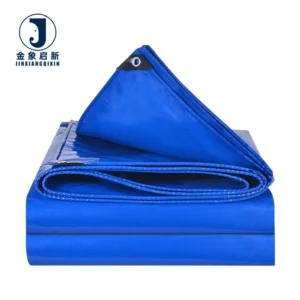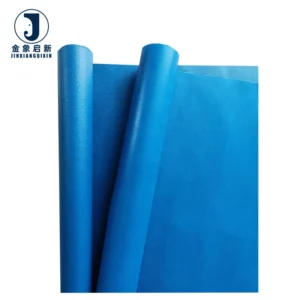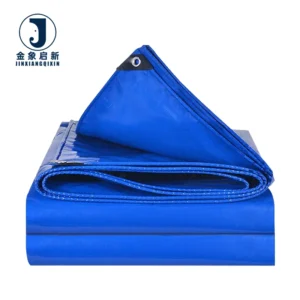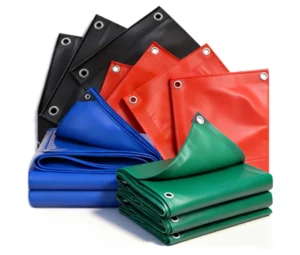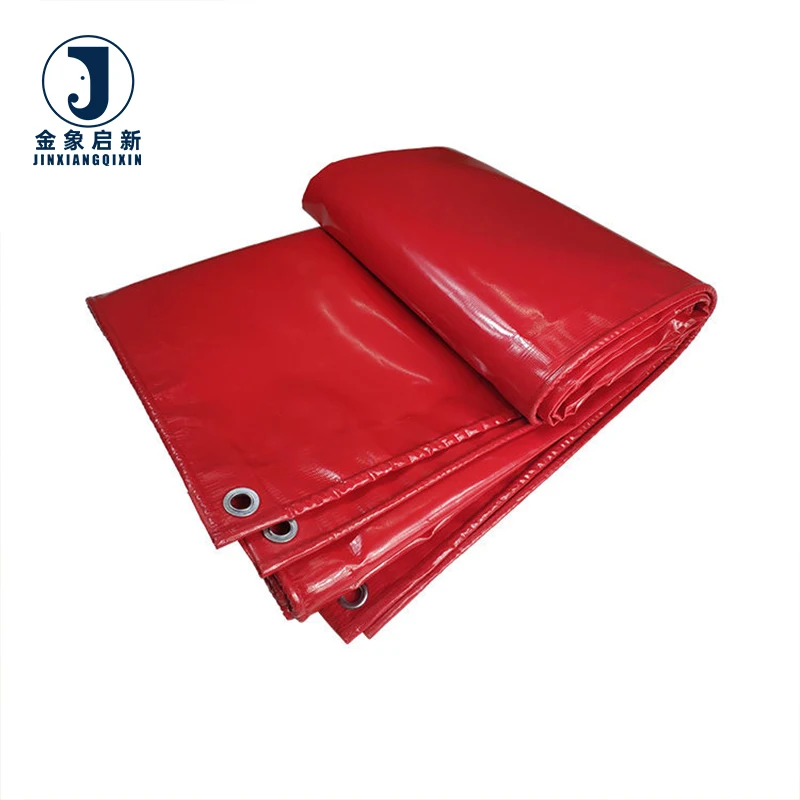
Model-specific pattern cutting — each cover is developed against the exact truck or trailer dimensions, with seam placement mapped to flex points where cargo movement concentrates stress.
Technical Specifications
Product Type | PVC Coated Tarpaulin
| Parameter | Value |
|---|---|
| Base Fabric Denier | 500D×840D, 500D×1000D, 1000D×1000D, 1000D×1300D, 1300D×1300D, 1000D×2000D |
| Mesh Count | 30×19, 20×20, 30×15 |
| Coating Material | PVC |
| Total Thickness | 0.29mm – 0.65mm (varies by grade) |
| Tensile Strength (Warp) | 1650 – 3900 N (test standard not stated) |
| Tensile Strength (Weft) | 1600 – 3500 N (test standard not stated) |
| Treatment | High frequency hot melt, hot air, sewing |
| Flame Retardant | Available in flame retardant grades (grade not stated) |
| UV Treatment | Anti-UV (test basis not stated) |
| Anti-Mildew | Yes |
| Key Features | Waterproof, flexible, heavy duty, self clean, heavy metal free |
| Edge & Hem Options | 3cm enlarged aluminum alloy buttonhole, 5mm thick rope without splicing, reinforced corners on all sides, high temperature heat sealed seamless edge wrapping |
| Printing | Printable, customized |
| Roll Width | 2m, 2.1m (varies by grade) |
| Brittle Temperature | ≤ -50 to -60°C |
| Softening Temperature | ≥ 80°C |
| Melting Point | 212°C |
Application Suitability
| Application | Exposure & Requirement |
|---|---|
| Truck side curtain | Constant flexing, road abrasion, UV exposure, wind load during high-speed transit |
| Top roof cover | Direct sun exposure, rain pooling, thermal cycling between day and night |
| Open-bed trailer cover | Point loading from cargo edges, tie-down tension at eyelets, vibration from road surface |
| Flatbed pallet cover | Abrasion at contact points with load edges, moisture ingress from below and above |
| Intermodal container cover | Stacking pressure, salt spray exposure during port transit, repeated lashing tension |
Why Generic-Sized Covers Fail at the Corners First
A cover cut to a blanket width leaves unsupported spans where the trailer geometry demands a shaped panel.
When a PVC coated tarpaulin for truck and transport is produced to a standard rectangle and stretched over a non-rectangular load bed, the material bridges gaps at corners and wheel arches. Those unsupported zones collect water, flap in crosswinds, and concentrate every road shock into a single fold line. Over time, the fold line becomes a crack line — and the seam nearest the gap fails before the field fabric shows any sign of wear. Pattern-cutting each cover to the specific vehicle model eliminates the bridging span entirely, so tension distributes across the full hem instead of pulling at one corner [NEED_CITE: field failure analysis of transport tarpaulin seam integrity].
Pattern Development Against Vehicle Geometry
Each cover begins as a measurement set taken from the specific truck or trailer model — not from a catalogue dimension. The pattern accounts for wheel arch clearance, hinge pin positions, and the exact location of tie-down rails. For a PVC coated tarpaulin for truck and transport, this means the eyelet spacing aligns with the vehicle’s existing anchor points rather than forcing the fleet to drill new holes. The 3cm enlarged aluminum alloy buttonhole is positioned where the load path requires it, and the reinforced corner panel is oriented to resist the dominant pull direction during transit.
Seam Placement at High-Stress Flex Zones
Road vibration and cargo shift create repeated bending at predictable locations along a moving cover. The high temperature heat sealed seamless edge wrapping is applied at these flex zones with controlled heat and pressure so the coating fuses into the base fabric rather than sitting on top as a separate layer. This fusion prevents the glue-line cracking that generic heat-seal equipment produces when the cover flexes thousands of times over a single haul [NEED_CITE: coated fabric weld integrity under cyclic flex loading].
Reading the Specification Beyond GSM
GSM alone does not determine whether a cover will survive a long-haul route. The base fabric denier and mesh count together define the skeleton that carries the tensile load — a 1000D×1000D weave at 20×20 density distributes force differently from a 500D×840D weave at 30×19, even if both grades are coated to a similar total weight. The coating method matters equally: high frequency hot melt bonding creates a different peel strength profile than solvent-based lamination, and that difference shows up first at the hem where the rope channel transfers tie-down force into the fabric body. Thickness ranges from 0.29mm for lighter side-curtain applications to 0.65mm for heavy-duty top-roof protection, and the correct grade depends on whether the cover faces abrasion, UV, or point loading as its primary stress.
What Happens When the Hem Rope Is Spliced
The 5mm thick rope without splicing runs the full length of each hem in one continuous strand. Spliced rope introduces a weak point where two cut ends meet inside the hem channel — and that weak point is exactly where road vibration concentrates its energy. Under sustained tension, the splice unravels, the rope pulls through the hem, and the eyelet tears out of the fabric. A continuous rope distributes the tie-down load evenly across the entire hem line, so no single eyelet carries more force than its neighbour. Combined with the reinforced corners on all sides, this construction prevents the progressive tear-out that forces fleets to replace covers months earlier than the base fabric would warrant.
Sourcing from a Producer with Process Control
Three full production lines and 36 sets of equipment allow this PVC coated tarpaulin for truck and transport to be manufactured in volumes that match fleet replacement cycles without sacrificing per-unit inspection. A dedicated 10-person R&D team develops the pattern, selects the base fabric grade, and produces an approval sample before any production run begins. Every roll undergoes 100% pre-shipment inspection against the material specification sheet, so the GSM, thickness, and coating adhesion arriving at the depot match what was agreed at the quotation stage. Documentation travels with each shipment — packing list, certificate of origin, and material specification sheet — so the receiving team can verify the delivery without guesswork.
Documentation & Verification
- Material specification sheet stating exact GSM, base fabric denier, and coating weight per roll
- Pre-shipment inspection record confirming weight and thickness match the approved sample
- Flame retardant and anti-UV test reports where applicable to the specified grade
- ISO and CE certificates covering the manufacturing facility and process
- Roll packing list with individual roll identification for traceability
- Certificate of origin and customs support documentation for import clearance
Fabrication, Handling & Storage
- Store rolls upright on pallets to prevent flat-spot deformation of the PVC coating surface
- Unroll at ambient temperature above 5°C to avoid coating cracking during deployment
- Use only PVC-compatible cleaners; solvent-based products will degrade the coating adhesion
- Heat-seal repair patches at the same temperature and pressure settings as the original seam
- Cut patterns with the warp direction aligned to the primary tension axis of the cover
- Avoid folding finished covers along the same crease line repeatedly during storage
Specifying Your Cover for Production
Provide the truck or trailer model, the exact dimensions required, and the primary exposure conditions the cover will face on route. Indicate whether flame retardant or anti-UV certification is needed for your market, and confirm the tie-down system type so eyelet spacing can be matched. Sample approval is available before production begins, and the R&D team will develop a pattern based on your vehicle geometry for sign-off.
Frequently Asked Questions
Q: How do you determine the correct cover dimensions for a specific truck model?
A: The pattern is developed from measurements of the actual vehicle — including wheel arch positions, hinge points, and tie-down rail locations — rather than from generic catalogue sizes. A sample or detailed drawing is produced for approval before any production run begins, ensuring the cover fits the specific trailer geometry without unsupported spans at corners.
Q: What reinforcement is applied at points where the cover flexes during transit?
A: High temperature heat sealed seamless edge wrapping is applied at identified flex zones, fusing the PVC coating directly into the base fabric rather than relying on adhesive alone. Reinforced corner panels are oriented to resist multi-directional pull, and the continuous 5mm rope inside the hem distributes tension evenly across the full tie-down line.
Q: How is colour consistency maintained across multiple covers ordered for the same fleet?
A: All rolls within a single production batch are coated from the same colour master batch, and each roll is inspected against the approved colour reference before dispatch. Pre-shipment inspection records document the colour match, so covers installed side by side on a fleet will not show visible variation once fitted.
Q: What GSM grades are suitable for side curtain versus top roof applications?
A: Side curtains experience constant flexing and abrasion but less direct UV and water pooling, so mid-range grades are often specified. Top roof covers face sustained sun exposure and rain pooling, so heavier grades with higher thickness are typically selected. The final choice depends on the specific route conditions and expected service exposure.
Q: What documentation is provided with each shipment?
A: Each dispatch includes a material specification sheet, pre-shipment inspection record, roll packing list, certificate of origin, and customs support documents. Where flame retardant or anti-UV treatment is specified, the corresponding test report is supplied alongside the shipment for compliance verification.