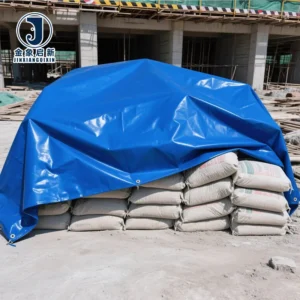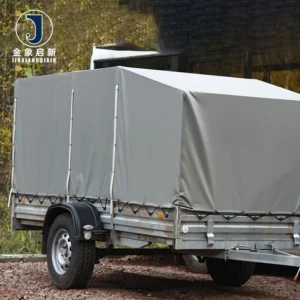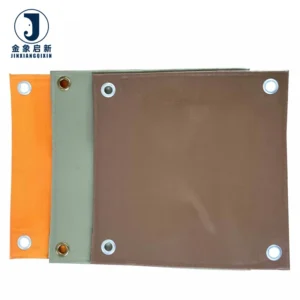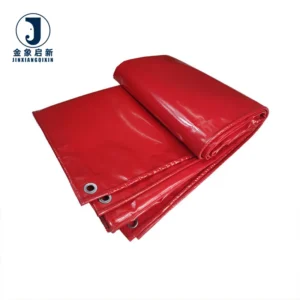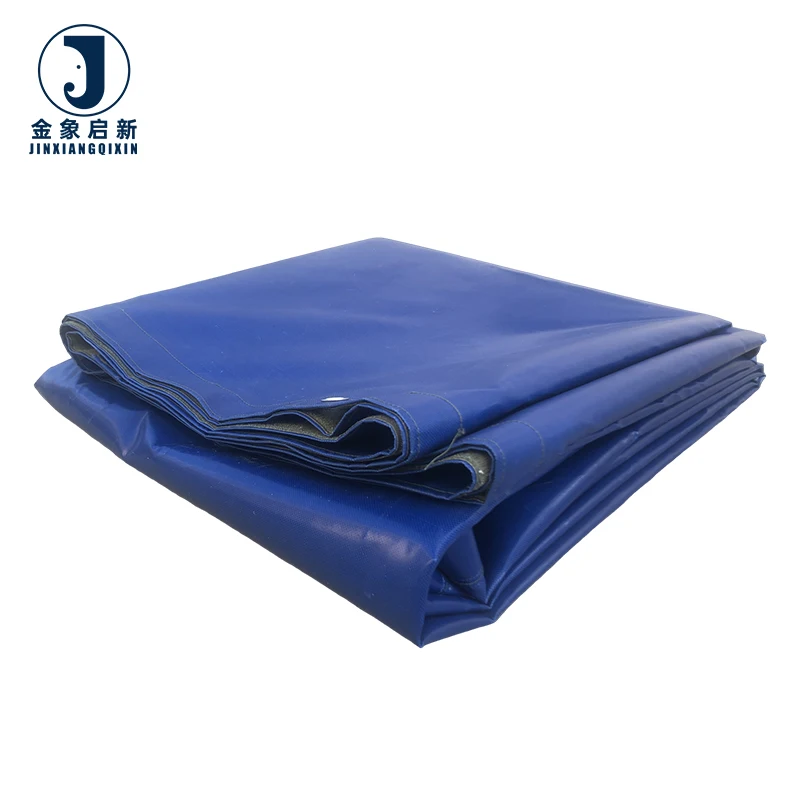
Precision Coating Control — three dedicated production lines maintain tight GSM tolerance across every PVC Coated Tarpaulin Roll, verified roll-by-roll before dispatch to fleet operators.
Technical Specifications
| Parameter | Value |
|---|---|
| Product Type | PVC Coated Tarpaulin |
| Material | 100% high toughness polyester yarn with PVC coating |
| Manufacturing Technology | Lamination technology and hot melt coating technology |
| Weight Range (Medium) | 400-500 g/m² |
| Weight Range (Heavy-duty) | 700-1000 g/m² |
| Weight Range (Super Heavy) | 1100-1500 g/m² |
| Thickness (Medium) | 0.35-0.45 mm |
| Thickness (Heavy-duty) | 0.70-1.0 mm |
| Thickness (Super Heavy) | 1.2-1.5 mm |
| Base Fabric Denier (Medium) | 500D |
| Base Fabric Denier (Heavy-duty) | 1000D |
| Base Fabric Denier (Super Heavy) | 500D-2000D |
| Tensile Strength (Medium – Warp/Weft) | 1500-2000 / 1200-1800 N/5cm |
| Tensile Strength (Heavy-duty – Warp/Weft) | 2000-2500 / 1800-2200 N/5cm |
| Tensile Strength (Super Heavy – Warp/Weft) | 2500-3000 / 2200-2800 N/5cm |
| Treatment Options | Flame retardant, anti-static, cold resistant, mold proof, UV resistant (confirm the grade required for your market) |
| Welding Tear Strength | Excellent |
| Weather Resistance | 3-5 years outdoor service life |
| Available Colors | Blue, Blue/Orange, Green, Grey, Black, Clear, Grey/Green, Orange, or custom |
Application Suitability
| Application | Exposure & Requirement |
|---|---|
| Truck and trailer side curtain | Constant flexing at load points, highway-speed wind load, road spray and abrasion |
| Full-size pickup and farm machinery cover | Prolonged UV exposure, rain pooling, repeated folding and unfolding |
| Heavy truck tarpaulin for construction transport | Punctures from shifting loads, dust and debris impact, tie-down tension |
| Industrial pipe canopy and protective cloth | Chemical splash, thermal variation, prolonged outdoor weathering |
| Tensioned structural fabric | Continuous biaxial stress, wind uplift, long-term weather resistance |
Why Welded Seams Fail Before the Fabric Does on Truck Covers
Hot melt coating technology produces the adhesive bond that keeps the weld intact through thousands of flex cycles.
Fleet operators who have replaced side curtains prematurely often find the failure line runs exactly along the welded seam, not through the body of the PVC coated tarpaulin for truck and transport. The fabric itself still has tensile capacity left, but the coating adhesion at the joint gave way under repeated flexing at highway speed. When lamination bonding is weak or coating weight is inconsistent across the roll, the heat-activated weld zone becomes the first point of degradation. [NEED_CITE: tensile and tear test methods for coated fabrics per ISO 1421]
Coating Adhesion and Its Role in Curtain Longevity
The hot melt coating process used on this PVC coated tarpaulin for truck and transport forces PVC into the weave structure of the high-tenacity polyester base, creating a mechanical lock that goes beyond surface bonding. This matters most at the weld line, where two fabric panels overlap and heat fuses the coating layers together. If the base coating has poor adhesion to the yarn, the weld inherits that weakness and peels apart under flex load — a failure mode that does not show up in a standard tensile test but appears within weeks on the road.
Tensile Capacity Across Three Grade Tiers
Selecting the correct weight tier — medium at 400-500 g/m², heavy-duty at 700-1000 g/m², or super heavy at 1100-1500 g/m² — determines how much biaxial stress the fabric absorbs before the weave distorts. The super heavy tier, with warp tensile strength reaching 2500-3000 N/5cm, is engineered for trailer side curtains that face sustained wind pressure at highway speeds. [NEED_CITE: wind load testing standards for transport curtain fabrics] Choosing a medium grade for this application would mean the base fabric approaches its elastic limit under normal operating conditions, accelerating fatigue at the eyelet and hem lines.
Reading the Specifications Beyond GSM
GSM alone tells you how much material is present, not how that material is structured. A 650 g/m² fabric woven from 500D yarn will behave very differently under load than a 650 g/m² fabric built on a 1000D base — the heavier denier yarns resist tear propagation by distributing force across more filament bundles before a single yarn rupture cascades into a full rip. The coating method further changes performance: lamination technology bonds a pre-formed PVC film to the scrim, while hot melt coating penetrates the weave, and each approach produces different peel strength values that directly affect how well heat-welded seams hold. Thickness, ranging from 0.35 mm on the medium tier to 1.5 mm on super heavy, correlates with abrasion resistance at contact points where the curtain rubs against load edges and tie-down straps.
The Cost of Ordering the Wrong Grade for Your Fleet
A transport company that specifies PVC coated tarpaulin for truck and transport by price per kilogram rather than by application stress will inevitably face premature replacement costs. A medium-weight cover installed on a long-haul trailer side curtain flexes beyond its fatigue threshold within the first season, with cracking appearing first at the welded seams and then propagating along the weft. Similarly, specifying a flame retardant grade without confirming the exact classification required by the destination market can result in an entire shipment being rejected at compliance inspection, forcing a complete reorder. [NEED_CITE: fire classification requirements for transport and building material fabrics]
What This Supplier Brings to Fleet Fabric Procurement
Three full production lines and 36 sets of professional equipment support bulk roll orders with consistent on-time dispatch, so fleet operators can plan curtain fabrication without supply uncertainty. A 10-person R&D team develops custom colour matches and cut sizes within days, eliminating the long sampling cycles that delay fleet-wide side curtain rollouts. Dedicated QA/QC runs at every stage, with 100% pre-shipment inspection ensuring that each roll of PVC coated tarpaulin meets the GSM, colour, and coating adhesion standards stated on the specification sheet. Nearly 30 years of focused coated fabric production means process parameters for hot melt coating and lamination are refined from long production history rather than trial and error. ISO and CE certified production provides the documentation framework that fleet compliance teams require for material traceability.
Documentation & Verification
- Material specification sheet confirming GSM, base fabric denier, and coating method for each roll
- Test reports for UV resistance and flame retardant grades where applicable, stating the grade achieved
- Pre-shipment inspection record covering 100% of rolls against colour, weight, and surface quality criteria
- Roll packing list with individual roll IDs for traceability through fabrication and installation
- Certificate of origin and customs documentation for cross-border fleet supply chains
Fabrication, Handling & Storage
- Hot melt coating allows standard hot-air welding at temperatures matched to the 0.35-1.5 mm thickness range
- Reinforce eyelet zones with extra patches where tie-down loads concentrate on the 1000D heavy-duty base
- Store rolls horizontally on pallets to prevent permanent creasing in the 1100-1500 g/m² super heavy grade
- Allow cold-resistant treated rolls to acclimatise before unrolling in low-temperature workshop environments
- Use mild detergent only on the PVC surface to preserve the coating finish and colour fastness
- Plan cut patterns across the roll width to minimise offcuts on wide-format side curtain panels
Specify Your Fleet Cover Requirements
To receive an accurate specification recommendation and sample, share your trailer model dimensions, the operating climate your fleet encounters, and the annual roll volume you expect to consume. If your market requires specific fire safety or anti-static compliance for transport covers, state the standard reference so the correct treatment grade can be confirmed before production begins. Indicate whether you need full rolls for in-house fabrication or pre-cut panels with welded hems and eyelets ready for installation.
Frequently Asked Questions
Q: How do I verify the GSM of truck tarpaulin rolls matches what was quoted?
A: Every roll ships with a material specification sheet stating the exact GSM, base fabric denier, and coating weight. Our pre-shipment inspection record documents measured values for each roll. If your receiving team requires independent verification, we can arrange third-party weighing and provide a signed inspection certificate alongside the packing list.
Q: Which flame retardant grades are available and what standards do they meet?
A: Flame retardant treatment is available across the medium, heavy-duty, and super heavy weight tiers. The specific grade depends on your destination market’s transport or building compliance requirements. Share the standard reference your compliance team needs — such as DIN 4102, NFPA 701, or a local equivalent — and we will confirm the achievable classification with a test report before bulk production.
Q: Should I specify welded seams or stitched seams for trailer curtain flex points?
A: For side curtain zones that flex continuously during transit, welded seams are strongly recommended over stitched construction. The hot melt coating on this PVC coated tarpaulin for truck and transport allows heat-welded joints that maintain coating continuity, whereas stitched seams create needle holes that become water ingress and tear propagation points under repeated bending stress.
Q: What lead time and minimum apply to custom cut sizes for specific trailer models?
A: Custom cut sizes are developed through a sampling phase first — our R&D team produces dimensioned samples within days for your fitment approval. Once the sample is signed off, bulk production lead time depends on order volume and whether custom colour matching is involved. Share your trailer model list and annual cover quantity for a precise schedule.
Q: How is batch colour consistency maintained across multiple rolls for fleet installation?
A: Colour matching is controlled at the coating stage using reference standards for each production run. Rolls destined for the same fleet order are produced in a single batch and inspected side by side before dispatch to confirm visual consistency. If your fleet rollout spans multiple orders over time, we retain the colour formulation on file to maintain continuity across production runs.