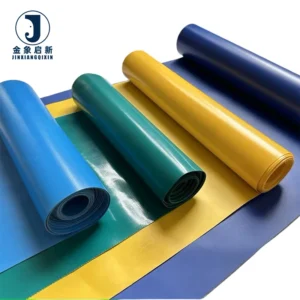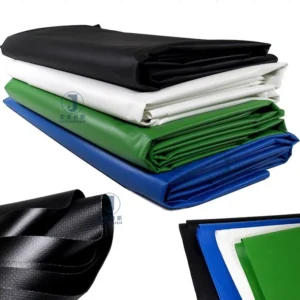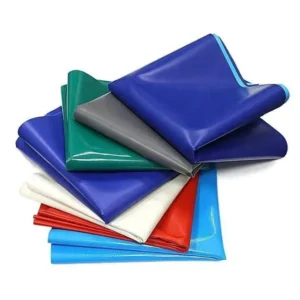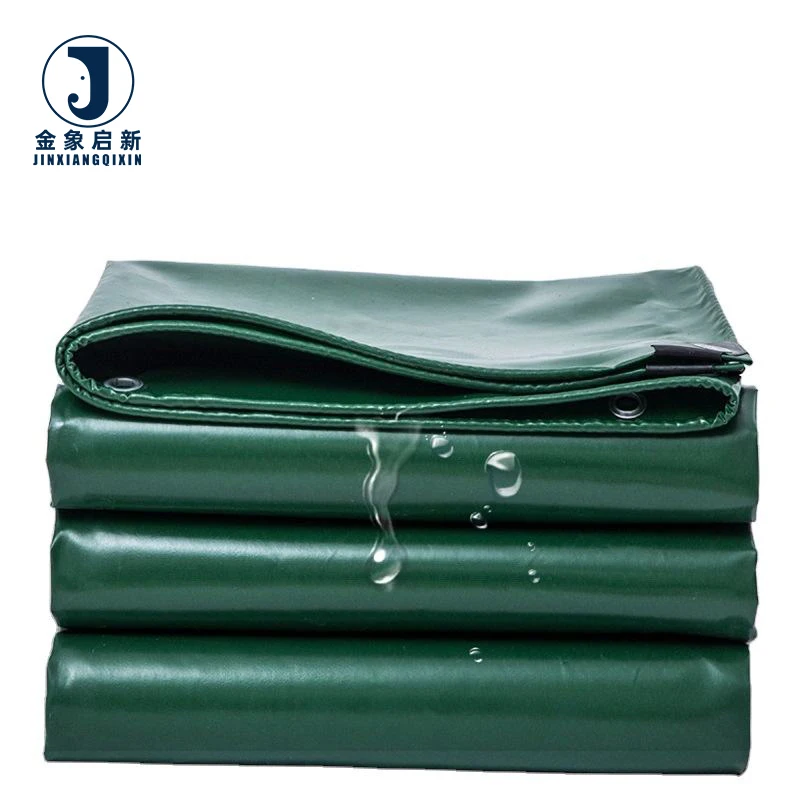
Process Control Over Coating Weight — Each roll undergoes dedicated QA/QC at every production stage with 100% inspection before shipment to confirm GSM and coating adhesion match the order specification.
Technical Specifications
| Parameter | Value |
|---|---|
| Product Type | PVC Coated Tarpaulin Roll |
| Material | PVC + High-strength polyester mesh fabric |
| Coating Technology | Laminated & Hot-melt Coating |
| Weight Options | 350gsm / 420gsm / 500gsm / 550gsm / 600gsm / 750gsm |
| Thickness Options | 0.32mm / 0.35mm / 0.4mm / 0.45mm / 0.5mm / 0.65mm |
| Roll Size | 2m width × 75m length / 2.1m width × 50m length |
| Surface Finish | Glossy or Matt |
| Color Options | Blue / Red / Yellow / Light Blue / Grey (Customized) |
| Key Features | Waterproof, Cold Crack Resistance, Anti-Mildew, Anti-Static treatment (standard not stated), UV Resistance (test basis not stated) |
| Standards | ISO, CE |
Application Suitability
| Application | Exposure & Requirement |
|---|---|
| Truck and trailer side curtains | Constant flexing at load points, road vibration, weather and abrasion exposure |
| Flatbed load covers | Direct sunlight, rain ingress, tie-down strap friction at reinforced hems |
| Tipping trailer enclosures | Repeated deployment and stowage, material folding stress, bulk load contact |
| Curtain-side new trailer builds | Dimensional accuracy per model, weld seam integrity at panel joins |
| Fleet replacement covers | Matched color across panels, consistent GSM for uniform tension across the trailer |
Why Truck Covers Fail at the Weld Before the Fabric Gives
PVC tarpaulin for truck and trailer cover must deliver tearing strength at the weld line, not just across the body of the fabric.
Fleet operators replacing failed covers commonly find the split runs along a heat-seamed join rather than through the coated fabric itself. The flex zone — where the side curtain bends around the load or meets the tie-down rail — concentrates stress on every journey. When the coating adhesion to the base fabric is weak, or the polyester mesh lacks sufficient tear propagation resistance, the weld becomes the first point of failure. [NEED_CITE: tensile and tear test methods for coated fabrics per ISO 1421] This pattern repeats across flatbed, curtain-side, and tipping trailer applications where the cover is under constant mechanical load.
Coating Adhesion and the Polyester Mesh Base
The hot-melt coating process bonds PVC to a high-strength polyester mesh fabric, creating a composite where the coating and the base yarns share load transfer. Laminated technology produces a distinct coating layer on each face, while hot-melt coating drives the PVC into the mesh structure for deeper penetration. For truck and trailer applications, this adhesion determines whether a welded seam holds when the curtain flexes around a protruding load or absorbs lateral wind pressure at highway speed.
Weld Performance Across the GSM Range
The available weight options — from 350gsm through 750gsm — serve different positions on a trailer. Lighter grades suit temporary or internal dividers where flex cycles are moderate. Heavier grades serve side curtains and full load enclosures where the PVC tarpaulin for truck and trailer cover must resist tearing at every heat-seamed panel join. The high-strength polyester mesh provides the tear propagation resistance that keeps a small nick from running into a full-length split along a weld line.
Surface Finish and Color Consistency for Fleet Identity
Glossy and matt surface options serve different operational needs. Glossy finishes shed road grime and wash clean more readily in depot environments. Matt surfaces reduce glare and accept printed fleet branding with strong ink adhesion. Across either finish, color consistency roll-to-roll matters when panels are installed side by side on a curtain-side trailer — any shade variation is immediately visible once the cover is tensioned in the rail. [NEED_CITE: color fastness testing methods for coated textile panels]
Reading GSM in the Context of Base Fabric Density
Weight alone does not define strength. Two rolls at the same GSM can perform differently if one uses a denser polyester mesh with finer yarns and the other uses a heavier yarn at lower thread count. The denser weave distributes load across more yarn intersections, improving tear propagation resistance. Coating weight also plays a role — a heavier PVC coat adds to GSM but does not necessarily increase tensile performance if the base mesh is light. This is why material specification sheets list base fabric construction alongside total weight.
The Cost of Ordering on GSM Without Verifying Construction
When a truck cover is specified only by weight, the base fabric density and coating method may not match what the application demands. A side curtain that flexes thousands of times per journey needs high adhesion between coating and mesh — without it, delamination starts at the weld zone and spreads under vibration. Covers supplied without pre-shipment inspection records leave the buyer to discover shortfalls only after installation, when the first seam opens on a loaded trailer. [NEED_CITE: common failure modes in PVC coated truck curtain fabrics]
Why Fleet Operators Source Coated Fabric Through Verified Production Lines
Three full production lines and 36 sets of professional equipment support bulk roll output with consistent coating weight across the production run. The 10-person R&D team handles custom sizing cut to specific trailer model dimensions rather than generic panel sizes. Every roll passes dedicated QA/QC inspection at each production stage, with 100% pre-shipment checking before dispatch. PVC tarpaulin for truck and trailer cover orders ship with material specification sheets stating GSM, base fabric, and coating details. Samples are developed within days when custom widths, colors, or finishes are required for fleet trials.
Documentation & Verification
- Material specification sheet stating GSM, base fabric construction, and coating method for each roll
- Pre-shipment inspection record confirming weight and coating match the purchase order
- Test report for UV and flame-retardant grades available where applicable — confirm the grade required for your market
- Roll packing list with roll count, dimensions, and net weight per container load
- Certificate of origin and customs documentation for cross-border fleet supply chains
Fabrication, Handling & Storage
- Heat-seam temperature and dwell time must match the PVC coating method — laminated and hot-melt coatings respond differently at the weld interface
- Cut panels to trailer model dimensions before welding to avoid on-site adjustment that stresses freshly joined seams
- Store rolls upright on pallets to prevent flat-spot deformation that shows as a visible line once the curtain is tensioned
- Avoid dragging glossy-finish rolls across concrete surfaces to prevent coating scuff that compromises waterproof integrity
- Deploy cold crack resistant grades for winter fleet operations — allow the material to warm before unrolling in freezing conditions
- Use mild detergent for cleaning — aggressive solvents can degrade the PVC coating surface over repeated wash cycles
What We Need to Quote Your Truck Cover Requirement
Provide the trailer model or exact panel dimensions, the operating climate range, and whether you need glossy or matt finish for your fleet. Specify the PVC tarpaulin for truck and trailer cover weight grade you require and whether flame-retardant or anti-static certification applies in your market. If you need color matching to an existing fleet, share the reference or request a sample panel before committing to roll production.
Frequently Asked Questions
Q: How is the GSM verified before my truck cover rolls are dispatched?
A: Every roll undergoes 100% pre-shipment inspection with a documented record confirming weight and coating thickness against your order specification. The material specification sheet shipped with your order states the measured GSM, base fabric construction, and coating method for traceability.
Q: Can the tarpaulin be cut to fit my specific trailer model?
A: Yes. Custom sizing is cut to your exact trailer model dimensions rather than generic panel sizes. The R&D team develops samples within days for fitment trials, and production follows only after your sample approval to ensure the PVC tarpaulin for truck and trailer cover panels match your rail and buckle hardware.
Q: How do you ensure color consistency across multiple rolls for one fleet order?
A: Roll-to-roll color consistency is verified before dispatch so that panels installed side by side on a curtain-side trailer show no visible shade variation. This applies across both glossy and matt finish options and all standard and customized color selections.
Q: What welding parameters work best with this PVC coated fabric?
A: Weld temperature and dwell settings depend on whether the roll uses laminated or hot-melt coating — each responds differently at the seam interface. We recommend running test welds on sample material first, and our technical team can advise on settings based on your specific heat-seaming equipment.
Q: Are flame-retardant or anti-static grades available for truck covers?
A: These treatments are available — confirm the grade required for your market and application. Where applicable, a test report is provided with your shipment. Contact our team with your regulatory requirements so we can match the correct grade to your fleet specification before production.