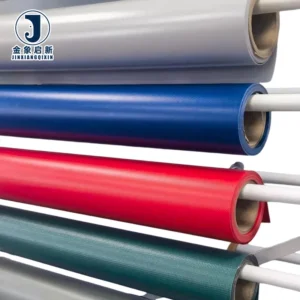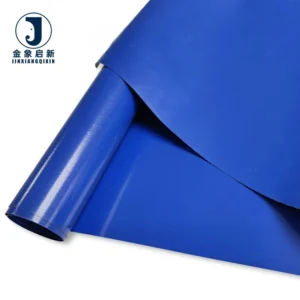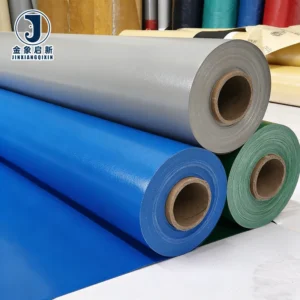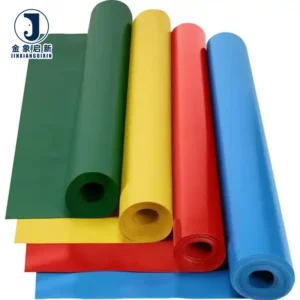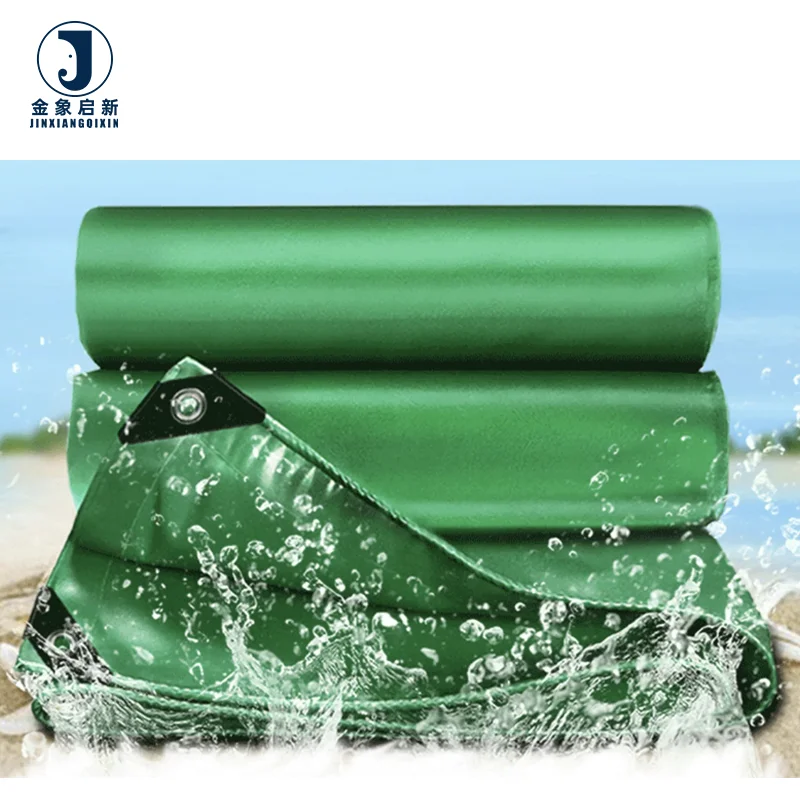
Coating adhesion control — Three production lines with hot-melt and laminated coating processes ensure the PVC bond to polyester mesh survives repeated load flexing at welded seams without delamination.
Technical Specifications
| Parameter | Value |
|---|---|
| Product Type | PVC Tarpaulin Roll |
| Base Material | High-tenacity polyester yarn |
| Coating Material | PVC |
| Coating Technology | Laminated technology & Hot-melt coating technology |
| Weight Range (Family) | 250GSM to 1000GSM (confirm grade for your application) |
| Thickness Range (Family) | 0.32mm to 0.65mm (corresponds to selected grade — confirm at inquiry) |
| Base Fabric Denier Options | 500D×500D, 500D×1000D, 840D×840D, 1000D×1000D, 2000D×2000D (varies by grade) |
| Roll Width Options | 2m / 2.1m |
| Roll Length Options | 75m (for 2m width) / 50m (for 2.1m width) |
| Color Options | Blue, Red, Yellow, Light Blue, Grey (Custom colors available) |
| Waterproof | Yes |
| Anti-Mildew | Yes |
| Cold Crack Resistance | Yes |
| Anti-UV Treatment | Claimed — test basis not stated in source; confirm test standard for your market |
| Anti-Static Treatment | Claimed — surface resistance or standard not stated; confirm requirement |
| Flame Retardant | Available in flame retardant grades — confirm the grade required for your market |
| Standards & Certification | ISO, CE |
Application Suitability
| Application | Exposure & Requirement |
|---|---|
| Flatbed truck covers | Constant road vibration, UV exposure, tie-down strap abrasion, wind uplift on highway speeds |
| Curtain-side trailers | Repeated flexing at fold points, lateral load pressure, daily roll-up and deployment stress |
| Goods yard and logistics hub covers | Prolonged sun exposure, pooling water, forklift contact, stacked load compression |
| Cargo ship deck covers | Salt spray, heavy weather, extended UV and moisture immersion |
| Push and pull retractable tents | Frame abrasion, frequent folding and unfolding, seasonal storage and redeployment |
Why a Generic-Size Cover Fails Where a Moving Load Flexes Most
A truck cover cut to standard dimensions concentrates stress at the wrong points on a specific trailer model.
When a flatbed or curtain-side operator installs a cover that is even slightly oversized or undersized for the actual trailer dimensions, the excess fabric billows under highway wind or the undersized cover pulls tight at the eyelets. Either scenario accelerates wear at the hem and the welded seams — precisely where the load flexes during transit. Fleet operators replacing covers multiple times per year often discover the issue is not the fabric weight itself but the fitment and seam construction. Generic covers shift the failure point away from the material body and onto the finishing details [NEED_CITE: tensile and tear test methods for coated fabrics per ISO 1421]. A PVC Tarpaulin Roll for Truck Cover aftermarket supplier that cuts to exact vehicle model dimensions eliminates this mismatch at the source.
Model-Specific Fitment for Fleet and Trailer Covers
Every trailer model has a different bed length, side rail height, and tie-down configuration. A PVC Tarpaulin Roll for Truck Cover supplied in standard widths of 2m or 2.1m gives fabricators and fleet maintenance teams the material to cut and weld covers that match the exact trailer model in service. This removes the gaps at the edges where wind gets underneath and the tension points where an ill-fitting cover tears at the eyelet line during a long haul.
Coating Adhesion at Welded Seams Under Road Vibration
The point where a truck cover fails first is rarely the middle of the fabric — it is the welded seam where the load flexes during braking and cornering. Laminated and hot-melt coating technologies both bond the PVC layer to the polyester mesh, but the adhesion strength differs between the two methods. For side curtain applications where the fabric is deployed and retracted daily, hot-melt coating delivers the peel strength needed to resist delamination across repeated flex cycles [NEED_CITE: DIN 53354 peel strength test for coated fabrics].
Reading the Denier and Mesh Count Beyond GSM
A 650GSM tarpaulin made from 1000D×1000D yarn in a 20×20 mesh will behave differently under tension than a 650GSM product made from 500D×500D yarn in a 30×30 mesh, even though the weight is identical. The heavier denier yarn provides higher individual thread strength and better resistance to tear propagation, which matters when a strap pulls against the fabric at a single eyelet. The tighter mesh count distributes load across more intersection points, improving dimensional stability during high-speed transit. For curtain-side applications, the denier selection directly affects how the fabric tracks along the curtain rail without stretching out of alignment over months of daily use.
The Hidden Cost of Batch Colour Variation Across a Fleet
When a transport company orders twenty truck covers in the same blue for a fleet rebrand, the expectation is that every cover looks identical once installed on the trailers in the yard. Colour variation between production rolls — even within the same order — becomes immediately visible when covers are parked side by side. This is not a cosmetic concern alone; it signals inconsistency in the coating batch that may extend to weight and treatment levels. Dedicated QA at each coating stage, with colour reference checks against a standard, prevents a fleet from receiving covers that look like they came from different suppliers [NEED_CITE: colour fastness and batch consistency standards for coated textiles].
Sourcing from a Manufacturer That Controls the Coating Line
The PVC coating weight and its adhesion to the base fabric are determined on the production line, not in a lab after the fact. Three full production lines with 36 sets of equipment allow concurrent runs of different grades without cross-contamination between batches. The 10-person R&D team handles material selection for specific route climates — selecting the denier and coating method matched to the operating environment rather than defaulting to a single grade. Every roll undergoes 100% pre-shipment inspection with a documented check against the specification sheet, so the GSM and colour reference stated on the quotation match what arrives at the dock. Custom widths and colours are developed as samples within days before bulk production begins, giving buyers a physical reference to approve before the full order runs.
Documentation & Verification
- Material specification sheet stating base fabric denier, mesh count and coating weight per grade ordered
- Weight verification per roll against the stated GSM before dispatch, with inspection record included
- Colour reference document confirming batch match across all rolls in the shipment
- Pre-shipment inspection record covering visual defects, dimensional accuracy and coating adhesion
- ISO and CE certificates supplied with each order for customs and compliance filing
Fabrication, Handling & Storage
- Hot-melt coated rolls require temperature-controlled heat welding to maintain peel strength at seams
- Reinforce eyelet zones with additional PVC patches before installing tie-down hardware on 2m or 2.1m wide rolls
- Store rolls horizontally on racking to prevent permanent creasing across the full 75m length
- Allow cold-stored rolls to reach ambient temperature before unrolling to avoid surface cracking
- Use mild detergent without solvents to clean anti-mildew treated surfaces without stripping the treatment
- Plan cutting layouts across the 2.1m width to minimize offcut waste on curtain-side panel fabrication
What to Specify When Requesting a Quote
Provide the trailer model, the type of cover required (flatbed, curtain-side, or retractable tent), and the operating climate including typical temperature range and UV exposure level. Indicate whether you need rolls in stock width or custom dimensions, and confirm if flame retardant or anti-static certification is required for your market. Specify colour requirements with a RAL or Pantone reference if fleet matching is needed, and state whether you require finished covers with eyelets and hems or roll stock only.
Frequently Asked Questions
Q: How is GSM verified on arrival and what happens if the received material is lighter than quoted?
A: Each roll is weighed and recorded during pre-shipment inspection against the specification sheet. The inspection record ships with the order so you can verify on arrival. If any roll falls below the stated GSM, replacement material is dispatched at no additional cost before the next production cycle.
Q: Can truck covers be cut to fit specific trailer models rather than generic standard sizes?
A: Yes. Provide the trailer model and exact bed dimensions, and the R&D team develops a cutting pattern and sample cover for approval before bulk production. This ensures eyelet placement aligns with the trailer’s tie-down points and hem lengths match the side rails.
Q: How do welded seams perform at flex points compared to stitched seams under road vibration?
A: Welded seams fuse the PVC coating layers together, creating a continuous bond without needle holes that can wick moisture or tear under repeated flexing. Stitched seams introduce perforation lines that propagate tears under the constant vibration of highway transit, making welding the preferred method for truck cover construction.
Q: What is the batch colour consistency process when ordering multiple covers for a fleet?
A: All rolls for a single fleet order are produced in the same coating batch with colour checked against the reference standard at each stage. A colour verification document accompanies the shipment, confirming all rolls match the approved sample within the agreed tolerance.
Q: What eyelet spacing and hem reinforcement options are available for tie-down and ratchet strap compatibility?
A: Eyelet spacing is configured to match the trailer’s tie-down rail, with standard and reinforced options depending on strap tension requirements. Hems are folded and welded with an additional PVC strip to distribute load across a wider area, preventing pull-through at high-tension points.