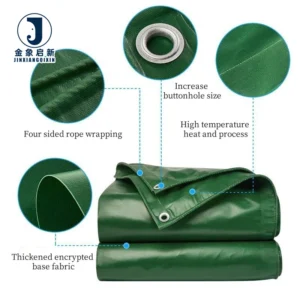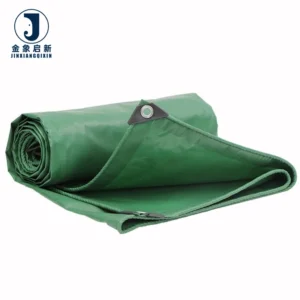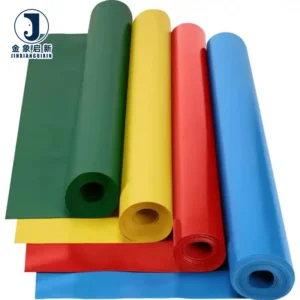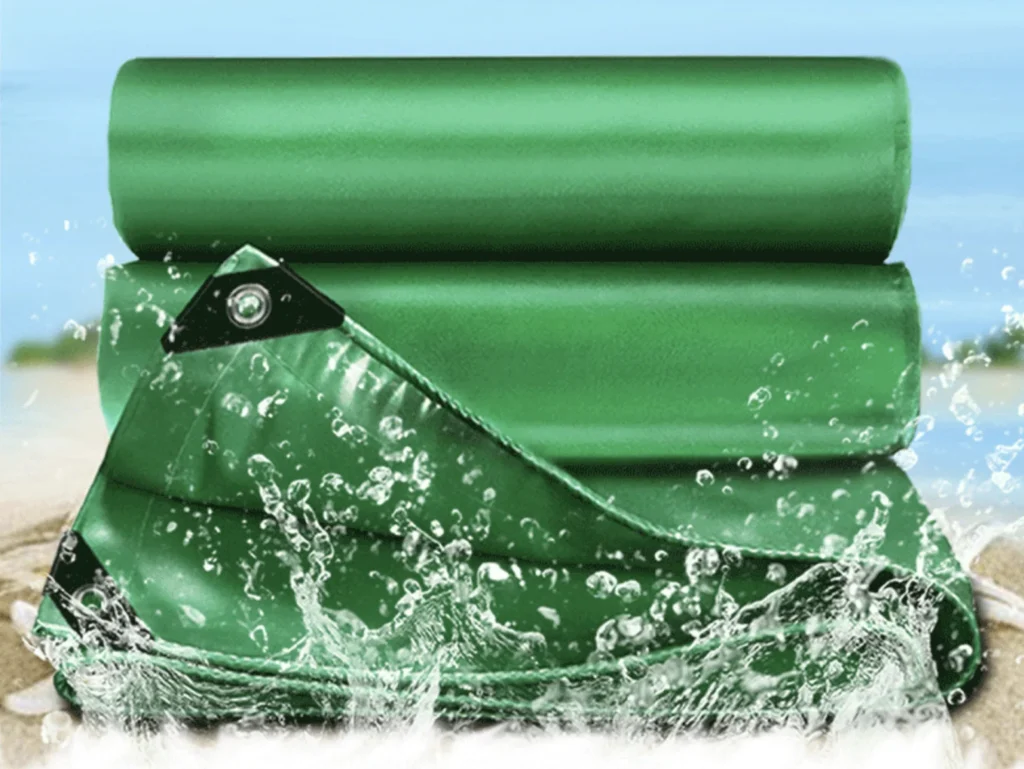
Coating Adhesion Control — three full production lines and 36 sets of professional equipment deliver consistent PVC knife coated fabric rolls with verified GSM and batch-to-batch colour uniformity for fleet cover fabrication.
Technical Specifications
| Parameter | Value |
|---|---|
| Product Type | PVC Tarpaulin Roll |
| Coating Method | Knife Coated |
| Coating Material | PVC |
| Tensile Resistance | Excellent |
| Tearing Resistance | Excellent |
| Peeling Resistance | Excellent |
| Fire Retardant | Available in flame retardant grades — confirm the grade required for your market |
| UV Resistance | Available with UV treatment — test basis to be confirmed per order |
| Antibacterial & Mildew Proof | Yes |
| Chemical Resistance | Oil, stain, acid and alkali resistant |
| Temperature Resistance | High temperature and cold resistant (range to be confirmed) |
| Anti-Oxidation | Yes |
| Weather Resistance | Yes |
| Flexibility | Highly flexible, cracking resistant |
| Self-Cleaning | Yes |
| Welding Options | HF / Hot Air / Sewing |
| Standards | ISO / CE certified production |
Application Suitability
| Application | Exposure & Requirement |
|---|---|
| Truck side curtain and trailer cover | Constant flexing at load points, road debris abrasion, prolonged UV exposure, rain and wind ingress |
| Tensile and architectural membrane structures | Sustained tension, wind uplift, solar heat gain, long-term weathering |
| Portable storage and shade systems | Repeated assembly and disassembly, UV exposure, wind load, puncture from handling |
| Airport hangar and stadium fabric roofs | Large span tension, fire safety compliance, thermal expansion and contraction |
| Outdoor tent and awning fabrication | Folding and unfolding stress, water pooling, mildew in humid storage |
Why Generic-Size Truck Covers Fail Where It Matters Most
A PVC Knife Coated Tarpaulin for Truck Cover cut to a generic dimension wastes fabric, leaves gaps at the trailer edges, and concentrates stress at poorly fitted seams.
When fleet operators order covers without specifying the exact trailer model, the result is excess material that flaps in transit or insufficient overlap that exposes the load. I have reviewed field returns where the fabric itself held up but the cover failed because the cut did not account for the trailer’s actual profile — the fabric bunched at the corners, rubbed against tie-down hardware, and tore within months [NEED_CITE: tarpaulin failure analysis at flex and abrasion points]. The PVC knife coated fabric performs as engineered; the problem is fitment, not material. This is why cut-to-model sizing with reinforced hem and eyelet placement specified to your trailer drawing eliminates the most common source of early cover failure.
Knife Coated Construction and What It Means for Weld Integrity
Knife coating deposits a controlled PVC layer onto the base fabric, producing uniform coating weight and strong adhesion between the polymer and the yarn. For truck cover fabrication, this means welded seams — whether by high-frequency, hot air, or sewing — bond to a consistent coating surface rather than one with thin spots or air pockets. A PVC Knife Coated Tarpaulin for Truck Cover fabricated from knife coated stock shows fewer pinholes along the weld line compared with cheaper coating methods, reducing the chance of water tracking through the seam under road spray.
Flex-Point Performance Under Moving Load Conditions
Truck covers experience cyclic flexing every time the vehicle brakes, corners, or encounters road irregularities. The coating must stretch and recover without micro-cracking at the surface. This PVC knife coated fabric is engineered for high flexibility and cracking resistance, which keeps the waterproof barrier intact at the points where the load shifts most. When the cover is tensioned over a curved or uneven load, the material conforms without developing stress whitening or coating delamination at the fold lines [NEED_CITE: cyclic flex testing methods for coated fabrics]. Fleet operators who have switched from generic tarpaulin to this grade report fewer mid-route cover repairs.
Reading the Specification Sheet Beyond GSM
Buyers often use GSM as the sole indicator of fabric quality, but coating weight alone does not determine how the material behaves under load. The base fabric denier and weave density govern tensile and tear strength; the coating method governs adhesion and weld behaviour. A knife coated fabric at a given GSM may outperform a laminated fabric at the same weight because the coating penetrates the weave rather than sitting on top, improving peel resistance. Surface finish — glossy or matte — affects self-cleaning behaviour and print adhesion for branded fleet graphics. Fire retardant grades must be matched to the transport regulation in your destination market, as classification systems differ between regions [NEED_CITE: fire classification standards for transport and building textiles]. Always request the material specification sheet that states base fabric construction, coating weight, and the specific treatment grade rather than relying on GSM alone.
The Hidden Cost of Overlooking Batch Consistency
When a fleet order spans multiple rolls, colour variation between rolls becomes visible once the covers are installed side by side on identical trailers. This is not a cosmetic complaint — it signals inconsistent coating formulation across the batch, which can also mean variation in plasticiser content and therefore flexibility. Covers cut from rolls with lower plasticiser content become brittle faster and crack at the hem fold [NEED_CITE: plasticiser migration and long-term flexibility loss in PVC coated fabrics]. Specifying batch-to-roll colour consistency as a contractual requirement and verifying it against the pre-shipment inspection record prevents the situation where half the fleet looks correct and the other half does not, avoiding partial rework that costs more than getting it right the first time.
Why Fabricators Source This PVC Knife Coated Tarpaulin for Truck Cover Here
Deep process control over coating weight and adhesion means the GSM stated on the quotation is the GSM that arrives on the roll, verified by dedicated QA/QC at every production stage.
Three full production lines and 36 sets of professional equipment support bulk roll orders with reliable on-time delivery, reducing the downtime your workshop faces waiting for fabric.
A 10-person R&D team handles material selection, pattern printing, custom sizing, and sample development, so you receive a sample cut to your trailer model within days rather than weeks.
Full welding compatibility — HF, hot air, and sewing — means you do not need to adjust your fabrication setup when switching between orders from this mill.
One hundred percent pre-shipment inspection with documented records ensures you can trace every roll back to its production batch before it leaves the factory.
Documentation & Verification
- Material specification sheet stating base fabric, coating method, and colour reference per roll
- Weight verification per roll against the stated GSM before dispatch
- Test report for UV and flame retardant grades where specified in the purchase order
- Batch-to-roll colour consistency documented in pre-shipment inspection record
- ISO and CE certificates covering the production facility and quality system
- Roll packing list and certificate of origin for customs clearance
Fabrication, Handling & Storage
- HF and hot air welding parameters should be calibrated to the knife coated PVC surface for full penetration at seams
- Reinforce eyelet and tie-down points with additional fabric patches to distribute load across the coated surface
- Store rolls upright on end caps to prevent flat-spot creases that become permanent in cold conditions
- Allow rolls to acclimatise before unrolling in cold weather to avoid coating stiffness and cracking
- Use mild detergent for cleaning; avoid solvent-based products that attack the PVC plasticiser
- Plan cutting layouts to minimise off-cut waste and keep seam count low on large truck covers
Before You Request a Quote
Provide the specific truck or trailer model, the cover type — side curtain, top cover, or full enclosure — and the exposure conditions your fleet encounters, such as coastal salt air or high-altitude UV. Specify whether you need rolls in stock widths or custom cut-to-model panels with hem and eyelet reinforcement. Confirm the fire retardant or UV treatment grade required by your destination market’s transport regulations so we can include the correct test documentation with your shipment.
Frequently Asked Questions
Q: How is GSM verified on arrival against the quotation?
A: Each roll undergoes weight verification during our 100% pre-shipment inspection. The inspection record states the measured GSM per roll and is included with your dispatch documentation. On arrival, you can cross-check with a simple scale test on a known-area sample. Any discrepancy is addressed before the goods leave the factory, not after.
Q: Which welding method suits truck cover flex-point seams best?
A: High-frequency welding produces the strongest bond at flex points because it fuses the PVC coating through the full thickness. Hot air welding is suitable for field repairs and smaller shops without HF equipment. Sewing with sealed thread and taped seams is an option for lighter-duty covers. We recommend HF for side curtain seams that experience constant flexing.
Q: How is roll-to-roll colour consistency controlled across an order?
A: All rolls in a single order are coated from the same batch of compounded PVC. Our QA team checks colour against the approved reference under standardised lighting before packing. The pre-shipment inspection record documents the colour check result for every roll, so you can verify consistency before installation.
Q: What fire retardant grade is available and does it meet my transport standard?
A: Flame retardant grades are available on request. The specific grade and test standard depend on your destination market — for example, European transport may require a different classification than North American or Asian regulations. Provide your market and the applicable standard when enquiring so we supply the matching test report.
Q: How are custom sizes and eyelet placements specified for specific trailer models?
A: Supply the trailer drawing or dimensions including door openings, tie-down rail positions, and corner radii. Our R&D team develops a cutting pattern and eyelet layout, then produces a sample panel for your approval. Once confirmed, production runs follow the approved pattern with reinforced hems at all eyelet and stress points.