Waterproof PVC PE Tarpaulin Supplier for Canada: China Factory Direct
Higher gram weight does not mean better cold resistance — it is the plasticizer formula and UV stabilizer package that determine whether a tarpaulin survives a Canadian winter or shatters at first frost.
When sourcing a waterproof tarpaulin supplier for Canada from China, buyers must validate three dimensions: cold-flex formulation, composite anti-UV stabilization, and heat-weld seam durability under freeze-thaw cycles. A factory-direct supplier who adjusts resin recipes to Canadian climate data — rather than shipping generic stock — is the only viable path to avoid brittle failure and customs rejection.
I still remember a shipment that went sideways years ago. A farm operator in Saskatchewan ordered rolls of standard PE cover for grain bin protection. The spec sheet looked fine — same gram weight we had shipped to Southeast Asia for years. But when January hit and the thermometer dropped well below freezing, the material cracked like biscuit dough under boot pressure. We traced it back to the anti-UV masterbatch ratio. The same masterbatch dosage that works under desert sun fails completely under the combination of low-angle winter UV and snow-surface reflection that defines the Canadian prairie. That loss cost us freight, replacement material, and a customer relationship we had built over multiple seasons. From that point forward, I made it a rule: any order flagged for Canadian delivery gets a separate formulation review before a single roll is extruded. [NEED_CITE: correlation between snow-surface UV reflectance and polymer degradation rates in northern latitudes]
If you are comparing options for a waterproof tarpaulin supplier for Canada, the rest of this guide walks through the exact specs, material choices, verification steps, and certification thresholds that separate a workable supply partner from a costly mistake.
What Specs Does Canada’s Climate Demand from Waterproof Tarpaulins?
Canadian conditions stack three stressors that rarely coexist in other markets: extreme sub-zero temperatures, intense seasonal UV exposure amplified by snow albedo, and repeated freeze-thaw cycling that attacks seams before it attacks fabric.
A waterproof tarpaulin supplier for Canada must be able to demonstrate performance across all three, not just one. Most generic export tarpaulins are engineered for a single dominant stressor — UV in the Middle East, abrasion in Africa, or waterproofing in tropical logistics. Canada requires a balanced formulation.
| Performance Factor | Standard Export Spec | Canadian-Adapted Spec | Verification Method |
|---|---|---|---|
| Cold Flexibility | Passes at moderate sub-zero | Retains flexibility at extreme sub-zero | Low-temperature bend test per CAN/CGSB [NEED_CITE: CAN/CGSB low-temperature flexibility test standard for coated fabrics] |
| UV Stabilization | Carbon black addition only | Composite stabilizer package with hindered amine light stabilizers | Accelerated weathering test with extended cycle count |
| Seam Integrity | Basic heat-weld overlap | Reinforced weld width with controlled peel strength | Strip peel test after freeze-thaw conditioning |
| Fire Retardancy | Optional add-on | Mandatory for construction and industrial use | NFPA and CAN-compliant flame-spread rating |
The cold-flexibility point deserves emphasis. I have seen buyers specify heavier gram weight assuming thickness equals durability. It does not. The critical variable is the plasticizer system — specifically whether the factory uses a low-temperature-grade plasticizer that remains mobile well below freezing. Without it, even a thick PVC sheet becomes a rigid board that snaps on impact. [NEED_CITE: relationship between plasticizer migration and low-temperature embrittlement in flexible PVC compounds]
For PE tarpaulins, the equivalent issue is the crystallinity of the polyethylene resin and the dispersion of anti-UV masterbatch. A poorly dispersed masterbatch leaves micro-zones of unprotected polymer that become initiation points for crack propagation once temperatures drop. This is why a reputable waterproof tarpaulin supplier for Canada will ask about your end-use temperature range before quoting, not after.
PE vs PVC Tarpaulin for Canada: Which One Fits Your Application?
The choice between PE and PVC is not about which material is universally better — it is about matching material behavior to the specific mechanical and thermal demands of your application.
When buyers contact a waterproof tarpaulin supplier for Canada, the first question I ask is what the cover will actually do on site. The answer determines everything.
| Selection Factor | PE Tarpaulin | PVC Coated Polyester |
|---|---|---|
| Typical Weight Range | Light to medium | Medium to heavy |
| Cold Crack Resistance | Dependent on resin grade and masterbatch dispersion | Dependent on plasticizer formulation |
| Seam Method | Heat-weld or tape | High-frequency or hot-air weld |
| Best-Fit Application | Agricultural covers, light equipment protection, temporary grain storage | Truck covers, mining containment, heavy construction enclosure |
| Repairability | Difficult in field | Field-repairable with patch kits |
| Cost Position | Lower per square meter | Higher per square meter |
A grain farm in Manitoba covering silage bunkers needs a PE cover that stays flexible through a full winter season without tearing at fold lines. The PE formulation must include a cold-impact modifier and a UV stabilizer package calibrated for prairie conditions. Sending standard tropical-grade PE to that farm is a guaranteed failure.
On the other hand, a logistics company running flatbed trailers through Alberta in January needs PVC-coated polyester with a heat-weld seam that will not delaminate after repeated freeze-thaw cycles. The weld width and peel strength matter more here than the base fabric weight. I have reviewed cases where a seam peeled open not because the PVC was weak, but because the weld temperature during production was set for a different ambient humidity range than what the Canadian winter demands. [NEED_CITE: effect of ambient humidity on hot-air weld peel strength in PVC-coated fabrics]
The key takeaway when evaluating a waterproof tarpaulin supplier for Canada is this: do not accept a one-material-fits-all recommendation. A capable factory will stock both PE and PVC lines, understand the formulation differences for cold climates, and recommend based on your actual工况 rather than pushing whichever roll happens to be in inventory.
How to Verify a China Factory-Direct Supplier for Canada Orders?
Three verification pillars separate a genuine factory-direct partner from a trading company repackaging generic stock: formulation customization capability, verifiable export certification history, and documented cold-climate delivery track record.
Working with a waterproof tarpaulin supplier for Canada requires due diligence that goes beyond a product catalog. Here is how I evaluate any factory before recommending them for a Canadian order.
First — formulation customization. Ask the factory to explain how they adjust their PE or PVC recipe for sub-zero markets. If the answer is “we just add more UV stabilizer,” walk away. The real answer involves plasticizer selection for PVC, resin grade and masterbatch dispersion protocol for PE, and potentially a cold-impact modifier. A factory that formulates to order — rather than selling from a single universal batch — demonstrates technical depth. [NEED_CITE: role of cold-impact modifiers in polyethylene compounds for low-temperature applications]
Second — certification documentation. Request copies of test reports, not just certificates. A certificate says “passed.” A test report shows the actual values, the test method, and the lab that performed it. For Canadian orders, you need to see low-temperature bend test results, accelerated UV aging data, and — for construction applications — flame-spread ratings compliant with North American standards. If the supplier cannot produce these on request, they are not manufacturing to Canadian spec.
Third — cold-climate delivery evidence. Ask for references or case evidence from previous Canadian or similar cold-region shipments. A waterproof tarpaulin supplier for Canada who has been shipping north for multiple seasons will have no problem showing this. A factory that primarily serves tropical markets will either hesitate or provide irrelevant references from completely different climate zones.
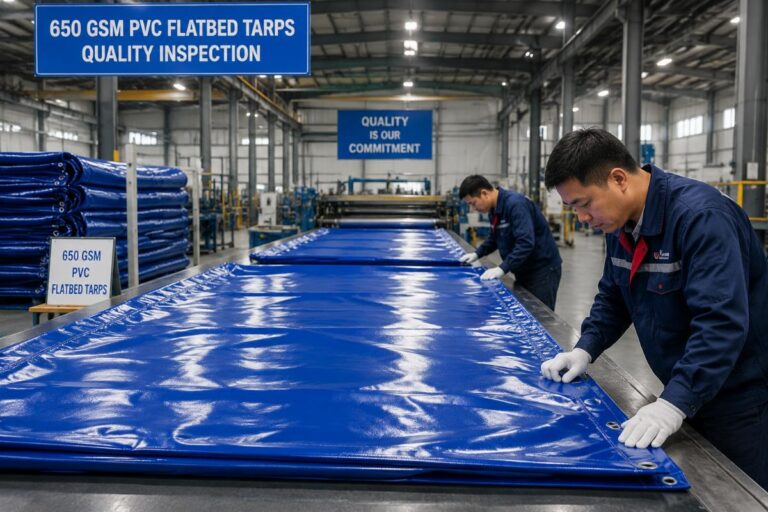
I apply this same three-pillar check internally at our production facility in Shandong. When a Canadian buyer places an order, we pull the formulation sheet for that specific batch, attach the third-party test reports, and include photos from the production line showing the actual extrusion and coating run. This is not marketing — it is traceability. And it is the minimum standard any serious buyer should expect.
What Certifications and Testing Reports Do Canadian Buyers Need?
Canadian customs and end-user acceptance require specific certifications that go well beyond a generic “waterproof” claim — flame-spread rating, low-temperature flexibility, and UV aging resistance each have defined test protocols that must be documented.
When a waterproof tarpaulin supplier for Canada ships a container, the paperwork must match the physical product exactly. Mismatches trigger customs holds, re-inspection fees, and in the worst case, return shipments that destroy the economics of the entire order.
The core certification cluster for Canadian tarpaulin imports includes:
- Flame-spread and fire-retardant rating — Required for construction site enclosures, mining applications, and any cover used near ignition sources. The test must comply with recognized North American fire-safety standards. The retardant additive level must be consistent throughout the roll, not just on the surface. [NEED_CITE: fire-retardant additive distribution uniformity requirements in coated flexible fabrics]
- Low-temperature flexibility test — This is the single most overlooked certification for Canadian imports. The test simulates the material’s behavior at the lowest expected service temperature. A pass at moderate cold means nothing if the material will see extreme prairie winters.
- Accelerated UV weathering report — Standard UV tests run for a set number of hours under controlled conditions. For Canada, the test protocol must account for the combined effect of direct UV and snow-reflected UV, which effectively doubles the exposure intensity on the underside of a horizontal cover.
- Waterproof integrity test — Hydrostatic pressure resistance must be documented. This is less climate-specific but remains a baseline requirement for any product marketed as waterproof.
A common mistake I see is buyers accepting a certificate from the factory’s in-house lab without third-party verification. Canadian end-users — particularly in construction and mining — increasingly require reports from internationally recognized testing laboratories. A waterproof tarpaulin supplier for Canada who only offers self-issued certificates is creating downstream risk for the buyer.
At our facility, we run every Canadian-bound order through third-party testing for flame retardancy and UV aging before shipment. The cost is modest relative to the risk of a rejected container. We also retain batch samples for each production run, so if a field issue arises months later, we can pull the exact sample and retest rather than guessing.
Conclusion
Selecting a waterproof tarpaulin supplier for Canada is a formulation and verification challenge, not a price-comparison exercise. Cold-flex plasticizer chemistry, composite UV stabilization, and heat-weld seam integrity under freeze-thaw conditions define whether a cover performs or fails. Buyers who validate formulation customization, demand third-party test reports, and confirm cold-climate delivery history will consistently outperform those who select on gram weight and unit price alone.