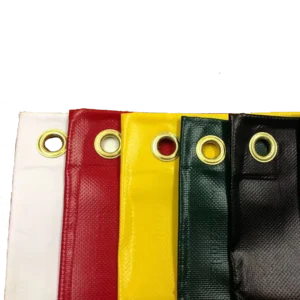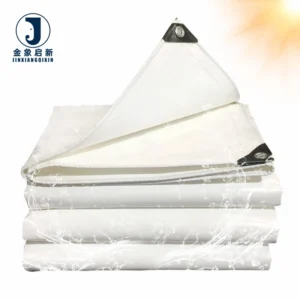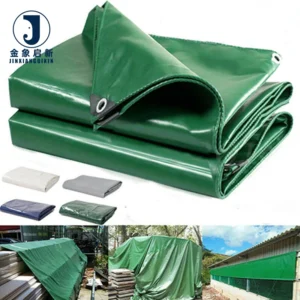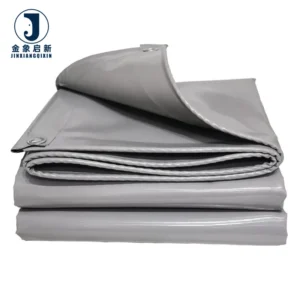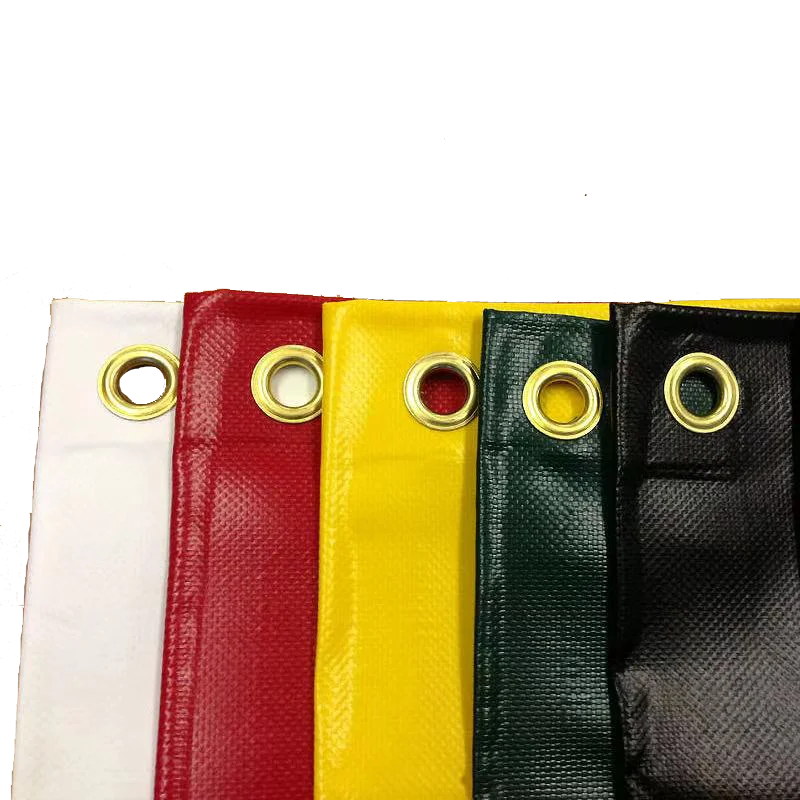
Deep Process Control Over Coating Weight — Three full production lines and 36 sets of equipment maintain consistent adhesion and GSM across every roll of knife-coated fabric leaving the facility.
Technical Specifications
| Parameter | Value |
|---|---|
| Product Type | PVC Knife-Coated Fabric Tarpaulin |
| Weight Range | 300-600 gsm (confirm the grade for your application) |
| Coating Method | Knife Coated |
| Coating Material | PVC |
| Waterproof | Yes |
| Oilproof | Yes |
| UV Treatment | Anti-UV coated (test basis not stated in source) |
| Flame Retardant | Available (grade not stated in source) |
| Anti-Static | Available (standard not stated in source) |
| Anti-Mildew | Available |
| Anti-Cold | Available |
| Key Features | Tear-Resistant, Custom sizing, Roll format |
Application Suitability
| Application | Exposure & Requirement |
|---|---|
| Truck side curtain | Constant flexing at load points, road spray, UV exposure, abrasion from cargo contact |
| Flatbed trailer cover | Tie-down strap pressure, wind flap fatigue, weather exposure during transit |
| Curtain-side trailer replacement | Dimensional accuracy to vehicle model, welded seam integrity at flex zones |
| Transport fleet branding | Colour consistency across multiple vehicles, surface receptivity to pattern printing |
Why a Generic-Size PVC Knife-Coated Tarpaulin for Truck and Trailer Fails Before the Fabric Does
The cover must match the trailer model, not a catalogue dimension.
When a truck cover is cut to a generic rectangle instead of the specific trailer profile, the material bunches at corners and pulls tight across the load bed. That tension concentrates at the welded seams — precisely where the load flexes most during transit. The seam separates before the fabric itself shows any wear. Fleet operators replacing covers repeatedly often blame the material weight, when the root cause is a cover that was never dimensioned for their vehicle. Sourcing a PVC Knife-Coated Tarpaulin for truck and trailer applications begins with the trailer model, not the GSM. [NEED_CITE: weld seam failure analysis for coated fabrics under cyclic flex loading]
Dimensional Fitment to Specific Trailer Models
Every trailer manufacturer designs different corner radii, curtain track profiles, and tie-down spacing. A cover that fits one curtain-side model will not transfer directly to another, even within the same fleet. This PVC Knife-Coated Tarpaulin for truck and trailer use is cut and welded to the vehicle model specified at the inquiry stage, so eyelets align with the trailer’s anchor points and the fabric sits without tension across the load bed.
Seam Behaviour Under Road Load Flex
The knife-coating process forces PVC into the base fabric weave under pressure, creating a mechanical bond between coating and yarn rather than a surface laminate. When the welded seam is heated and pressed, the PVC from both panels fuses into a continuous layer. This matters for side curtains that flex with every corner and lane change — the seam must carry the same load as the parent fabric, or it becomes the first failure point on the route.
Reinforcement Strategy at Stress Concentrations
Eyelet rows and hem edges carry the highest point loads on any truck cover. The base fabric’s tensile strength determines whether those reinforcements hold through years of strap tension and wind flap cycles. [NEED_CITE: tensile and tear test methods for coated fabrics per ISO 1421] Selecting the correct GSM grade for your fleet’s strap configuration prevents pull-through at the eyelet line and delamination at the hem fold.
Material Selection for Fleet Operating Environments
Fleets running northern routes in winter need anti-cold treatment to prevent the PVC from stiffening and cracking at low temperatures. Those operating in high-UV regions require stabilised coating to resist surface degradation. Flame retardant and anti-static grades are available in this PVC Knife-Coated Tarpaulin for truck and trailer specification — confirm the grade required for your market and regulatory environment before placing the order.
How GSM, Coating Method, and Base Fabric Interact
GSM measures total weight per square metre, but that number combines base fabric density and coating weight in different proportions depending on the construction. A knife-coated fabric at a given GSM typically carries more PVC in the weave than a laminated fabric at the same weight, because the coating is driven into the yarn structure rather than bonded on top. This gives knife-coated material better peel strength at welded seams and better resistance to coating delamination under flex. The base fabric’s denier and weave density determine tear propagation resistance — a high-denier yarn in a tight weave stops a puncture from becoming a split. Selecting the right grade within the 300-600 gsm range depends on the mechanical stress your covers face, not on choosing the heaviest option available.
The Hidden Cost of Ordering Off-Specification
A cover ordered without specifying the trailer model arrives and does not seat properly in the curtain track, leaving a gap where water enters the load space. Material ordered with a flame retardant claim but no supporting test report fails the site safety audit when the inspector asks for documentation. Colour variation between rolls becomes visible the moment two panels are installed side by side on adjacent trailers — the fleet branding looks inconsistent before the vehicles even leave the yard. These are not material defects; they are specification gaps that surface only after the order has been delivered and installed. [NEED_CITE: colour consistency measurement standards for coated fabrics in fleet applications]
Why Source This Fabric Through Jinxiang
Nearly 30 years of focused production on coated fabric means the coating weight and adhesion parameters for each PVC grade are established process settings, not trial runs. Three full production lines with 36 sets of professional equipment provide the capacity to fulfil fleet-scale orders with consistent on-time delivery across multiple trailer types. The 10-person R&D team handles material selection and sample development so you can verify fitment, colour, and weld behaviour before committing to a production run. Dedicated QA/QC at every production stage, with 100% inspection before shipment, catches GSM deviation and colour drift before rolls are packed. Samples for custom sizing and treatment requirements are developed within days, shortening the approval cycle for fleet operators managing tight replacement schedules.
Documentation & Verification
- Material specification sheet confirming GSM, base fabric, and coating weight per roll
- Test reports for UV and flame retardant grades supplied where applicable to your order
- Pre-shipment inspection record verifying dimensions match the specified trailer model
- Roll packing list with individual roll weights for GSM cross-check on arrival
- Colour reference documentation for consistency verification across multi-roll orders
Fabrication, Handling & Storage
- Heat-weld at temperatures suited to knife-coated PVC to maintain coating-to-fabric adhesion at the seam
- Store rolls horizontally on a flat surface to prevent creasing that becomes permanent in heavier GSM grades
- Allow cold-stored rolls to reach ambient temperature before unrolling to avoid coating crack in anti-cold grades
- Use PVC-compatible cleaners on the coated surface to preserve anti-UV and flame retardant treatment integrity
- Plan cutting layout from roll width to minimise off-cuts and welded joins across the truck cover panels
- Reinforce eyelet zones with additional PVC patches bonded to the base fabric before punching
What to Include With Your Inquiry
Provide the trailer make, model, and year for each vehicle type in your fleet so covers can be dimensioned to the specific curtain track and anchor point layout. Specify whether you need roll stock for your own fabrication or finished covers with welded hems and eyelets installed. Identify any fire-retardant or anti-static compliance requirements your operating region mandates so the correct treatment grade is quoted from the start.
Frequently Asked Questions
Q: How is GSM verified on delivery against the quoted specification?
A: Each roll ships with a material specification sheet stating the coating weight and total GSM. You can cross-check on arrival by cutting a measured sample and weighing it. Any deviation beyond the agreed tolerance is flagged during the 100% pre-shipment inspection, so rolls that fall outside the specification do not leave the facility.
Q: How do you cut covers to fit specific truck and trailer models?
A: We work from the trailer manufacturer’s dimensional drawings or physical measurements taken from your vehicle. The cover is then cut and welded to match the curtain track profile, corner radius, and tie-down spacing of that specific model. A sample is developed for fitment approval before production begins on the full order.
Q: What reinforcement options are available at eyelet and hem stress points?
A: Eyelet rows can be reinforced with additional PVC patches welded to the base fabric before punching, distributing the strap load across a wider area. Hem edges are folded and welded to double the material thickness at the perimeter. The reinforcement specification is matched to the GSM grade and the tie-down configuration your fleet uses.
Q: How are welded seams tested to prevent failure at load flex points?
A: Welded seams undergo peel testing to confirm the bond strength between joined panels meets the required threshold for the fabric grade. The test verifies that the PVC from both panels has fused completely through the coating layer. Seam samples from each production run are retained for reference against the pre-shipment inspection record.
Q: What fire-retardant or anti-static certifications are available for fleet compliance?
A: Flame retardant and anti-static treatments are available across this product range. The specific grade and test standard depend on your market’s regulatory requirements. Provide the certification your operating region mandates at the inquiry stage, and the corresponding test report is supplied with the shipment documentation.