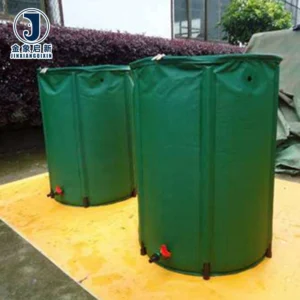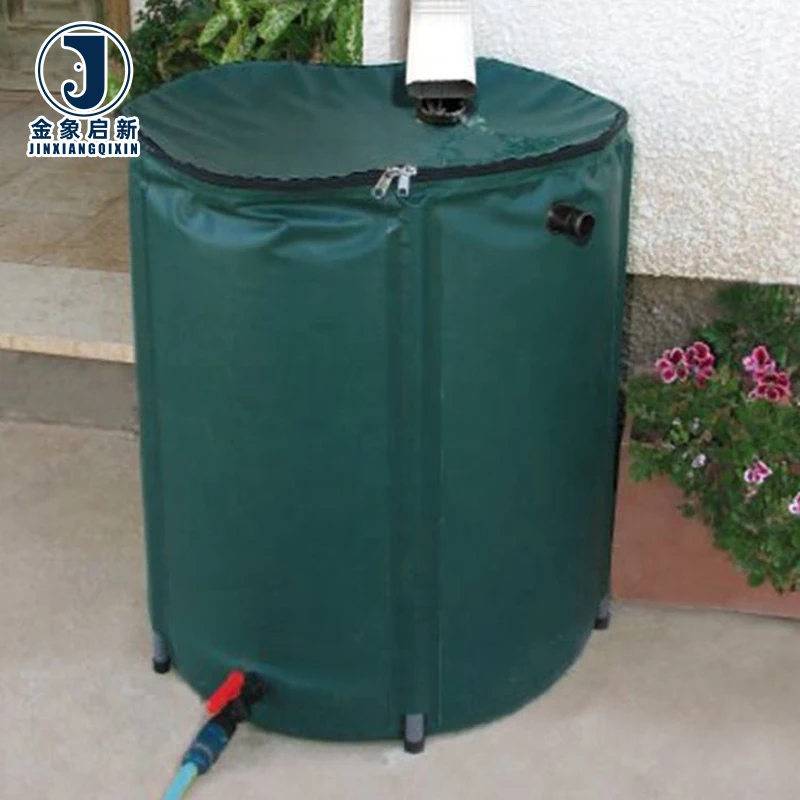
Custom Sizing & Fitment — Each collapsible rain barrel is developed from application-specific patterns to match your exact volume and site footprint, verified through sample approval before production runs.
Technical Specifications
| Parameter | Value |
|---|---|
| Product Type | Waterproof Storage Tank |
| Capacity | 50 Gallon / 750L |
| Material | PVC Mesh Cloth |
| Support Structure | PVC Support Rod |
| Assembly State | Collapsible, Portable |
| Waterproof | Yes |
| UV Treatment | Available — confirm the UV stability grade required for your climate zone |
| Flame Retardant | Available — confirm the grade required for your market |
| Anti-Static | Available — confirm the standard applicable to your site |
| Anti-Mildew | Yes |
| Tear-Resistant | Yes |
| Abrasion-Resistant | Yes |
| Anti-Bacteria | Yes |
| Shrink-Resistant | Yes |
Application Suitability
| Application | Exposure & Requirement |
|---|---|
| Garden rainwater harvesting | Constant water contact, outdoor UV exposure, anti-mildew and anti-bacteria integrity for plant-safe storage |
| Agricultural irrigation supply | Seasonal fill-and-drain cycles, field-edge abrasion, collapsible storage between growing seasons |
| Temporary site water containment | Rapid deployment on uneven ground, repeated transport and repositioning, puncture risk from debris |
| Remote or off-grid water storage | Freeze-thaw exposure, no rigid tank infrastructure, portability for seasonal relocation |
Why Generic Capacity Claims Fail When the Barrel Is Full
A collapsible PVC rain barrel must hold its rated volume without seam separation or fabric deformation under full hydrostatic load.
Buyers frequently specify a target capacity and receive a barrel that sags or bulges once filled, reducing usable volume and stressing the welded seams beyond their rated peel strength. The issue is rarely the PVC mesh cloth itself but the interaction between water weight, support rod placement, and seam geometry [NEED_CITE: hydrostatic pressure distribution in flexible containment vessels]. Without a documented pre-shipment fill test, the stated capacity remains a theoretical number rather than a verified performance threshold.
Support Rod Geometry and Load Distribution
The PVC support rod system in this collapsible PVC rain barrel maintains the cylindrical profile without a rigid external frame, transferring hydrostatic pressure evenly into the coated mesh fabric. Rod positioning determines where the barrel flexes under partial fill versus where it resists outward pressure at maximum capacity. Incorrect rod spacing causes localized stress at the weld lines, particularly at the base-to-wall junction where water weight concentrates. The rod diameter and wall thickness are matched to the barrel’s rated capacity to prevent buckling when the unit is filled on soft or uneven ground.
Seam Construction and Water Containment Integrity
Every seam on this waterproof storage tank is heat-welded rather than stitched, eliminating needle holes that would compromise waterproof integrity under sustained water pressure. The overlap width at each weld is set to exceed the peel strength threshold of the PVC mesh cloth coating, ensuring the seam outlasts the fabric body through repeated fill-and-drain cycles [NEED_CITE: peel strength test methods for PVC-coated mesh fabrics per ISO 1421]. Base seams receive additional reinforcement layers because the hydrostatic head is greatest at the lowest point of the barrel, where water weight pushes outward and downward simultaneously.
Reading the PVC Mesh Cloth Specification
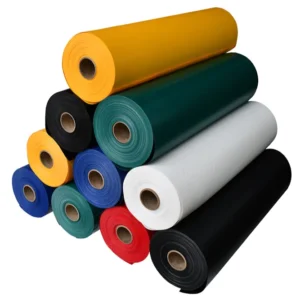
The PVC mesh cloth base fabric provides the structural backbone that prevents the barrel from stretching or deforming under full load. Mesh denier and weave density together determine how the fabric distributes stress across the coated surface — a higher thread count in the base fabric limits tear propagation if the coating is punctured by a sharp object on the ground. The coating weight applied to both faces of the mesh governs weldability and long-term waterproof performance, as insufficient coating thickness leads to pinhole formation after repeated folding and unfolding. Anti-mildew and anti-bacteria treatment is integrated into the coating compound rather than applied as a surface spray, maintaining water quality for garden and agricultural use through multiple seasons.
The Hidden Cost of Underspecified Fabric
Selecting a waterproof storage tank based solely on capacity and price, without verifying the mesh denier and coating weight, leads to predictable field failures. Lightweight mesh cloth deforms under hydrostatic load, causing the support rods to shift and the barrel to lean or collapse. Insufficient coating thickness allows water to migrate through the fabric over time, particularly at stress points where the barrel contacts the ground. Buyers who skip pre-shipment inspection often discover seam delamination only after the first full fill, by which point the barrel is already deployed and replacement logistics become costly [NEED_CITE: field failure rates in flexible water containment products].
Why Procurement Verification Matters Here
Each collapsible PVC rain barrel is produced on lines equipped for coated fabric handling, ensuring consistent coating adhesion across the full mesh surface. The ten-person R&D team develops capacity-specific patterns and support rod configurations, producing samples for buyer approval before bulk production begins. Dedicated quality control inspects weld integrity and dimensional accuracy at every production stage, with full pre-shipment inspection recorded before dispatch. Custom capacities beyond standard offerings are developed with confirmed lead times, and all PVC mesh cloth is traceable to its coating batch for consistency across repeat orders.
Documentation & Verification
- Material specification sheet confirming PVC mesh cloth denier and coating weight per production batch
- UV and flame-retardant test reports provided where the specified grade requires third-party validation
- Pre-shipment inspection record verifying seam peel strength and dimensional accuracy at rated capacity
- Roll packing list detailing quantity, capacity rating, and support rod component count per shipment
- Certificate of origin and customs documentation prepared for cross-border delivery
Fabrication, Handling & Storage
- Heat-weld all seams at temperatures matched to the PVC mesh cloth coating weight to prevent delamination
- Store collapsed barrels flat in a dry environment to avoid permanent creasing of the PVC mesh cloth fabric
- Inspect PVC support rods for straightness before each deployment, replacing any that show buckling or fracture
- Clean interior surfaces with mild detergent only, as solvents degrade the anti-mildew and anti-bacteria treatment
- Avoid dragging the barrel base across abrasive ground surfaces to protect the coating from puncture damage
What We Need to Quote Accurately
To provide a meaningful specification for your collapsible PVC rain barrel, share the target capacity or volume range, the deployment environment including UV exposure level and ground conditions, and whether you require flame-retardant or anti-static certification for your market. Confirm whether standard capacities meet your needs or if custom sizing is required, along with estimated annual volume. Sample development is available for approval before production commitment.
Frequently Asked Questions
Q: How is the barrel capacity verified at full water load without seam failure?
A: Each waterproof storage tank undergoes pre-shipment inspection that includes dimensional verification at rated capacity. The PVC mesh cloth base fabric and weld overlap width are matched to the hydrostatic pressure at full fill, and seam peel strength is checked against the coating specification to confirm the seam will not separate under sustained water weight.
Q: What UV treatment basis supports extended outdoor exposure?
A: UV treatment is available in grades matched to different climate zones and exposure durations. The specific UV stabilizer package and test basis are confirmed during the specification stage based on your deployment region. Request the test report applicable to your local compliance requirements before placing a bulk order.
Q: How is anti-mildew performance maintained across multiple fill-and-drain cycles?
A: The anti-mildew and anti-bacteria treatment is integrated into the PVC coating compound rather than applied as a topical finish, meaning it does not wash off during emptying and refilling. The PVC mesh cloth structure allows the barrel to be fully drained and aired between seasons, further reducing mildew formation risk.
Q: Can the barrel be sized to specific volume requirements beyond standard capacities?
A: Custom capacities are developed by the R&D team using application-specific patterns and adjusted support rod configurations. Samples are produced for buyer approval before bulk manufacturing begins, with lead time and minimum order quantity confirmed at the quotation stage.
Q: What packing method protects the PVC mesh fabric during container shipping?
A: Collapsed barrels are packed flat with PVC support rods bundled separately to prevent rod ends from puncturing the mesh cloth during transit. Each unit is individually wrapped to avoid surface abrasion between units, and container loading plans are calculated by unit count and pallet weight.