Coating weight control — nearly three decades of focused coated fabric production with dedicated QA at every stage ensures the stated GSM on your truck cover matches what arrives at your dock.
Technical Specifications
| Parameter | Value |
|---|---|
| Product Type | PVC Truck Cover |
| Material | HDPE weaving with LDPE lamination on both sides |
| Weight Range | 50 g/m² – 220 g/m² (grade-dependent — confirm required GSM for your application) |
| Thickness | 0.2 – 0.4 mm / 8 mil – 16 mil |
| Knitting Density | 8×8 / 10×10 / 12×12 |
| Tensile Strength | Meridian 300–1200 N/5cm / Latitude 250–1000 N/5cm |
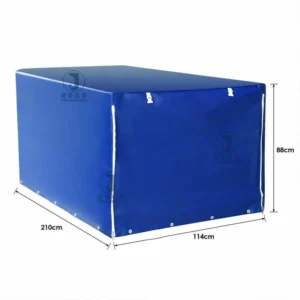
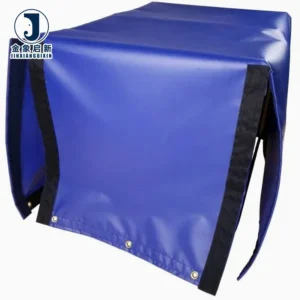
| Edge Reinforcement | PP rope in hem on all four edges |
| Eyelets | Galvanized, spaced every 3 ft or 1 meter |
| Corner Treatment | Reinforced plastic corners |
| UV Treatment | Available (test basis not stated — request documentation) |
| Key Features | Waterproof, washable, tear resistant, weather proof, mildew proof, anti-aging |
| Color Options | Blue, Blue/Orange, Green, Grey, Black, Clear, Grey/Green, Orange, or custom |
| Roll Width Options | 6 ft, 8 ft, 10 ft, 12 ft or 2 m, 4 m, 6 m |
| Roll Length Options | 100 yards, 100 meters, or custom |
| Certifications | ISO, CE |
Application Suitability
| Application | Exposure & Requirement |
|---|---|
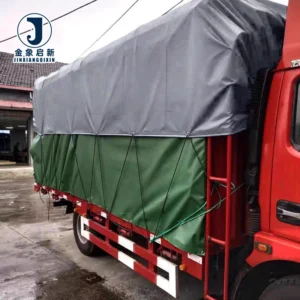
| Flatbed truck load covering | Highway wind load, rain ingress, UV exposure, tie-down tension at eyelet points |
| Trailer side curtain fabric | Continuous flexing at roll-up points, road debris abrasion, colour consistency across fleet |
| Container top cover | Prolonged sun exposure, water pooling, thermal expansion and contraction |
| Equipment transport cover | Custom cut-to-fit profile, corner abrasion from machinery edges, repeated deployment |
| Fleet standardisation programme | Batch colour matching across multiple trailer types, consistent eyelet placement |
Why Generic-Sized Truck Covers Cost Fleets More Than Custom-Fit Ones
A cover that does not match the trailer profile fails first at the mismatch points — not because the fabric is weak, but because the geometry is wrong.
Fleet operators ordering PVC Truck Cover material often receive tarps cut to nominal dimensions that ignore the specific rail height, corner radius and tie-down layout of their trailer models. The result is excess fabric that flaps at speed, creating fatigue cracking along the hem within weeks. Meanwhile, undersized covers leave cargo edges exposed to spray and grit. [NEED_CITE: coated fabric fatigue failure patterns under cyclic wind loading] The cost shows up as premature replacement cycles and damaged freight claims rather than a line item on the original purchase order.
Cut-to-Model Sizing Eliminates the Flap Zone
Every trailer model has a distinct profile — side rail height, header bow radius, door frame clearance. When truck cover fabric is cut to a generic rectangle and forced onto a specific model, the excess material becomes a sail. This PVC Truck Cover range supports custom sizing so the hem line lands exactly where the tie-down rail sits, removing the loose section that accelerates edge wear. Confirming the exact trailer model before cutting is a step that eliminates the majority of early field complaints.
Eyelet Placement Aligned to Tie-Down Hardware
Standard eyelet spacing at 3 ft or 1 meter intervals works for general cargo, but fleet operators often need placement matched to their specific ratchet strap positions and load bars. Galvanized eyelets set at non-standard intervals prevent the strap from pulling the fabric at an angle, which concentrates stress on a single yarn line rather than distributing it across the reinforced hem. The PP rope hem and reinforced plastic corners work together to spread the tie-down load across the edge system.
Reading the Spec Sheet Beyond the Headline GSM
Knitting density — 8×8, 10×10, or 12×12 — determines how many yarns carry the load in each direction. A 180 g/m² fabric at 8×8 uses heavier individual yarns but has fewer cross-over points to stop a tear from propagating. The same weight at 12×12 distributes force across more intersections, limiting tear spread from a puncture. For truck covers exposed to tie-down tension and road debris impact, the density grade often matters more than the weight alone. The LDPE lamination on both sides of the HDPE weave locks the yarn grid in place, which preserves the alignment under repeated flexing. [NEED_CITE: relationship between weave density and tear propagation in woven coated fabrics per ISO 1421]
What Happens When the Specification Does Not Match the Route
A cover specified without UV treatment documentation deployed on a long-haul desert route will show embrittlement at the fold lines before a treated equivalent. Similarly, a lightweight grade used on a flatbed carrying sharp-edged steel coil will puncture at contact points that a heavier grade with higher knitting density would resist. The failure is not the fabric — it is the gap between what the route demands and what the spec sheet confirms. Batch colour variation across a single fleet order becomes visible the first time two trailers park side by side at the depot. [NEED_CITE: UV degradation mechanisms in polyethylene laminated fabrics under prolonged solar exposure]
Why Sourcing from This Production Line Matters for Transport Covers
Three full production lines and 36 sets of professional equipment mean custom-width rolls for truck covers can be scheduled without queuing behind standard stock orders. A 10-person R&D team handles the pattern from trailer dimensions to cut profile, producing samples within days so the fit is confirmed before the full run. Dedicated QA at every production stage catches coating weight drift and colour shift between rolls — the two most common complaints from fleet buyers. The 100% pre-shipment inspection covers eyelet pull strength and hem reinforcement integrity, not just visual defects. ISO and CE certification documentation ships with each order, supporting compliance in markets that require it for transport equipment.
Documentation & Verification
- Material specification sheet stating base fabric denier, knitting density and coating type for each roll
- Weight verification per roll against the stated GSM before dispatch
- UV treatment test result documentation where applicable — confirm grade required
- Pre-shipment inspection record covering eyelet pull strength and hem integrity
- Roll packing list with individual roll dimensions and colour reference
Fabrication, Handling & Storage
- Heat-seal temperature settings must match the LDPE lamination grade to avoid delamination at the weld
- Galvanized eyelet setting force should be calibrated to the specific thickness range (0.2–0.4 mm)
- Store rolls horizontally on padded racks to prevent permanent creasing of the coated surface
- PP rope hem reinforcement must be tensioned during sewing to avoid puckering on wider widths
- Avoid folding at the same line repeatedly — rotate fold positions to prevent coating crack propagation
- Clean with mild detergent only; solvent-based cleaners degrade the LDPE lamination bond
What We Need to Quote Your Truck Cover Order
Provide the trailer make, model and year — or the exact cover dimensions if the trailer is a custom build. Specify the tie-down hardware layout so eyelet spacing can be matched. Confirm whether UV treatment documentation is required for your operating region and whether you need finished cut sizes or roll stock for in-house fabrication. Colour reference or fleet branding requirements should be included at inquiry stage so batch consistency can be planned across the full order.
Frequently Asked Questions
Q: How is GSM verified on arrival and what documentation supports the quoted weight?
A: Each roll is weighed and measured during pre-shipment inspection, with results recorded on the inspection report that ships with your order. The material specification sheet states the base fabric and coating weight separately. If your receiving team wants to independently verify, we recommend cutting a measured sample and comparing it against the documented value per roll.
Q: Can truck covers be cut to specific trailer model dimensions rather than generic sizes?
A: Yes. Provide the trailer make, model and year — or detailed dimensional drawings for custom trailers. The R&D team produces a sample cover for fit confirmation before the production run proceeds. This eliminates the excess fabric that causes flapping and premature hem failure on generic-sized covers.
Q: What UV treatment documentation is available for long-term outdoor transport use?
A: UV treatment is available across this product range, but the specific test basis must be confirmed for your application and market. Request the test report at inquiry stage so you can verify it meets your regional or fleet compliance requirements before placing the full production order.
Q: How is colour consistency maintained across rolls in a single fleet order?
A: Production runs for a single order are scheduled consecutively with in-process colour checks between rolls. The pre-shipment inspection includes a side-by-side comparison under standard lighting. The colour reference is recorded on the packing list so reorders can be matched to the original batch.
Q: What eyelet spacing and hem reinforcement options suit heavy-duty tie-down applications?
A: Standard spacing is galvanized eyelets every 3 ft or 1 meter, with PP rope reinforcement in the hem on all four edges and reinforced plastic corners. For heavier tie-down loads, custom eyelet spacing matched to your strap positions can be specified. Confirm your ratchet strap layout at the inquiry stage.