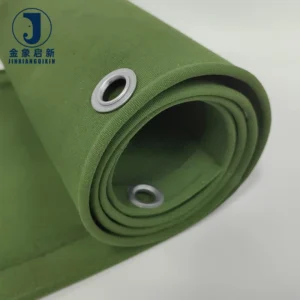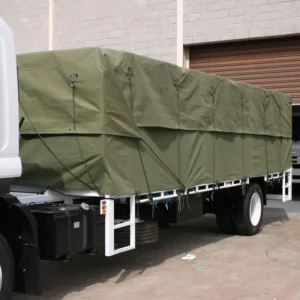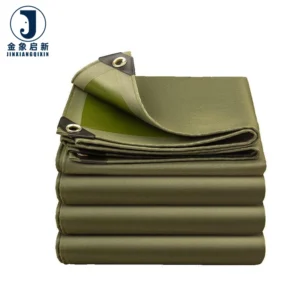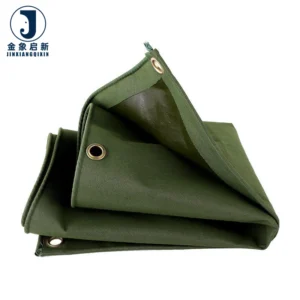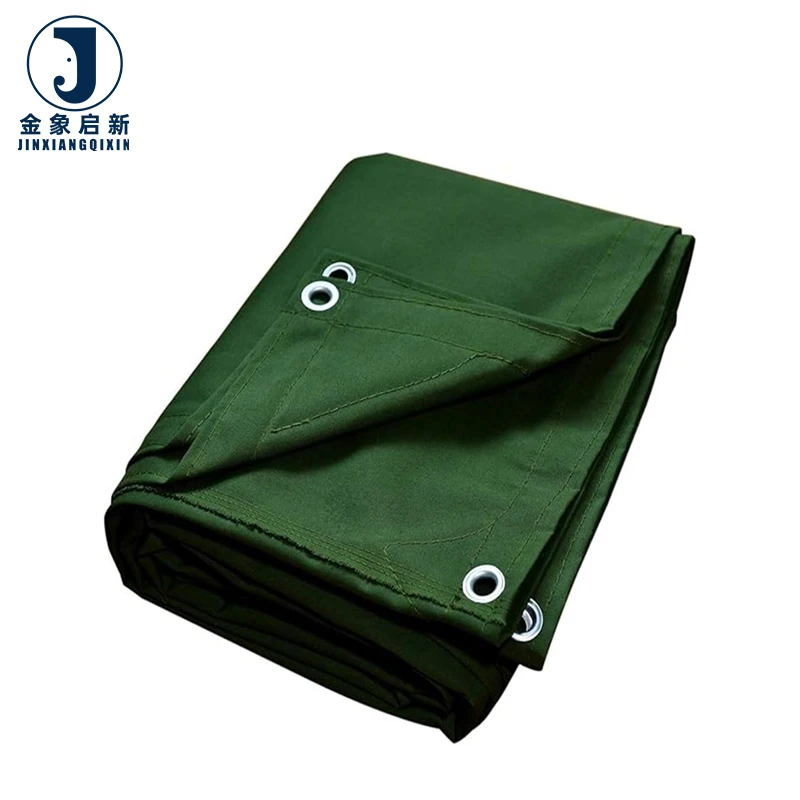
Proven Coating Control — we hold a 600gsm polyester-cotton canvas specification within tight adhesion and weight tolerances across every production run for truck and transport cover applications.
Technical Specifications
| Parameter | Value |
|---|---|
| Product Type | Canvas Tarps |
| Weight | 600gsm |
| Base Fabric | Polyester cotton industrial textile, 8-12 strands of fine cotton yarn |
| Coating Material | Silicone |
| Total Thickness | 0.5mm / 0.6mm / 0.7mm |
| Roll Width | 2m |
| Roll Length | 100m |
| Color Options | Army Green Camouflage / Custom |
| Key Features | Wear-resistant, corrosion-resistant, tensile-resistant, high- and low-temperature resistant |
| Waterproof Rating | Waterproof (test basis not stated) |
| UV Treatment | UV resistant (test basis not stated) |
| Anti-Mildew | Mold resistant (test basis not stated) |
| Eyelet Spacing | Aluminum eyelets every 1 metre at corners and hem |
| Edge Reinforcement | Welded and sewn hems with poly ropes |
| Certifications | CE, ISO |
Application Suitability
| Application | Exposure & Requirement |
|---|---|
| Truck and trailer load cover | Constant road vibration, flex at tie-down points, wind load at highway speed |
| Construction material transport | Abrasion from load shift, asphalt contact, UV exposure during staging |
| Machinery and engine hood cover | High-temperature exposure near engines, repeated removal and refit cycles |
| Open-air stock cover | Prolonged weather exposure, moisture ingress, mold risk in humid climates |
Why Canvas Tarpaulin for Truck and Transport Cover Fails at the Hem Before the Fabric Does
The seam carries more load than the panel.
When a truck cover is cut to a generic size and tied down over a moving load, the stress concentrates at every eyelet and along the welded hem. The 600gsm woven base holds its shape under road vibration, but if the hem reinforcement is undersized or the eyelet spacing is too wide, the fabric tears outward from the grommet. I have seen covers pulled off trailers at highway speed because the tie-down rope cut through an unreinforced edge while the centre of the panel was untouched [NEED_CITE: tensile and tear test methods for coated fabrics per ISO 1421]. This is why every aluminium eyelet on this canvas tarpaulin for truck and transport cover is placed at one-metre intervals along both the corners and the full hem, and why each edge is folded, welded, and sewn around a poly rope before it ever reaches a fleet.
Cut-to-Model Fit for Fleet Operators
A cover that is two hundred millimetres too wide flaps in crosswind and wears itself against the load. This canvas tarpaulin for truck and transport cover is cut to the exact vehicle dimensions in your fleet — not pulled from a generic roll and trimmed on site. The 2-metre base roll width is joined and welded to the required panel size, then each finished cover is matched against the truck or trailer model drawing before dispatch. Fleet operators covering mixed vehicle types receive individually labelled covers so the right unit goes on the right trailer every time.
Tie-Down Security Under Highway Wind Load
The aluminium eyelets are rust-proof and spaced every 1 metre, giving a secure anchor point for rope or ratchet strap at each interval. The poly rope sewn into the hem distributes the tie-down force across a wider fabric zone rather than letting it concentrate at a single grommet. For long-haul routes that cross climate zones, the high- and low-temperature resistance of the silicone-coated base prevents the hem from stiffening and cracking in cold starts or softening in midday heat [NEED_CITE: silicone coating thermal performance range for industrial textiles].
Reading the Specification Beyond the Weight
The 600gsm figure describes the total mass per square metre of the coated fabric, but the actual load-bearing performance comes from the polyester cotton base woven with 8-12 strands of fine cotton yarn. That woven structure determines how far a tear will propagate once it starts — a denser weave arrests tear spread faster than a loose one at the same weight. The silicone coating adds water resistance, surface durability, and the high- and low-temperature tolerance that PVC-only coatings cannot match in extreme climates. Thickness options of 0.5mm, 0.6mm, and 0.7mm give flexibility depending on whether the priority is packability for daily removal or abrasion resistance for semi-permanent installation. The 2m roll width and 100m roll length mean large covers require joining; the number and placement of those weld lines directly affect the finished cover’s flex behaviour under load.
The Cost of Underspecified Edge Reinforcement
A cover that meets its GSM target in the centre panel but has poorly welded hems will fail at the eyelet line within the first season of highway use. The repeated cycle of tying down, releasing, and refitting fatigues the edge faster than any other zone. When the weld adhesion is insufficient, the hem peels away from the base fabric and the eyelet pulls free under load. This failure is not a material defect — it is a fabrication gap. Every hem on this canvas tarpaulin is folded, heat-welded, and then sewn around a poly rope in a single continuous process so the mechanical bond and the sewn bond back each other up [NEED_CITE: welded seam peel strength testing for coated fabrics].
Why Sourcing This Canvas Tarpaulin Through Jinxiang
Three full production lines and 36 sets of professional equipment hold the 600gsm coating weight within specification across every roll in a batch. The 10-person R&D team develops cut-to-model patterns against your fleet’s truck and trailer drawings before production begins, eliminating on-site trimming. A dedicated QA/QC process runs at every production stage, with 100% inspection before shipment — not a sampling check on one roll per container. Custom widths, colours, and finished cover sizes are handled in-house without the extended minimums that converters typically impose. Sample development for custom requirements is completed within days, letting you verify weight, hand feel, and colour before committing to bulk. Documentation travels with every dispatch so the material on your dock can be checked against the quoted specification immediately.
Documentation & Verification
- Material specification sheet confirming 600gsm weight and silicone coating type per roll
- Pre-shipment inspection record with photographic evidence per finished cover
- Roll packing list detailing roll count, weight, and dimensions per container
- CE and ISO certificates included in the dispatch documentation package
- Custom sizing confirmation sheet matched to vehicle model drawing
Fabrication, Handling & Storage
- Weld temperature must suit the silicone coating to maintain peel strength at the 0.5mm–0.7mm thickness range
- Aluminium eyelets at 1-metre spacing require a reinforced die setting to avoid crushing the woven base
- Store 2m rolls upright on a flat pallet to prevent edge deformation across the 100m length
- Avoid prolonged compression stacking of finished covers to preserve the woven cotton yarn structure
- Use mild detergent for cleaning; solvents may degrade the silicone coating surface
What We Need to Quote Your Fleet Covers
To return an accurate specification and lead time, provide the truck and trailer model list with overall dimensions, the required colour or camouflage pattern, and the annual cover volume your fleet cycles through. If your route network includes extreme temperature zones, note the lowest and highest ambient conditions so the silicone coating grade is matched accordingly. Let us know whether you need finished cut-to-model covers or roll stock for your own fabrication line.
Frequently Asked Questions
Q: How do you cut canvas tarpaulin covers to fit specific truck and trailer models?
A: We work from the vehicle manufacturer’s dimension drawing or a measurement sheet you provide. The 2m base rolls are joined, welded, and cut to the exact panel size required, then each hem is folded and sewn with poly rope before the aluminium eyelets are set at one-metre intervals. A fit confirmation is shared before bulk production.
Q: How is the 600gsm weight verified on arrival?
A: Every roll carries a material specification sheet stating the 600gsm target. Our pre-shipment inspection includes a weight-per-square-metre check recorded on the inspection report that ships with your order. You can cross-check the figure on receipt using a simple cut-and-weigh method on a sample piece.
Q: What eyelet spacing and hem reinforcement options are available for highway tie-down?
A: The standard configuration places rust-proof aluminium eyelets every 1 metre at corners and along the full hem, with each edge folded, welded, and sewn around a poly rope. If your tie-down system requires closer spacing or additional corner reinforcement, the pattern is adjusted before the hem is closed.
Q: How do you handle colour consistency when ordering multiple covers for a mixed fleet?
A: All rolls in a single order are coated from the same batch of silicone compound and base fabric, so the army green camouflage or custom colour stays consistent across every finished cover. The pre-shipment inspection record includes a visual colour check across the batch before dispatch.
Q: What UV and weather resistance test basis supports the outdoor durability claim?
A: The canvas tarpaulin is specified as UV resistant and mold resistant; the specific test method or exposure duration is confirmed on request. If your market requires a particular UV standard or weathering certification, provide the reference so we can include the matching test report with your documentation.