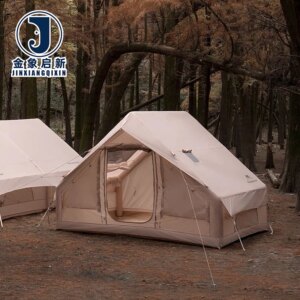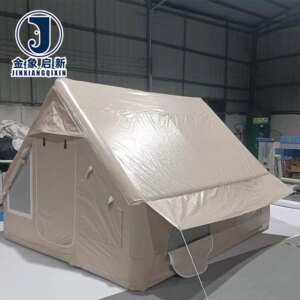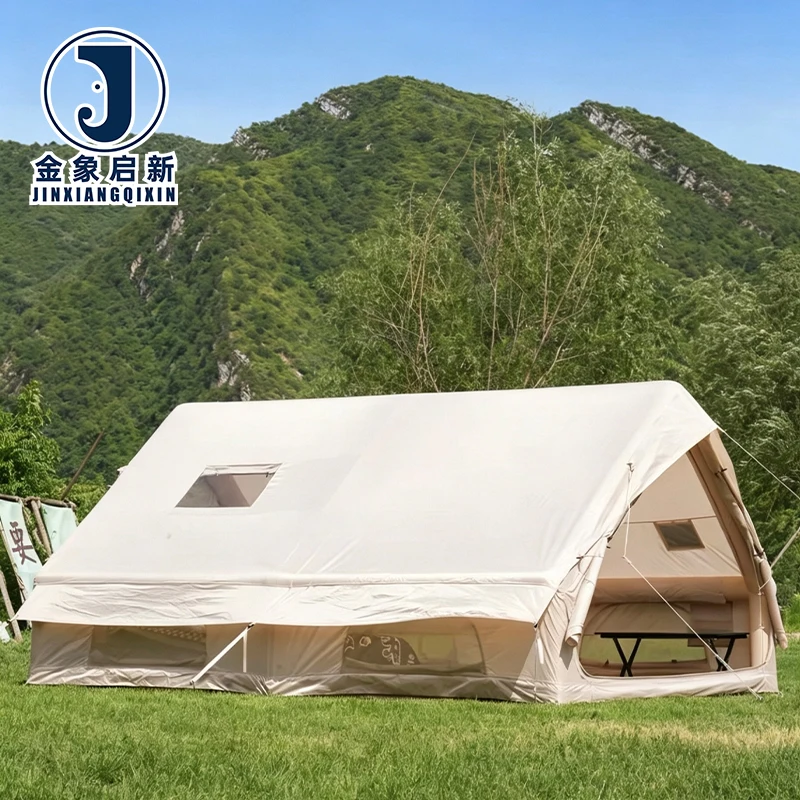
Single-Source Material Control — Every roll of inflatable tent fabric is traced from base yarn to final coating, eliminating the batch-to-batch weight drift that plagues multi-vendor supply chains.
Technical Specifications
| Parameter | Value |
|---|---|
| Product Type | Inflatable Tent Fabric |
| Core Material | PVC Tarpaulin |
| Construction | Single-layer coated fabric |
| Capacity | 8-10 Person |
| Opening Mechanism | Quick automatic opening |
| Season Rating | Four-season |
| Waterproof | Available — confirm test standard required for your market |
| UV-resistant | Available — confirm test standard required for your market |
| Tear-resistant | Available — confirm test standard required for your market |
| Flame-retardant | Available in flame retardant grades — confirm the grade required for your market |
| Anti-static | Available — confirm test basis required for your application |
| Customization | OEM & ODM including sample customization and pattern printing |
| Certifications | ISO9001, ISO14001, ISO45001, CE |
Application Suitability
| Application | Exposure & Requirement |
|---|---|
| Family camping equipment manufacturing | Repeated inflation cycles, ground moisture, sustained UV exposure, consumer safety compliance |
| Professional outdoor adventure packages | Extended field deployment, variable weather, abrasion from terrain contact, pack weight limits |
| Team accommodation solutions | High-frequency setup and teardown, multi-occupant load, wind loading on inflatable beams |
| Specialized event shelter systems | Rapid deployment timelines, public safety fire classification, visual branding consistency across units |
Why Fabric Consistency Matters More Than the Quoted GSM for Inflatable Tent Production
Inflatable tent fabric must perform identically from the first roll to the last, because a single weak panel compromises the entire air-beam structure.
When sourcing PVC tarpaulin for inflatable tent aftermarket supplier applications, buyers frequently discover that the GSM confirmed on the sample does not match the bulk delivery. Coating weight can drift across a production run when process controls are loose, and this variation shows up most visibly at the heat-welded seams where inflatable beams bend under load. Tent manufacturers then face field failures that trace back not to design flaws but to material inconsistency between panels cut from different rolls [NEED_CITE: tensile and tear test methods for coated fabrics per ISO 1421].
Coating Adhesion and the Inflatable Beam Stress Cycle
An inflatable tent relies on air pressure to maintain its structural shape, which places constant outward force on every seam and welded joint. The PVC tarpaulin used for this application must maintain coating adhesion through thousands of inflation and deflation cycles. When the coating separates from the base fabric at a flex point, the beam loses rigidity and the shelter collapses. This is why peel strength matters as much as tensile strength for inflatable tent aftermarket supplier specifications.
Heat-Welded Seams as the Critical Failure Boundary
Most inflatable tent failures originate at the welded seams rather than the fabric body. The heat-welding process fuses two PVC-coated surfaces together, and the bond strength depends directly on coating uniformity. If one roll carries a slightly different coating weight or plasticiser ratio, the weld temperature that works for one panel may under-bond or scorch the next. Maintaining weld integrity across an entire production batch requires that the inflatable tent fabric arrives with consistent coating chemistry from start to finish [NEED_CITE: DIN 4102 fire classification for building materials].
Reading Beyond the GSM Number on the Quotation
GSM tells you the total weight per square metre but says nothing about how that weight is distributed between base fabric and coating. A heavier coating on a lighter base yarn can deliver the same GSM as a balanced construction yet perform very differently under the cyclic stress of an inflatable beam. Base fabric denier and weave density determine how the material resists tear propagation, while coating weight governs waterproofing and weld behaviour. Specifying both elements separately, rather than relying on GSM alone, gives you a fabric that holds up through the inflation cycles your inflatable tent aftermarket supplier customers expect.
The Hidden Cost of Batch-to-Batch Colour Drift
When an event operator orders twenty identical inflatable shelters and the rolls arrive with visible colour variation, the entire shipment may be rejected at the installation site. This colour shift typically stems from pigment dosing inconsistency during the coating stage, and it becomes obvious only when panels are erected side by side outdoors. For inflatable tent fabric buyers producing branded event shelters or multi-unit accommodation camps, a single off-shade roll can trigger a full batch return, delayed project timelines, and strained relationships with end clients [NEED_CITE: colour fastness testing standards for coated textiles].
Why Procurement Verification Starts Before the Order Ships
Reliable inflatable tent production demands documentation that proves the material matches the specification, not just a quotation that promises it does. Every roll should be accompanied by a material specification sheet confirming GSM, base fabric construction, and coating weight. Where flame-retardant or anti-static treatment is required for your market, the corresponding test report must ship with the batch rather than being offered vaguely upon request. Pre-shipment inspection records and roll-by-roll packing lists close the verification loop before the container leaves the factory.
What Production Capacity Means for Your Delivery Schedule
Our facility operates three full production lines and 36 sets of professional processing equipment dedicated to coated fabric, giving us the throughput to fulfil bulk inflatable tent fabric orders without splitting your batch across multiple production windows. A 10-person R&D team handles sample development, pattern printing layouts, and custom sizing so you can validate the material before committing to full production. Dedicated QA and QC staff inspect every roll at each production stage, with 100% pre-shipment inspection ensuring that what leaves the factory matches what was approved on sample.
Documentation & Verification
- Material specification sheet confirming GSM, base fabric denier, and coating weight per roll
- UV and flame-retardant test reports supplied with each batch where applicable
- Pre-shipment inspection record covering coating adhesion, colour, and dimensional accuracy
- Roll packing list with individual roll weights and running metres for inventory planning
- Certificate of origin and customs documentation supporting international shipment
Fabrication, Handling & Storage
- Heat-weld at temperatures matched to the PVC coating formulation — test on a sample offcut from each roll before full production
- Store rolls upright on pallets in a dry, shaded warehouse to prevent flat-spot deformation of the single-layer PVC tarpaulin
- Avoid dragging rolls across concrete floors to protect the coating surface from abrasion damage
- Allow cold-stored rolls to reach ambient temperature before unrolling to prevent coating cracking at low temperatures
- Use PVC-compatible adhesives for field repairs on inflatable beam sections, matching the coating chemistry
How to Structure Your Enquiry for Fast Quoting
To move quickly from enquiry to sample, share your target inflatable tent dimensions, annual volume, and the specific fire-retardant or anti-static classification your end market demands. If you require custom pattern printing or branded panels, provide artwork files and colour references so we can prepare a print-proof sample alongside the base fabric swatch. Confirm whether you need finished cut-and-welded panels or roll stock for your own production line.
Frequently Asked Questions
Q: Can I receive test reports for UV resistance and flame-retardant treatment with my order?
A: Yes. Where UV or flame-retardant treatment is specified in your order, the corresponding test report is generated per production batch and included in the shipping documentation. Confirm the specific grade or standard your market requires during the enquiry stage so the correct treatment is applied and tested before dispatch.
Q: How do you maintain colour consistency across multiple rolls in one order?
A: Pigment dosing is controlled at the coating stage with calibrated dispensing equipment, and every roll is compared against the approved colour reference under standardised lighting. Rolls that fall outside the tolerance band are flagged during pre-shipment inspection and excluded from your batch, ensuring that panels erected side by side show no visible shade difference.
Q: What customisation options are available for inflatable tent fabric?
A: We offer OEM and ODM services including custom dimensions, pattern printing, and sample development. You can specify the cut size, seam configuration, and print layout for your inflatable tent design. A pre-production sample is prepared for your approval before bulk manufacturing begins, allowing you to validate material performance and visual appearance.
Q: What is the sample lead time and can I approve before bulk production starts?
A: Samples are developed within days of receiving your specification and artwork files. You evaluate the sample for coating weight, colour, weld behaviour, and print accuracy. Bulk production only begins after your written approval, so any adjustments are made at sample stage rather than after full manufacture.
Q: Which certifications are included and do you support customs documentation?
A: Production is certified to ISO9001, ISO14001, and ISO45001, and products carry CE marking. We supply a certificate of origin, roll packing list, and customs support documentation with every shipment to streamline import clearance in your destination market.