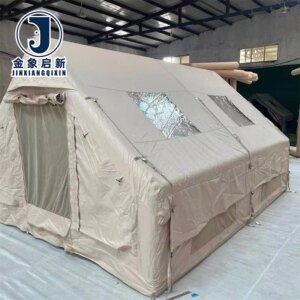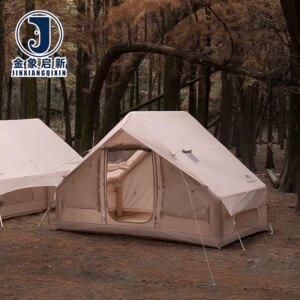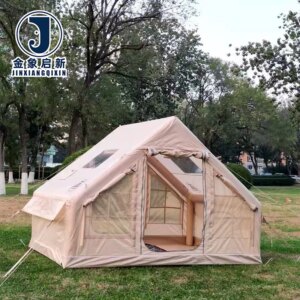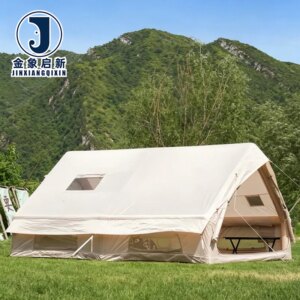
Coating Adhesion Control — verified through in-house peel strength checks on every PVC knife-coated batch before release, ensuring consistent seam welding performance for inflatable structures.
Technical Specifications
| Parameter | Value |
|---|---|
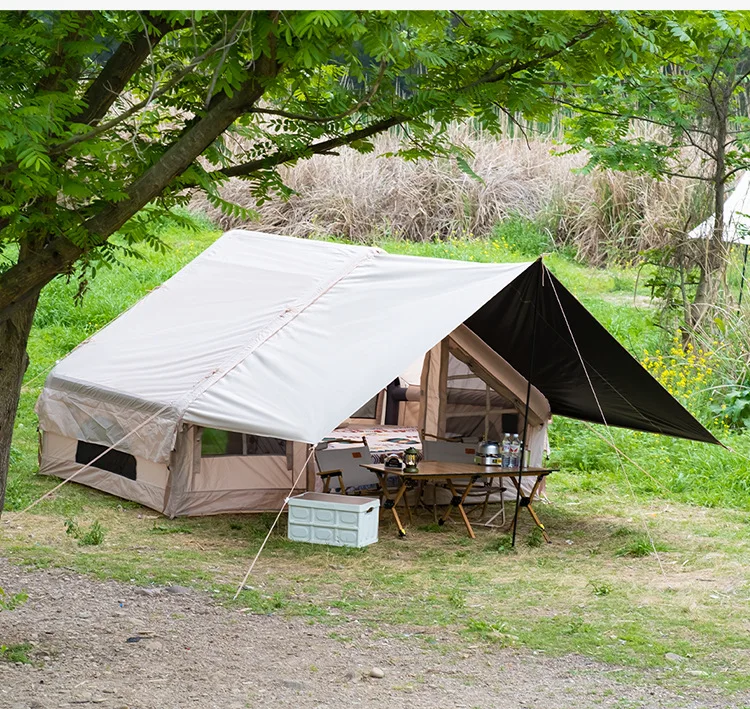
| Product Type | Inflatable Camping Tent |
| Core Material | PVC tarpaulin (knife coated fabric) |
| Construction | Single-layer |
| Capacity | 2-3 Person |
| Waterproof Rating | Hydrostatic head exceeding 5000mm (source value — verify against manufacturer catalog) |
| UV Service Life Claim | Minimum 5-year outdoor service life (source value — verify against manufacturer catalog) |
| Fire-Retardant | Claimed (grade not stated) |
| Key Features | Waterproof, UV-resistant, tear-resistant, quick automatic opening, four-season use |
| Customization | OEM & ODM — size adjustments, material thickness modifications, custom pattern printing, branding integration |
| Quality Control | Full-process QA & QC, 24-hour pressure retention testing, water immersion trials |
| Sample Lead Time | 5-7 days |
| Production Lead Time | 15-20 days (standard custom orders 50-500 units) |
| Standards | ISO9001, ISO14001, ISO45001, CE |
Application Suitability
| Application | Exposure & Requirement |
|---|---|
| Commercial outdoor gear product lines | Branded retail packaging, consistent colour across production runs, warranty-grade material performance |
| Emergency response temporary shelter modules | Rapid deployment, repeated inflation cycles, all-weather ground contact, multi-unit logistics staging |
| Industrial site operations | Continuous outdoor exposure, abrasion from site traffic, wind loading on inflated forms |
| Wholesale distribution to outdoor retailers | Container-load roll consistency, shelf-ready branding, compliance documentation for destination markets |
Why Stated Waterproof Ratings Fail Without Batch-Level Verification
A hydrostatic head number on a quotation means nothing unless the test report is traceable to the specific roll batch that arrives at your warehouse.
Inflatable camping tent buyers routinely face a gap between the waterproof rating quoted at the sampling stage and the performance of bulk production fabric. Coating weight variation across a production run can shift the hydrostatic head by a measurable margin, leaving some units vulnerable to seam leakage under sustained rain exposure. Without a batch-specific test record attached to each shipment, procurement teams have no basis for holding the mill accountable. [NEED_CITE: hydrostatic head test methods for coated fabrics per ISO 811]
Single-Layer PVC Architecture for Inflatable Tent Structures
The single-layer PVC tarpaulin construction serves a dual purpose in inflatable camping tent design: it provides the airtight envelope required for structural inflation while maintaining a weight profile suitable for transport and field deployment. Knife-coated PVC fabric delivers uniform coating thickness across the full roll width, which is critical when heat-welded seams must hold continuous internal pressure without leak paths. This custom PVC inflatable tent shell is engineered to balance portability with the mechanical demands of four-season use.
Airtight Seam Welding Validated Through Retention Testing
Every finished inflatable unit undergoes a 24-hour pressure retention test alongside water immersion trials to confirm that welded seams maintain airtight integrity under sustained load. This protocol catches micro-leaks at flex points and junction overlaps before dispatch — the exact locations where field failures concentrate. For an inflatable camping tent manufacturer, this level of in-process QA means fewer warranty returns and documented evidence that seam strength meets the structural requirement. [NEED_CITE: seam strength test methods for coated fabrics per ISO 1421]
Reading the Material Data Beyond the GSM Figure
The knife-coated PVC construction used here produces a homogeneous coating layer bonded directly to the base fabric, which affects both peel strength and heat-weld behaviour. Unlike laminated alternatives, knife coating allows the PVC compound to penetrate the weave interstices, creating mechanical anchoring that resists delamination under repeated inflation and deflation cycles. The base fabric denier and weave density together determine how tear forces propagate once a puncture initiates — a heavier denier yarn with tighter weave spacing restricts tear extension far more effectively than coating thickness alone. For inflatable structures that depend on continuous air pressure, this relationship between base fabric specification and coating method directly governs service reliability. Surface finish options — glossy or matte — influence both cleanability in the field and the adhesion characteristics for printed branding or applied logos.
The Cost of Overlooking Coating Consistency in Inflatable Applications
When coating weight drifts across a roll batch, heat-weld parameters calibrated on the sample no longer produce reliable seams on production units. Some welds over-fuse and become brittle; others under-fuse and separate under inflation pressure. Colour variation between rolls becomes visible when multiple inflatable tents are deployed side by side at a commercial site or photographed for retail catalogues. These inconsistencies force rework, delay shipment schedules, and erode buyer confidence in the supply chain. [NEED_CITE: coating weight tolerance standards for PVC coated fabrics]
Why Procurement Teams Source This Inflatable Fabric Here
Nearly 30 years of PVC coated fabric production provides the process control needed to hold coating weight and colour consistency across bulk runs — critical when every inflatable tent unit in an order must perform identically. Three full production lines and 36 sets of processing equipment support volume orders with dependable scheduling for 50–500 unit batches. A 10-technician R&D team develops OEM and ODM samples within days, handling size adjustments, material thickness changes, pattern printing, and branding integration under one roof. Every production stage carries dedicated QA and QC inspection, with 24-hour pressure retention and water immersion testing on every finished inflatable unit before it ships.
Documentation & Verification
- Material specification sheet stating PVC base fabric type, coating method, and waterproof rating matched to batch
- UV resistance and fire-retardant test reports included per shipment where applicable to your market requirements
- ISO9001, ISO14001, ISO45001, and CE certificates provided with every order for compliance clearance
- Pre-shipment inspection record documenting pressure retention and water immersion test results per unit
- Roll and unit packing list with count reconciliation for customs and warehouse intake
Fabrication, Handling & Storage
- Heat-weld temperature and dwell time must be calibrated to the specific PVC knife-coated fabric thickness for airtight seams
- Reinforce inflation valve mounting zones with additional PVC patches to distribute stress across the coated fabric
- Store rolls upright on pallets in shaded, ventilated areas to prevent coating adhesion between layers under heat
- Allow cold-stored PVC tarpaulin to reach ambient temperature before unrolling to avoid surface cracking
- Use mild detergent and soft cloth for field cleaning to preserve the PVC coating surface finish
What to Include in Your Enquiry
Provide the intended deployment environment and expected weather exposure so we can recommend the appropriate PVC fabric thickness and treatment package. Confirm your destination market’s fire safety classification requirements so we can supply the correct test documentation. Specify unit quantities, target dimensions, and any branding or pattern printing requirements to receive an accurate sample and production timeline.
Frequently Asked Questions
Q: How is waterproof performance verified and what documentation supports the rating?
A: Each batch undergoes hydrostatic head testing with results documented per roll. The stated rating exceeding 5000mm is supported by test records that ship with your order, allowing you to trace waterproof performance back to the specific production run. We recommend confirming the test method alignment with your market’s standards before placing your order.
Q: What UV resistance evidence is available and can third-party testing be arranged?
A: UV service life claims are supported by accelerated weathering test data where applicable. For buyers requiring independent validation, third-party laboratory testing can be arranged before production commences. Specify your destination market’s UV performance standards in your enquiry so we align the correct test protocol and reporting format.
Q: What OEM and ODM customisation options are available for inflatable camping tents?
A: Customisation covers size adjustments, material thickness modifications, custom pattern printing, and full branding integration. Our R&D team develops samples within 5–7 days for dimensional and performance validation. Approved samples then serve as the production benchmark, ensuring bulk units match the confirmed specification precisely.
Q: How does the 24-hour pressure retention test ensure welded seam integrity?
A: Every finished inflatable unit is inflated and held under continuous pressure for 24 hours, then subjected to water immersion to detect micro-leaks at weld junctions. This protocol identifies seam weaknesses that shorter tests miss, ensuring only units with verified airtight performance are cleared for dispatch.
Q: What lead times apply and what documentation ships with each order?
A: Sample development takes 5–7 days, with production requiring 15–20 days for standard custom orders of 50–500 units. Each shipment includes a material specification sheet, test reports where applicable, ISO and CE certificates, pre-shipment inspection records, and a detailed packing list for customs and inventory reconciliation.