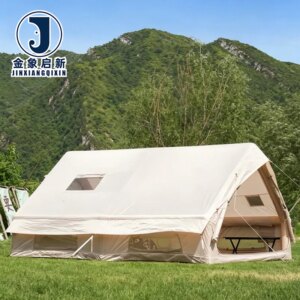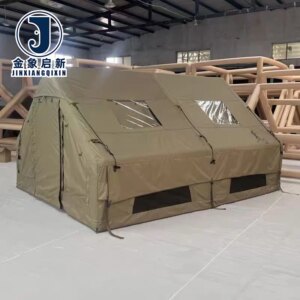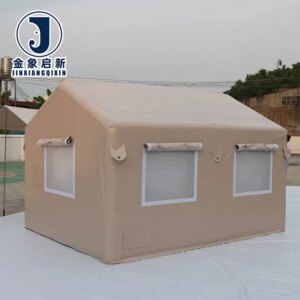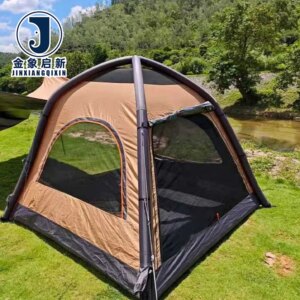
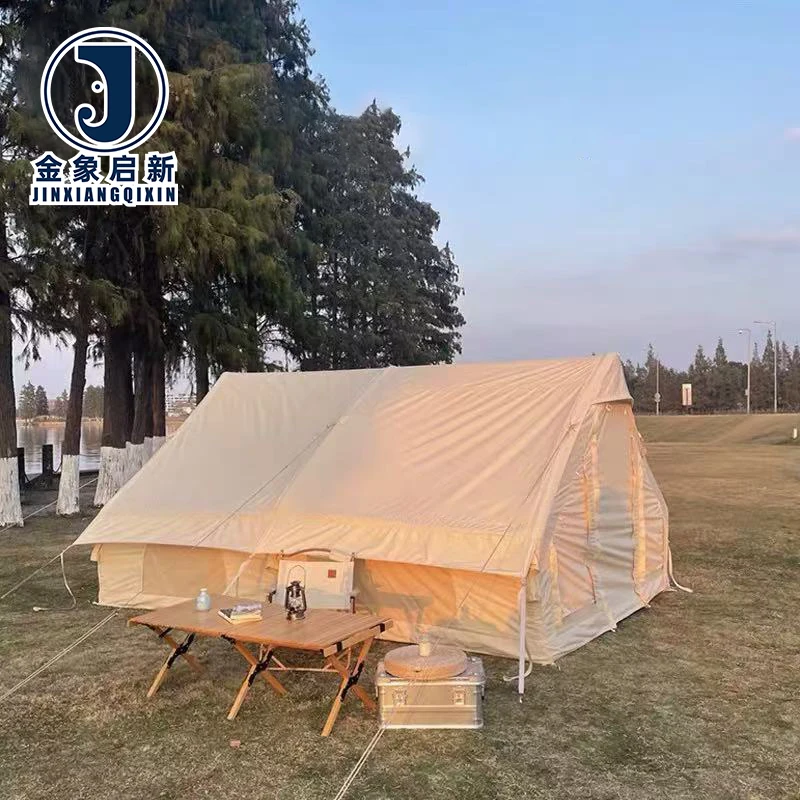
Proven Coating Process Control — Nearly 30 years of PVC tarpaulin production applied to inflatable tent fabric, ensuring batch-to-batch coating weight consistency that fleet operators and site contractors depend on when multiple shelters deploy side by side.
Technical Specifications
| Parameter | Value |
|---|---|
| Product Type | Inflatable Tent Fabric / PVC Glamping Tent |
| Core Material | PVC Tarpaulin |
| Key Performance | Waterproof, Quick Automatic Opening, Four-Season Design, Single Layer Construction |
| Production Facility Area | 9,180 m² |
| Production Lines | 3 full production lines |
| Processing Equipment | 36 sets of professional processing equipment |
| R&D Team Scale | 10 technicians |
| Customization Service | OEM & ODM (sample customization, pattern printing) |
| Quality Control System | Strict full-process quality inspection with dedicated QA & QC staff |
| Standards | ISO 9001, ISO 14001, ISO 45001, CE |
Application Suitability
| Application | Exposure & Requirement |
|---|---|
| Fleet roadside rest camps | Rapid deployment after long-haul runs, wind and rain exposure, repeated inflation cycles |
| Construction site temporary shelters | Dust, UV, mechanical abrasion from nearby equipment, frequent relocation |
| Event management staging areas | Crowd-facing appearance, weather protection for equipment and personnel, brand consistency across units |
| Expedition base operations | Variable altitude and temperature swings, moisture ingress prevention, single-layer transport efficiency |
| Industrial maintenance enclosures | Chemical splash resistance, confined workspace ventilation compatibility, short-term to mid-term duration |
Why Quick-Deploy Shelters Fail When Fabric Weight Varies Between Batches
A PVC glamping tent manufacturer must guarantee coating consistency — because even minor GSM drift between production runs changes inflation behaviour and structural rigidity.
When fleet operators order multiple inflatable shelters for a seasonal contract, the expectation is uniform performance across every unit. What actually happens in the field is that some tents pressurise faster than others, seams flex differently, and the visual colour match breaks down when units stand side by side at a base camp. These inconsistencies trace back to coating weight variation that was never caught before shipment. [NEED_CITE: ISO 1421 tensile and tear test methods for coated fabrics]
For transport contractors running remote site operations, a batch mismatch means one tent fails its pressure-hold test while the next passes — not because the design is wrong, but because the material entering the heat weld was lighter than specified. This is a custom inflatable tent problem that compounds with order volume.
How Single-Layer Construction Affects Fleet Deployment Logistics
A single-layer PVC glamping tent reduces packed weight and transport volume compared to double-wall inflatable systems. For fleet operators loading temporary shelters onto service trucks or trailers, this means more units per vehicle and fewer trips to establish a base camp. The trade-off is that thermal insulation depends entirely on the PVC tarpaulin mass and any internal lining added at site level.
The custom inflatable tent format works well where deployment speed matters more than overnight comfort — roadside breakdown response, emergency equipment cover, or crew rest rotation during extended transport runs. The quick automatic opening mechanism shortens setup from a multi-person task to a single-operator procedure, which directly impacts how fast a convoy can establish a working perimeter after arrival.
Automatic Opening Mechanism and Material Compatibility
The inflation mechanism relies on the PVC tarpaulin maintaining predictable flexibility across the temperature range encountered during a four-season operating cycle. If the coating formulation stiffens in cold conditions, the automatic opening sequence stalls and manual intervention becomes necessary — defeating the rapid-deployment advantage. Material selection must therefore account for the lowest expected ambient temperature at the deployment site. [NEED_CITE: low-temperature flexibility test standards for PVC coated fabrics]
Heat-welded seams in the inflation channels experience cyclic stress every time the tent is pressurised and deflated. A PVC glamping tent manufacturer that controls coating adhesion at the weld interface prevents delamination at these stress points. This is where production process discipline separates units that survive hundreds of inflation cycles from those that develop seam leaks within the first season.
Reading GSM, Base Fabric Density and Coating Method Together
Coating weight alone does not determine how an inflatable tent fabric performs under inflation pressure. The base fabric denier and weave density establish the tensile skeleton — a high-GSM coating on a loosely woven base will still tear under load because the yarn structure cannot distribute stress. The PVC glamping tent specification must be evaluated as a system: base fabric provides dimensional stability, coating provides waterproofing and abrasion resistance, and the interface adhesion determines whether the two layers behave as one composite or separate under flex.
Coating method matters for end-use behaviour. Knife-over-roll coating produces a uniform film that heat-welds cleanly, which is critical for inflatable chamber construction. Laminated coatings may offer cost advantages but can introduce adhesion weak points at seam intersections where inflation pressure concentrates. For a custom inflatable tent ordered in volume, the coating method directly influences weld yield rates during fabrication and field reliability over repeated deployment cycles.
Surface finish selection — glossy or matte — affects both cleaning behaviour and print adhesion. Glossy surfaces shed dirt and water more readily in muddy site conditions, while matte finishes accept screen-printed branding with better ink anchorage. The choice depends on whether the inflatable shelter serves a brand-facing event function or a purely operational industrial role.
What Happens When Inflatable Tent Material Is Specified on Price Alone
Procurement teams that select inflatable tent fabric based on the lowest quoted GSM often discover the true cost after deployment. Coating that is lighter than the stated specification means thinner inflation chambers that lose pressure faster, requiring continuous blower operation and higher fuel or power consumption on remote sites. The tent does not fail immediately — it underperforms gradually, consuming operational budget in ways the original quotation never predicted. [NEED_CITE: relationship between coating weight and air retention in inflatable structures]
Batch colour inconsistency is a second hidden cost. When a PVC glamping tent manufacturer does not control pigment dosing across production runs, tents from the same purchase order arrive in slightly different shades. For event management companies staging commercial outdoor operations, this visual mismatch undermines the professional presentation the client expects. The tents function, but the brand image suffers, and replacement orders introduce further delay.
Heat-welded seams that fail before the fabric itself does represent a third failure mode. This typically occurs when weld temperature or pressure was not calibrated to the specific coating thickness of the batch being processed. A PVC glamping tent with perfectly adequate fabric but poorly matched weld parameters will develop air leaks at the seams — the exact point where inflation stress is highest.
Why Procurement Teams Source Inflatable Tents Through This Facility
Three full production lines dedicated to PVC tarpaulin mean that inflatable tent fabric orders do not compete with unrelated product categories for machine time, reducing scheduling conflicts on large commercial contracts.
A 10-person R&D team handles specification matching for each custom inflatable tent project, reviewing base fabric selection, coating formulation and seam design against the buyer’s deployment environment before production begins.
Dedicated QA and QC staff inspect at every production stage rather than sampling only at final packing, catching coating weight deviations and weld quality issues before they compound across a full production run.
Sample development within days allows buyers to physically verify material behaviour — inflation response, weld integrity, colour accuracy — before committing to a mass-production order that could otherwise lock in an unsuitable specification.
Pattern printing and branding services integrated into the same production workflow eliminate the need to ship finished tents to a separate printing facility, reducing handling damage risk and total lead time.
ISO 9001, ISO 14001, ISO 45001 and CE documentation accompanies each shipment, providing the compliance trail that international buyers need for site approval and customs clearance.
Documentation & Verification
- Material specification sheet stating PVC tarpaulin core material, coating details and four-season performance parameters
- Batch quality inspection report accompanying each inflatable tent production run
- Pre-production sample record confirming specification match before mass fabrication
- Weight verification per roll against the stated coating parameters before dispatch
- ISO 9001, ISO 14001, ISO 45001 and CE certification documentation included with shipment
- Certificate of origin and customs support documents for international PVC glamping tent orders
Fabrication, Handling & Storage
- Heat-weld parameters must match the specific PVC tarpaulin coating thickness of each inflatable tent batch to avoid seam delamination
- Store rolled tent fabric upright on pallets to prevent flat-spot deformation that affects inflation symmetry
- Use PVC-compatible cleaners only — solvent-based products degrade the coating surface and compromise waterproof performance
- Allow cold-stored fabric to reach ambient temperature before inflation to prevent coating cracking at fold lines
- Inspect weld seams at inflation channel intersections after every deployment cycle for early-stage delamination signs
- When pattern printing is specified, confirm ink compatibility with the PVC tarpaulin surface finish before bulk production
Before You Request a Quotation — What We Need From You
To provide an accurate specification for your inflatable tent project, share the deployment environment including expected temperature range, wind conditions and duration of each setup cycle. Clarify whether the PVC glamping tent will serve a brand-facing event function or an operational shelter role, as this determines surface finish and printing requirements. Indicate the quantity range and whether multiple units must match visually for side-by-side installation. If your market requires specific fire safety or compliance documentation, state the applicable standard so the correct material grade can be selected from the outset.
Frequently Asked Questions
Q: How can I verify the PVC tarpaulin material specification matches the quotation when my inflatable tent order arrives?
A: Each shipment includes a batch quality inspection report and material specification sheet stating core material and coating parameters. You can cross-reference these documents against the original quotation and conduct your own GSM spot-check on receipt. Pre-production samples approved before mass production serve as the physical benchmark for comparison.
Q: What customization options are available for size, pattern printing and material thickness on a custom inflatable tent?
A: OEM and ODM services cover dimensional adjustments, pattern printing and coating specification selection. The 10-person R&D team develops samples for approval before mass production begins. Colour matching and branding integration are handled within the same production workflow to maintain consistency across the full order quantity.
Q: How does the sample development process work before I commit to a full production order?
A: Provide your application environment and specification requirements. The R&D team produces a physical sample reflecting the proposed PVC tarpaulin material, coating and construction. You evaluate inflation performance, weld quality and visual appearance, then approve or request adjustments. Mass production only proceeds after written sample approval.
Q: How is batch consistency controlled when I order multiple inflatable tents for a single commercial project?
A: All units within a production run use PVC tarpaulin from the same coating batch, processed on the same production line under consistent parameters. Dedicated QA and QC staff inspect at every stage. The batch quality inspection report documents coating uniformity and colour consistency across the full order before dispatch.
Q: What certification documentation is provided for international market compliance requirements?
A: Shipments include ISO 9001, ISO 14001, ISO 45001 and CE certification documentation, along with a certificate of origin and customs support papers. If your destination market requires additional testing standards for fire safety or environmental compliance, specify the applicable standard during the inquiry stage so the correct PVC glamping tent material grade is selected.