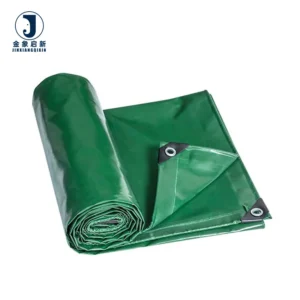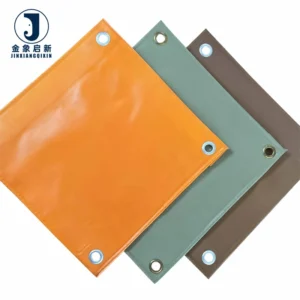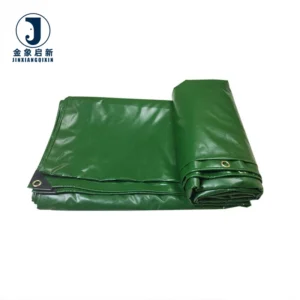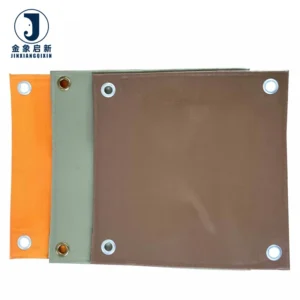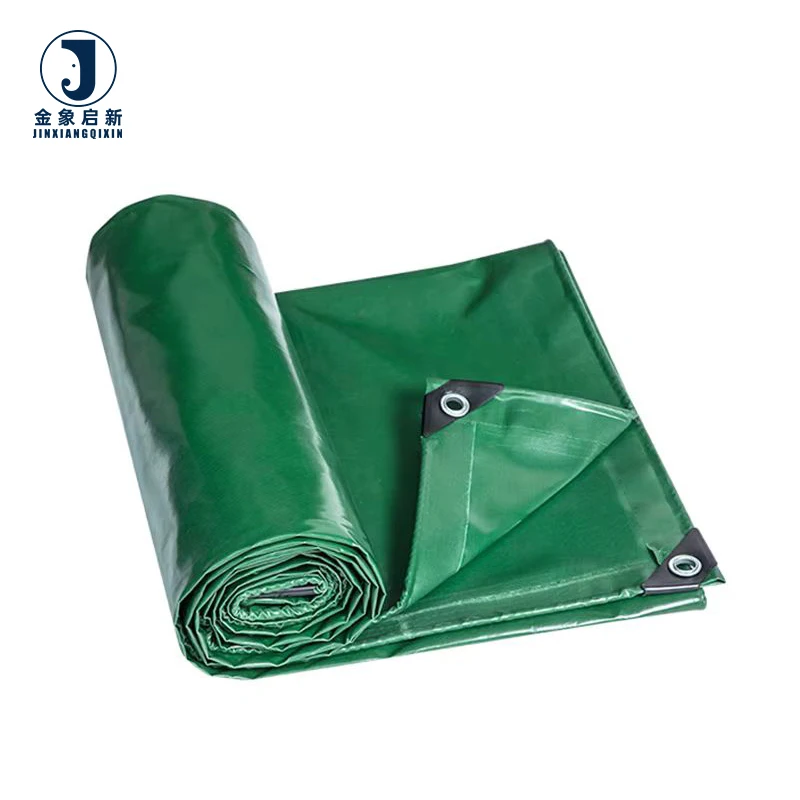
Process Control at Every Production Stage — PVC coating weight verified against specification before each roll leaves the production line, eliminating weight discrepancies that cost transport fleets downtime and rework.
Technical Specifications
| Parameter | Value |
|---|---|
| Product Type | PVC Coated Tarpaulin |
| Base Fabric | Woven Fabric |
| Coating Material | PVC Vinyl |
| Weight | At least 450 GSM |
| Waterproof | Yes |
| Tear & Wear Resistance | Wear and tear resistant construction |
| UV Treatment | Available — confirm the grade required for your market |
| Flame Retardant | Available in flame retardant grades — confirm the grade required for your market |
| Finish | Glossy or matte finish available |
Application Suitability
| Application | Exposure & Requirement |
|---|---|
| Truck and trailer load covers | Constant road vibration, flexing at tie-down points, rain and road spray |
| Side curtain fabric for transport bodies | Repeated opening and closing cycles, abrasion against curtain runners, weather exposure |
| Flatbed and tipper load protection | Heavy load contact, UV exposure during transit, wind flap stress at edges |
| Equipment covers on job sites | Dust and moisture ingress, handling abrasion, storage outdoors between deployments |
Why a Generic-Size Cover Fails Your Fleet Before the First Trip
PVC coated tarpaulin for truck and trailer covers must be cut to the exact trailer model dimensions, not a nominal size.
Fleet operators ordering covers by generic dimensions routinely face excess fabric that flaps at speed or fabric that falls short at the rear corner. Both conditions accelerate wear at the eyelets and hem. When a cover is built around the actual trailer profile — including roller door clearance, headboard shape and tailboard drop — the material sits flat and the stress distributes evenly across the welded seams. [NEED_CITE: ISO 1421 tensile and tear test methods for coated fabrics used in transport covers]
This PVC coated tarpaulin for truck and trailer covers supports custom sizing to confirmed vehicle dimensions before production begins, reducing the fitting issues that generic sheets cause in the field.
Fitment Accuracy from Quotation to Delivered Roll
Transport equipment builders and fleet operators need covers that match the trailer model on file, not a catalogue approximation. When you supply the make, model and body builder drawing, the pattern is developed against those exact dimensions. Eyelet spacing, hem reinforcement and weld line placement are then set to match the tie-down and tension points of that specific vehicle. This approach removes the guesswork from installation and prevents the edge lift that leads to premature hem failure on the road.
Seam and Edge Behaviour Under Road Load
Welded seams on side curtain and load cover fabric carry the highest stress during transit, particularly where the load flexes over uneven surfaces. The woven base fabric construction provides a stable substrate for heat welding, allowing the PVC coating layers to fuse without the thread pull-through associated with stitched seams. Reinforced hems distribute tie-down rope tension across a wider fabric area, reducing point loading at each eyelet. This PVC coated tarpaulin for truck and trailer covers can be fabricated with hem and eyelet configurations matched to your existing tie-down hardware. [NEED_CITE: welded seam peel strength testing per ISO 1421 for coated transport fabrics]
Reading the Specification Sheet Beyond GSM
GSM alone tells you how much material is present per square metre, but it does not tell you how that weight is distributed between the base fabric and the coating. A heavier coating on a lighter base may meet the stated GSM while delivering lower tear resistance than a balanced construction. The woven base fabric denier and thread count determine how the material resists tear propagation when a puncture or cut occurs under load. Coating weight governs waterproof integrity and weld performance. For transport covers subjected to daily handling, the ratio between these two layers matters more than the headline number.
The Cost of Getting the Specification Wrong
A cover that arrives lighter than the quoted GSM may look correct on the roll but fails earlier at the flex points where the trailer body twists. Covers without the required flame retardant certification for a mining or construction site will be rejected at inspection, forcing a full replacement order. Colour variation between rolls in the same batch becomes visible once installed side by side on a fleet, undermining the professional appearance operators expect. These failures are preventable with verified documentation at dispatch rather than discovered on the loading dock. [NEED_CITE: pre-shipment inspection standards for coated fabric roll consistency]
What This Supply Chain Delivers to Transport Buyers
Every roll of PVC coated tarpaulin for truck and trailer covers passes through dedicated quality checkpoints at coating, laminating and finishing stages. The 10-person R&D team develops patterns and samples for specific trailer models before bulk production commits. Three full production lines provide the capacity to fulfil fleet-scale orders within the quoted lead time. Pre-shipment inspection covers weight verification, colour consistency and weld integrity on every roll before packing. Samples are developed within days when custom sizing, treatment or colour is required, giving you physical confirmation before the production run starts.
Documentation & Verification
- Material specification sheet confirming GSM, base fabric type and PVC coating weight for each roll
- Pre-shipment inspection record with verified weight check against the stated specification
- Test report for UV or flame retardant treatment supplied with the applicable rolls
- Colour reference card matched to the production batch for side-by-side consistency checks
- Certificate of origin and customs documentation included with each shipment
Fabrication, Handling & Storage
- Heat weld at the temperature recommended for this PVC vinyl grade to avoid coating scorch at seam lines
- Space eyelets to match the tie-down rope tension load, reinforcing each with a PVC patch on this woven base
- Store rolls upright on a flat surface to prevent edge creasing that transfers into the finished cover
- Allow cold-stored rolls to reach ambient temperature before unrolling to avoid coating crack at the fold
- Clean with mild detergent only; solvent-based cleaners will soften the PVC coating surface
Before You Request a Quotation
Provide the trailer make and model or body builder drawing so the cover pattern matches your exact vehicle dimensions. Confirm whether your operating environment requires a specific flame retardant or UV treatment grade, and note the target market compliance standard. State whether you need finished covers with eyelets and hems, or roll stock for your own fabrication workshop, along with the quantity and colour required.
Frequently Asked Questions
Q: How is GSM verified on arrival and what happens if the rolls are lighter than quoted?
A: Each roll undergoes a documented weight check during pre-shipment inspection, recorded against the stated GSM on the material specification sheet. If a discrepancy is found before dispatch, the roll is held and reworked. On arrival, you can verify with a scale and sample cutter against the supplied inspection record, giving you a documented basis for any claim.
Q: Can the tarpaulin be cut to fit my specific truck or trailer model?
A: Yes. Provide the trailer make, model and body builder drawing, and a pattern is developed to those exact dimensions before production. This includes headboard shape, roller door clearance and tailboard drop so the PVC coated tarpaulin for truck and trailer covers fits without excess fabric or short corners.
Q: What eyelet spacing and hem reinforcement options are available for tie-down loads?
A: Eyelet spacing and hem width are set according to your tie-down rope layout and the load tension expected in service. Each eyelet is reinforced with a welded PVC patch on the woven base fabric to spread point loads and prevent pull-through during transit and windy conditions.
Q: How do welded seams perform at flex points under road vibration?
A: Heat-welded seams fuse the PVC coating layers directly, eliminating thread pull-through that stitched seams experience at high-flex areas. The woven base fabric provides a stable substrate for consistent weld penetration, which is verified during in-process quality checks before the cover leaves the production line.
Q: What UV or weathering treatment is applied and on what test basis?
A: UV stabiliser is available as a treatment option, applied during the coating stage. The specific grade and test basis depend on the exposure conditions and market requirements you specify. Confirm the performance standard required for your operating region so the correct treatment level is selected and documented with a test report.