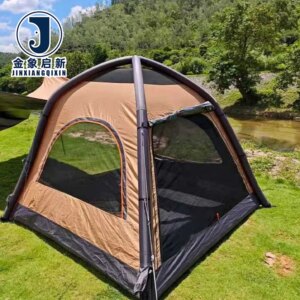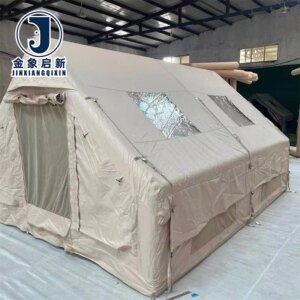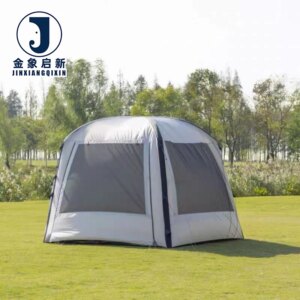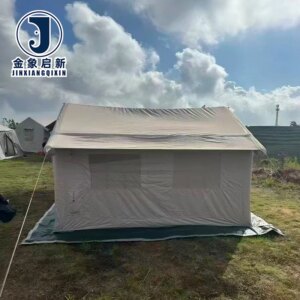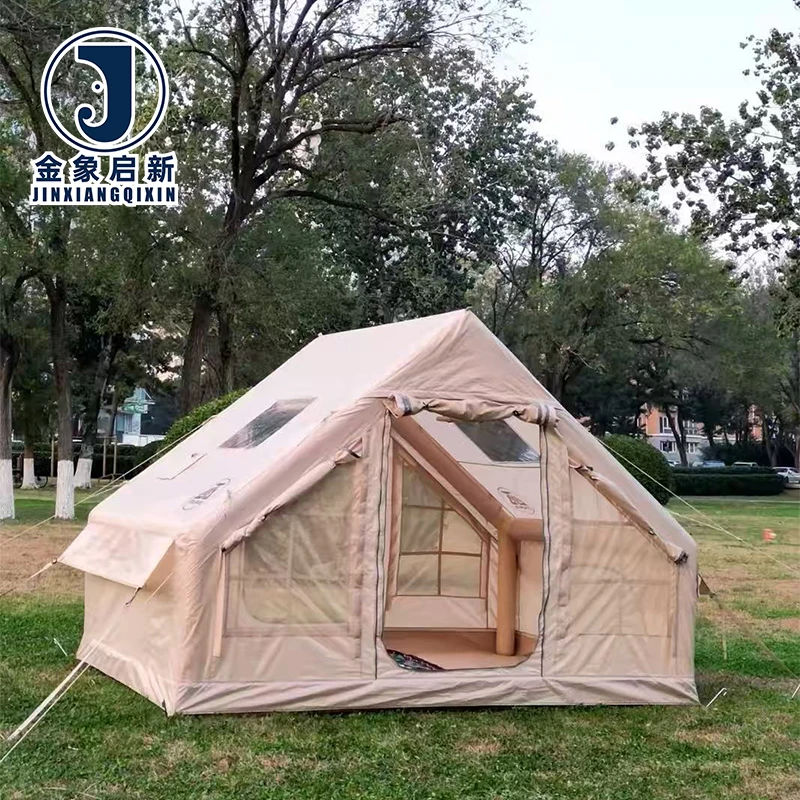
Process-Controlled Coating — Three full production lines and 36 sets of equipment support consistent PVC tarpaulin output, with dedicated QA and QC checking every inflatable tent before dispatch.
Technical Specifications
| Parameter | Value |
|---|---|
| Product Type | Inflatable Tent |
| Core Material | PVC tarpaulin |
| Product Form | Single layer construction, extended type |
| Waterproof | Stated (grade not stated in source) |
| UV-resistant | Stated (test basis not stated in source) |
| Tear-resistant | Stated (test standard not stated in source) |
| Flame-retardant | Stated (grade not stated in source) |
| Anti-static | Stated (standard / surface resistance not stated in source) |
| Deployment | Quick automatic inflatable frame opening |
| Season Rating | Four-season outdoor use |
| Customization | OEM & ODM (sample customization, pattern printing) |
| Standards | ISO 9001, ISO 14001, ISO 45001, CE |
Application Suitability
| Application | Exposure & Requirement |
|---|---|
| Temporary site offices | Wind loading on inflatable frame, rain and dust ingress, daily entry and exit abrasion at door zones |
| Construction material storage shelters | UV exposure over weeks or months, water pooling on roof, puncture risk from stored items |
| Mobile command centers | Rapid deployment requirement, repeated inflation and deflation cycles, equipment weight inside |
| Outdoor industrial events | High visibility and branding demand, public safety compliance, crowd contact on walls |
| Emergency response deployment | All-weather operation, transport over rough terrain, multi-day continuous use without ground anchoring |
Why "Flame Retardant" Without a Grade Leaves Buyers Exposed
Specify the exact fire classification your project requires before confirming any PVC inflatable tent order.
Procurement teams often see "flame retardant" on a quotation and assume the fabric will pass their local fire inspection. In reality, different markets enforce different standards — DIN 4102 B1 in parts of Europe, NFPA 701 in the United States, M2 in France — and a material that passes one may not satisfy another. When a PVC inflatable tent manufacturer cannot name the grade behind the claim, the buyer carries the compliance risk once the structure is erected on site. [NEED_CITE: fire classification standards for temporary structures in industrial settings]
Rapid Deployment Where Minutes Determine Operational Readiness
A custom inflatable tent built with PVC tarpaulin is designed for situations where traditional pole-and-rope assembly is impractical. The automatic inflatable frame opens in minutes once connected to an air source, eliminating the need for a trained rigging crew. For emergency response teams and construction project managers, that speed translates directly into earlier operational capability — whether the structure becomes a field command post or a weather-sealed material shelter.
Balancing Transport Efficiency with Four-Season Durability
The single-layer extended construction reduces packed weight and volume compared to multi-layer alternatives, which matters when inflatable tents travel by light truck or helicopter to remote sites. PVC tarpaulin as the core material holds its flexibility across a wide temperature range, so the fabric does not become brittle in freezing conditions or overly soft in sustained heat. This characteristic is essential for buyers who specify a single PVC inflatable tent manufacturer to supply structures across multiple climate zones.
How Base Fabric and Coating Weight Interact in Inflatable Structures
The performance of any inflatable tent fabric depends on the interplay between base fabric denier, weave density, and PVC coating weight. A heavier coating does not automatically mean higher tear strength — if the base fabric uses low-denier yarns with wide spacing, the coating bridges the gaps but contributes little to structural integrity under wind load. Coating adhesion also determines whether the PVC layer delaminates at stress points during inflation. [NEED_CITE: tensile and tear test methods for coated fabrics per ISO 1421] Buyers evaluating a PVC inflatable tent should request the base fabric specification alongside the total GSM to understand how the composite will behave when the frame is pressurized and the walls are loaded by wind or snow.
The Hidden Cost of Underspecified Seams in Inflatable Structures
Inflatable tents concentrate stress at every welded joint where air beams meet flat panels. If the welding temperature or dwell time is not matched to the exact coating weight and PVC formulation, the seam becomes the weakest point in the entire structure. Buyers have reported inflatable frames that held pressure during factory testing but failed after repeated inflation cycles in the field — almost always at a weld line rather than in the body of the fabric. When a batch of tents ships without documented weld-strength verification, the buyer discovers the shortfall only during deployment. [NEED_CITE: welded seam strength requirements for inflatable fabric structures]
Why Technical Buyers Source This PVC Inflatable Tent From Jinxiang
Nearly 30 years of coated-fabric production give the process engineers deep familiarity with how PVC adhesion behaves during high-frequency welding on inflatable geometries. Three full production lines allow simultaneous processing of multiple custom tent orders without sacrificing the inspection checkpoints at each stage. The 10-person R&D team develops samples within days, adjusting size, pattern printing, and treatment combinations so buyers can verify fit and performance before committing to a production run. Every finished PVC inflatable tent undergoes 100 percent pre-shipment inspection covering waterproof integrity, inflation hold, and seam strength. ISO 9001, ISO 14001, ISO 45001, and CE documentation ships with each consignment, removing the paperwork gap that often delays site approval.
Documentation & Verification
- Material specification sheet listing base fabric denier, coating weight, and total GSM for each tent
- Test reports for UV resistance and flame-retardant grades applicable to the order
- Pre-shipment inspection record confirming waterproof, inflation hold, and seam checks
- ISO 9001, ISO 14001, ISO 45001, and CE certificates with each dispatch
- Certificate of origin and customs documentation for cross-border shipments
Fabrication, Handling & Storage
- Heat-welding parameters must match the exact PVC coating weight to avoid seam delamination on inflatable beams
- Store deflated tents flat or loosely rolled to prevent permanent crease marks on the PVC tarpaulin surface
- Use only PVC-compatible cleaners; solvents can degrade the coating and compromise waterproof integrity
- Allow the fabric to warm to ambient temperature before inflation in cold conditions to reduce stiffness stress
- Plan cut patterns to minimize cross-grain seams on high-load inflatable panel zones
What to Include in Your PVC Inflatable Tent Inquiry
Provide your intended application, expected wind and snow loads, and the fire classification required by your local authority so the specification can be matched precisely. If you need custom dimensions, pattern printing, or branding, share artwork files and target quantities so sample development can begin without delay. Clarify whether you require finished tents or fabric-only supply for your own fabrication line.
Frequently Asked Questions
Q: How is the flame-retardant grade verified and which standards are covered?
A: Flame-retardant treatment is available in several grades. The applicable grade depends on your market — DIN 4102, NFPA 701, or other local codes. Confirm the required standard at inquiry stage so the correct formulation is applied and a matching test report is issued with your shipment.
Q: What UV test basis supports the claimed outdoor service life?
A: UV resistance is stated for the PVC tarpaulin used in these inflatable tents, but the specific test method varies by order specification. Request the UV test report during sampling so you can confirm the exposure rating meets your project duration and geographic location.
Q: How is batch-to-batch color and seam consistency controlled across finished tents?
A: Color references are locked at sample approval, and each production run is checked against that standard under controlled lighting. Weld parameters are recorded per batch so seam strength remains consistent across every inflatable tent in the order.
Q: What custom sizes, printing, and MOQ options are available for OEM and ODM orders?
A: The R&D team develops custom-size samples within days, including pattern printing and branding. Minimum order quantities depend on size and treatment combination. Share your drawings and target volume early so the sample and quotation can be aligned.
Q: How are welded seams and inflation structures inspected before shipment?
A: Every finished tent undergoes an inflation hold test and visual seam inspection. Waterproof integrity is verified on the full structure, and the pre-shipment inspection record is included with the dispatch documentation so you have traceability for each unit.