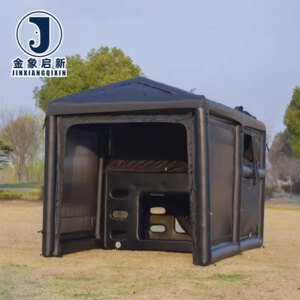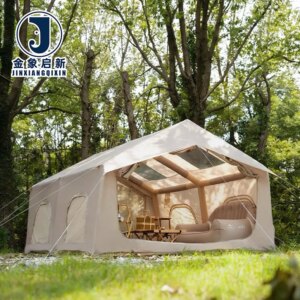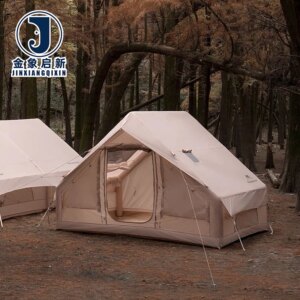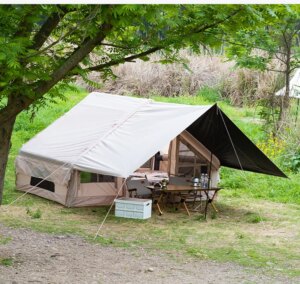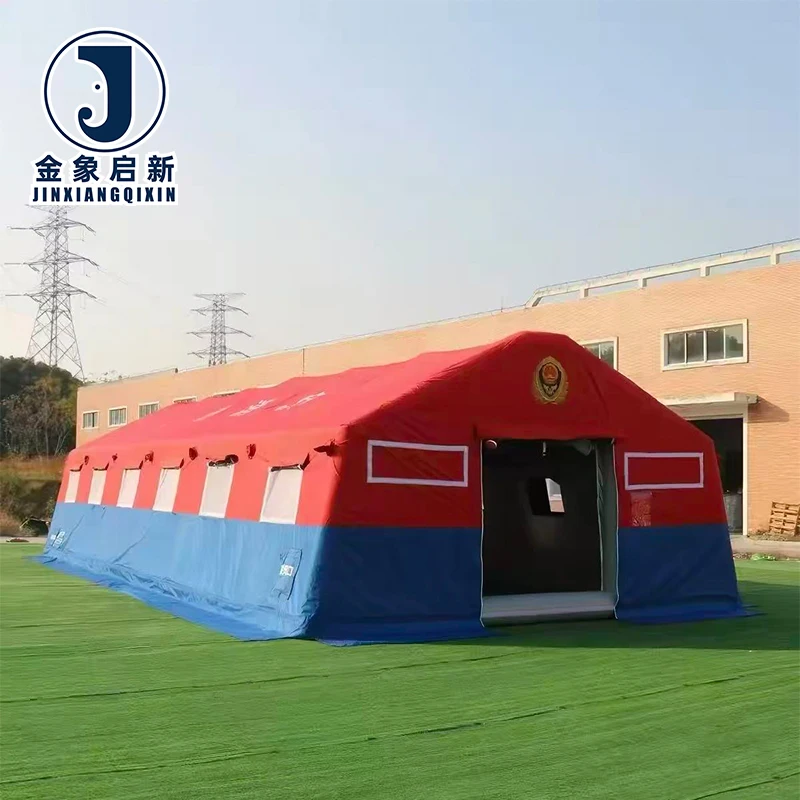
Coating Adhesion Control — every PVC inflatable tent batch undergoes full-process inspection with dedicated QA and QC staff to verify material integrity before dispatch.
Technical Specifications
| Parameter | Value |
|---|---|
| Product Type | Inflatable Tent |
| Core Material | PVC Tarpaulin |
| Product Form | Extended Type, Single Layer Construction |
| Key Performance | Waterproof, Tear-resistant |
| UV Resistance | Available — confirm the UV treatment grade required for your market |
| Customization | OEM & ODM, sample customization, pattern printing |
| Certifications | ISO9001, ISO14001, ISO45001, CE |
| Production Lines | 3 full production lines |
| Processing Equipment | 36 sets of professional equipment |
| R&D Team | 10 technicians |
| Quality Control | Full-process inspection with dedicated QA & QC staff |
Application Suitability
| Application | Exposure & Requirement |
|---|---|
| Temporary storage at construction sites | Rain ingress, dust contamination, equipment corrosion from prolonged outdoor staging |
| Emergency command centers during infrastructure projects | Rapid deployment under adverse weather, repeated inflation cycles, interior climate control |
| Mobile shelter units for logistics operations | Constant relocation handling, ground abrasion, wind load on inflatable frame |
| Disaster relief rapid deployment shelters | Time-critical setup, unpredictable terrain, extended occupant safety requirements |
| Temporary site operations and personnel staging | UV exposure, thermal fluctuation, frequent assembly and breakdown cycles |
Why Fabric Weight Alone Fails Inflatable Shelter Buyers
A heavier PVC inflatable tent does not guarantee structural integrity if the coating adhesion and seam construction are poorly controlled.
Many buyers specify a target GSM and assume the shelter will perform under field stress. In practice, inflatable structures concentrate load at inflation chambers and anchor points. When coating adhesion is weak, delamination begins at these stress zones long before the base fabric reaches its tensile limit. I have seen shelters fail at the valve collar and base seam while the field fabric remains intact — the material specification was correct, but the bonding process was not verified. [NEED_CITE: coating adhesion test methods for PVC tarpaulin per ISO 1421]
The PVC inflatable tent for transport and logistics must withstand repeated inflation and deflation without the coating separating from the base weave. This demands process control that goes beyond a weight check on the incoming roll.
Rapid Inflation Architecture for Time-Critical Deployment
The quick automatic opening mechanism addresses the most costly variable in emergency and logistics staging: setup time. When a fleet needs shelter at a remote depot or a disaster response team arrives at an unprepared site, the inflatable frame eliminates pole assembly and guy-line tensioning. The single layer extended construction keeps packed volume manageable while providing sufficient interior clearance for equipment staging and personnel movement.
Four-Season Reliability Through Material Selection
Waterproof PVC tarpaulin construction forms the primary barrier against rain and ground moisture. The tear-resistant specification handles the abrasion that occurs when shelters are dragged across gravel staging areas or rocky terrain. For UV exposure, buyers should confirm the treatment grade required for their climate zone — prolonged solar loading on dark-coloured PVC accelerates plasticiser migration and surface embrittlement when the formulation is not matched to the environment.
Understanding the Specification Parameters
The PVC tarpaulin core material determines both weather resistance and structural behaviour under inflation pressure. Single layer extended construction reduces packed weight and simplifies repair in the field, though it shifts thermal insulation responsibility to supplementary heating or ventilation systems. The inflatable frame relies on coating adhesion between the PVC layer and the base fabric — if the bond fails at a chamber weld, the entire section deflates regardless of how strong the base cloth is. Tear resistance matters most at anchor points and valve penetrations where concentrated stress propagates any small cut into a structural failure. [NEED_CITE: tensile and tear performance requirements for inflatable structure fabrics] Waterproof performance depends on seam sealing quality as much as the coated surface itself, since needle holes and hot-air welds are the most common ingress paths in single layer construction.
The Hidden Cost of Skipping Sample Validation
Buyers who approve a PVC inflatable tent from a data sheet alone often discover fit and performance issues only after the full order arrives. Colour variation between production batches becomes visible when multiple shelters are deployed side by side at a staging area. Weld strength that was adequate on the sample may drift when production speed increases, causing chamber failures during the first inflation cycle. I have encountered situations where the valve specification matched the drawing but the bonding adhesive was substituted, leading to slow leaks that were not detectable during pre-shipment visual inspection. These failures surface in the field, where replacement is slow and operational downtime is expensive. [NEED_CITE: pre-shipment inspection standards for inflatable shelter products]
Why Source This Inflatable Shelter Here
Three full production lines and 36 sets of professional equipment support consistent output volume without sacrificing the process control that inflatable structures demand. The 10-person R&D team handles pattern printing, custom sizing, and sample development in-house, so design changes are validated before mass production begins rather than corrected on the production floor. Full-process QA and QC inspection at every stage means coating weight, weld integrity, and inflation chamber sealing are checked continuously — not just sampled at final audit. OEM and ODM capability allows fleet-specific dimensions and branding to be incorporated without switching suppliers. ISO9001, ISO14001, ISO45001, and CE certified manufacturing provides the compliance documentation that infrastructure and disaster relief contracts require.
Documentation & Verification
- Material specification sheet confirming PVC tarpaulin grade and coating weight per batch
- Quality inspection report covering weld integrity and inflation chamber sealing before dispatch
- ISO9001, ISO14001, ISO45001, and CE certificates matched to shipment documentation
- UV and flame-retardant test reports where applicable grades are specified
- Pre-shipment inspection record with dimensional verification against approved sample
- Certificate of origin and customs documentation for cross-border shipment
Fabrication, Handling & Storage
- Hot-air weld temperature must match the PVC tarpaulin coating formulation to prevent delamination at chamber seams
- Valve collar bonding requires surface preparation specific to the PVC grade used in the inflatable frame
- Store deflated shelters in dry conditions to prevent moisture trapping between folded PVC tarpaulin layers
- Avoid dragging single layer construction across abrasive surfaces during deployment to protect the coated face
- Clean with mild detergent only — solvent-based cleaners degrade PVC plasticiser and compromise tear resistance
- Repair punctures with compatible PVC patches heat-welded at controlled temperature to restore chamber integrity
What to Include in Your Enquiry
Provide the intended deployment scenario and the environmental conditions the PVC inflatable tent will face — including expected wind load, temperature range, and duration of continuous use. Specify whether you need finished units with valve and anchor fittings or fabric-only supply for your own assembly line. Confirm any colour, pattern printing, or dimensional requirements so that samples can be developed for approval before production scheduling.
Frequently Asked Questions
Q: What customization options are available for fleet-specific shelter dimensions?
A: OEM and ODM services cover custom sizing, pattern printing, and valve configuration. The 10-person R&D team develops samples for approval before mass production, ensuring the PVC inflatable tent matches your fleet staging or transport logistics requirements. Specify dimensions, colour, and any branding needs in your enquiry.
Q: Is the UV-resistant performance suitable for prolonged outdoor deployment?
A: UV treatment is available in multiple grades. Confirm the exposure duration and climate zone for your application so the appropriate formulation can be specified. A test report can be provided for the selected grade to verify suitability for your PVC inflatable tent deployment environment.
Q: How is batch-to-batch consistency maintained across multiple shipments?
A: Full-process QA and QC inspection runs at every production stage. Each shipment includes a batch quality inspection report and material specification sheet with traceability data. This documentation ensures the PVC inflatable tent you receive matches the approved sample in material grade and construction.
Q: Can samples be provided before committing to a bulk order?
A: Yes. Sample development is completed within days for standard specifications and slightly longer for custom dimensions or printing. Sample approval is a formal step in the production workflow, ensuring the PVC inflatable tent meets your requirements before mass production begins on any of the three production lines.