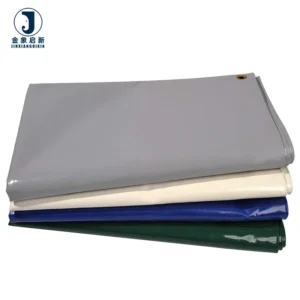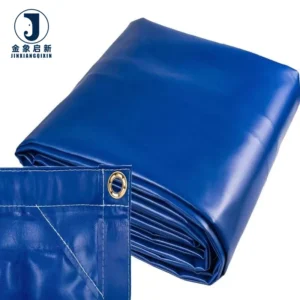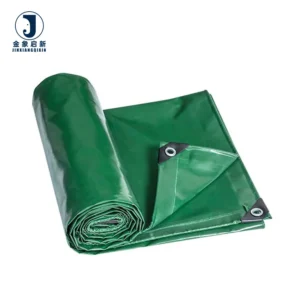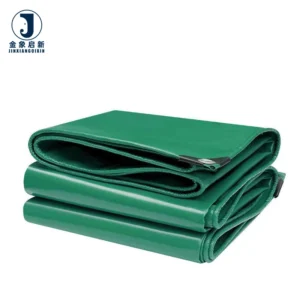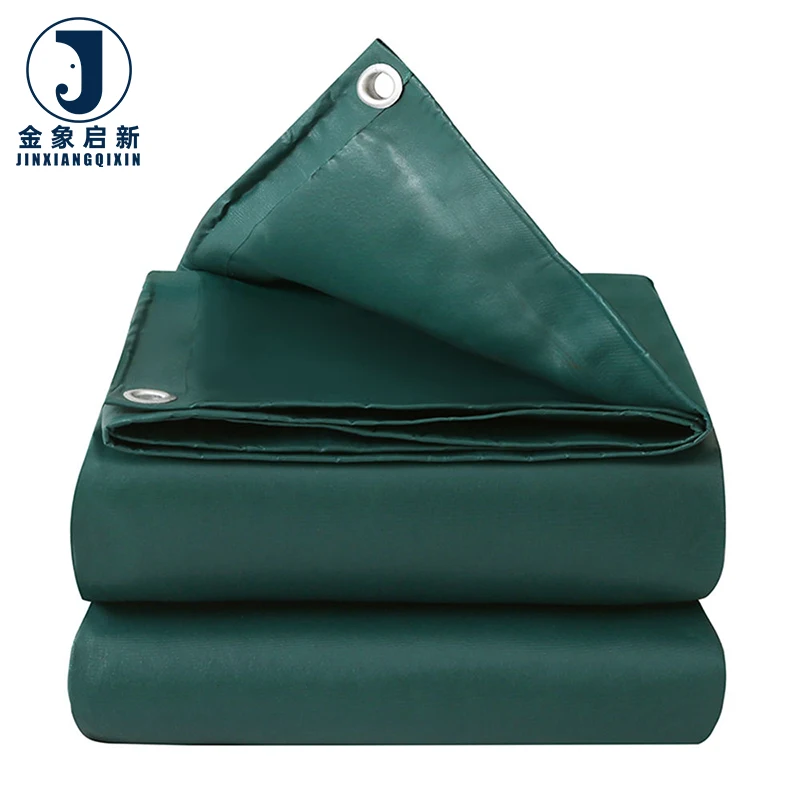
Process-Controlled Coating — three full production lines maintain consistent GSM and adhesion across every roll of PVC coated tarpaulin for truck cover applications.
Technical Specifications
| Parameter | Value |
|---|---|
| Product Type | PVC Coated Tarpaulin |
| Material | PVC + high-strength polyester mesh fabric |
| Weight (GSM) | 350 gsm / 420 gsm / 500 gsm / 550 gsm / 600 gsm / 750 gsm (confirm the grade for this item) |
| Total Thickness | 0.32 mm / 0.35 mm / 0.4 mm / 0.45 mm / 0.5 mm / 0.65 mm (confirm the grade for this item) |
| Coating Method | Laminated technology & hot-melt coating technology |
| Yarn Type | High tenacity polyester yarns |
| Roll Width | 2 m / 2.1 m |
| Roll Length | 75 m (2 m width) / 50 m (2.1 m width) |
| Finished Product Size | Custom cut to customer dimensions or sold from inventory |
| Color Options | Blue / Red / Yellow / Light blue / Grey (customized) |
| Special Treatments Available | Flame retardant, anti-static, anti-cold, anti-mildew (confirm the grade required for your market) |
| Key Features | Cold crack resistance, waterproof, sunproof, good color fastness, outstanding tearing strength for welding |
| Standards | ISO, CE |
Application Suitability
| Application | Exposure & Requirement |
|---|---|
| Truck side curtain (curtain-sider trailer) | Constant flexing at load points, road abrasion, weather exposure — requires high tear strength at welded seams |
| Flatbed truck cover with tie-down | Point loading at eyelet zones, wind lift, UV and rain — demands reinforced hems and secure eyelet anchoring |
| Truck awning and canopy | Repeated deployment and stowage, sun and precipitation — needs flexibility and color fastness over time |
| Trailer load enclosure | Aerodynamic drag, buffeting at highway speed, cargo security — requires consistent GSM and weld integrity |
| Equipment cover for transport fleet | Contact abrasion against irregular loads, stacking, forklift handling — needs puncture resistance and coating adhesion |
Why Generic-Size PVC Coated Tarpaulin for Truck Cover Fails on the Road
A cover cut to a generic rectangle flaps, abrades and exposes cargo within the first few trips.
When a fleet operator orders PVC coated tarpaulin for truck cover by width and length alone, the resulting panel rarely matches the trailer profile. Loose fabric catches wind at highway speed, generating whip stress at the hem that tears through eyelet zones within weeks. Tight panels stretch across protruding loads, concentrating force at welded seams until the weld fails before the fabric does [NEED_CITE: tensile and tear test methods for coated fabrics per ISO 1421]. Both failure modes trace back to the same root cause — a sizing process that ignores the vehicle model.
Cut to Vehicle Profile, Not to a Rectangle
The correct PVC coated tarpaulin for truck cover is patterned to the trailer geometry. Side curtain panels follow the rib spacing of curtain-sider trailers, with weld lines positioned away from the flex zones where the fabric folds during loading. Flatbed covers include darts or gussets at corners so the fabric sits flush against the load without bridging gaps. Each PVC coated tarpaulin for truck cover run is sampled first, hung on the actual trailer, and adjusted before bulk cutting begins.
Reinforcement Where Road Stress Concentrates
Tie-down straps and bungee cords press into the fabric at every eyelet, creating point loads that multiply with wind gusts and road vibration. Our PVC coated tarpaulin for truck cover panels receive additional lamination patches behind each eyelet row, spreading the load across a wider area of the base polyester mesh. Hem folds are heat-welded rather than stitched, eliminating needle holes that let water wick into the yarn bundle. [NEED_CITE: welded seam peel strength testing for PVC coated polyester fabrics]
Interpreting GSM, Thickness and Coating Technology Together
GSM alone does not predict how a truck cover will perform on the road. A 550 gsm fabric woven from thick, low-count yarns may resist tearing but crack when folded in cold weather, while a 550 gsm fabric woven from fine, high-count yarns stays flexible yet offers less puncture resistance. Hot-melt coating technology drives the PVC compound into the mesh under heat and pressure, producing higher peel strength at the weld zone compared with laminated construction — a meaningful difference when the cover flexes thousands of times per trip. Thickness, measured as the total caliper including both coating layers and the base fabric, correlates with stiffness; thicker grades resist forklift contact but add weight to manual deployment. Selecting the right combination of GSM, yarn count, coating method and thickness requires matching the specification to the trailer type, cargo profile and operating climate rather than choosing the highest number on the list.
The Cost of Specifying on GSM Alone
Fleet buyers who reduce their PVC coated tarpaulin for truck cover purchase to a single GSM figure often receive material that technically meets the weight target yet fails prematurely. A lighter base fabric compensated by heavier coating reaches the scale reading but delivers lower tear strength and poor weld adhesion. Coating applied too thick relative to the mesh absorbs road vibration as internal stress, leading to micro-cracks that spread across the panel [NEED_CITE: coating adhesion failure mechanisms in PVC tarpaulin under cyclic flexing]. Batch color drift between rolls compounds the problem when one replacement panel stands out against the rest of the fleet. These issues surface only after the covers are installed and in service, when re-cutting and re-welding cost more than the original order.
What the Production Line Delivers for Fleet Orders
Dedicated QA/QC stations inspect every roll before it leaves the facility, catching GSM variance, coating voids and color deviation at the point where correction costs least. The 10-person R&D team develops pattern-cut samples for new trailer models within days, adjusting hem allowances and eyelet spacing before bulk production starts. Three full production lines and 36 sets of professional equipment support simultaneous runs of multiple fleet orders without cross-contamination of color batches. Pre-shipment inspection records document actual measured values roll by roll, not lot averages. Hot-melt coating and laminated technology are both available in-house, allowing the coating method to be matched to the flex and weld demands of each application rather than forced into a single process.
Documentation & Verification
- Material specification sheet stating GSM, base fabric denier and coating weight matched to your purchase order
- Test report for UV and flame-retardant grades where applicable to your market regulations
- Pre-shipment inspection record with actual measured values for every roll in the shipment
- Roll packing list detailing width, length, color reference and net weight per roll
- Certificate of origin and customs documentation prepared for destination country clearance
- ISO and CE certificates included with each dispatch package
Fabrication, Handling & Storage
- Heat-weld seams at temperatures matched to the hot-melt or laminated coating grade specified for your truck cover panels
- Space eyelets to distribute tie-down loads across the high-tenacity polyester mesh without pulling through the hem fold
- Store rolls upright on their cores to prevent flat spots that telegraph through the finished cover after welding
- Allow cold-stored rolls to reach ambient temperature before unrolling to avoid cracking the PVC coating surface
- Use mild detergent and soft brush for cleaning; solvent-based cleaners may attack the plasticizer in the PVC layer
- Patch field damage with the same coating technology and GSM grade as the original panel to maintain weld compatibility
Sending the Right Specification with Your Inquiry
Provide the trailer model, side curtain rib spacing or flatbed dimensions so the pattern can be drafted before sampling. State the climate range and whether anti-cold or anti-mildew treatment is required for your operating region. Confirm whether you need finished covers cut and welded to size or roll stock for your own fabrication line. If your fleet carries corporate livery, indicate the color references and print area so the R&D team can prepare sample panels for approval.
Frequently Asked Questions
Q: How is the truck cover sized to fit a specific trailer model?
A: We request the trailer make, model and body dimensions, then draft a cutting pattern that follows the rib spacing and corner geometry. A sample panel is produced, hung on the vehicle and adjusted before bulk cutting starts. This eliminates the flapping and cargo exposure caused by generic rectangular covers that ignore vehicle profiles.
Q: How do you verify GSM matches the quotation on arrival?
A: Every roll is weighed and measured at the pre-shipment inspection stage, and actual values are recorded on the inspection report that ships with your order. The material specification sheet cross-references the quoted GSM, base fabric denier and coating weight so you can confirm delivery matches the specification you approved.
Q: What testing is done on welded seams before bulk dispatch?
A: Weld samples from the start of each production run are peel-tested to confirm adhesion strength meets the requirement for your application. If the coating method is hot-melt, parameters such as temperature and dwell time are logged. Any roll showing weld weakness is segregated before the order is packed [NEED_CITE: welded seam peel strength testing for PVC coated polyester fabrics].
Q: How is batch color consistency maintained across a fleet order?
A: All rolls in one fleet order are produced in a single coating run using the same pigment batch, and a color reference swatch is compared under standard illumination before packing. The roll packing list records the color lot number so future reorders can be matched to the same shade range.
Q: What flame-retardant and anti-static options are available?
A: Flame retardant and anti-static treatments are available in grades suited to different regulatory markets. Confirm the classification or standard required by your destination country so we can supply the matching grade with the corresponding test report included in your documentation package.