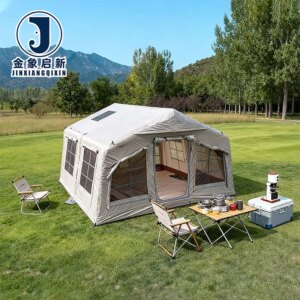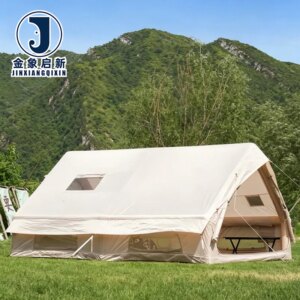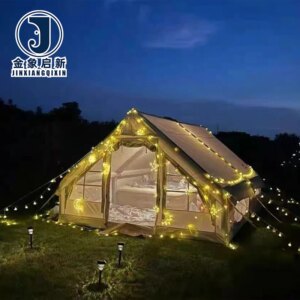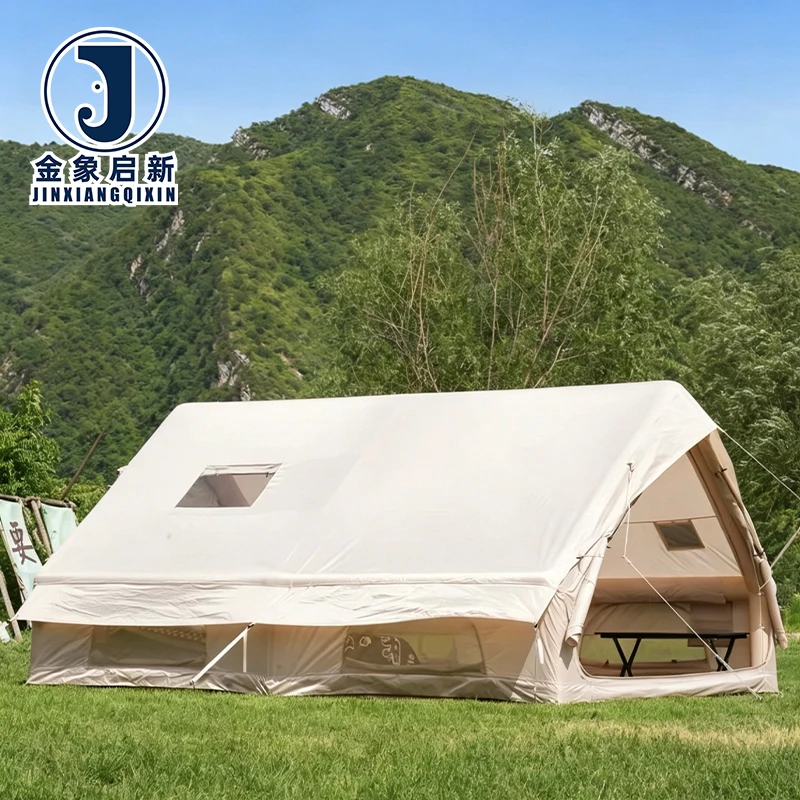
Precision-Coated Inflatable Tent Fabric — 3 full production lines and 36 sets of equipment supporting airtight inflatable tent structures with batch-traceable QA from coating to final inspection.
Technical Specifications
| Parameter | Value |
|---|---|
| Product Type | Inflatable Tent |
| Core Material | PVC Tarpaulin (knife-coated fabric) |
| Product Forms | 2-3 Person Single Layer Air Tent |
| Key Performance | Waterproof, UV-resistant, Tear-resistant, Quick Automatic Opening |
| Airtightness Testing | 20 kPa pressure validation |
| Tear Strength Standard | ASTM D751 |
| UV Aging Simulation | 2,000 hours (QUV test basis) |
| Quality Control System | 7-point inspection protocol |
| Customization Service | OEM & ODM with sample development and pattern printing |
| Sample Lead Time | 7–10 days |
| Mass Production Lead Time | 15–20 days for orders under 500 units |
| Production Facility | 9,180 m² with 3 full production lines |
| R&D Team | 10 technicians |
| Standards & Certifications | ISO 9001, ISO 14001, ISO 45001, CE |
Application Suitability
| Application | Exposure & Requirement |
|---|---|
| Commercial outdoor gear manufacturing | Repeated inflation/deflation cycles, consumer handling, retail packaging standards |
| Construction site temporary housing | Dust, mechanical abrasion, wind loading, rapid deployment demand |
| Expedition base camps | Extended weather exposure, sub-zero flexibility, high-wind structural integrity |
| Industrial event temporary structures | High foot traffic, frequent assembly breakdown, UV exposure during multi-day events |
| Equipment rental operations | Heavy rotation frequency, transport abrasion, cleaning chemical exposure between rentals |
Why Airtightness Testing Separates Reliable Inflatable Tents from Field Failures
A tent that loses pressure during the first night is a warranty claim, not a product.
When sourcing a PVC inflatable tent manufacturer, most buyers focus on fabric weight and colour. Yet the most common failure in inflatable camping tents is not the fabric tearing — it is the air-beam structure leaking at seams and valves under sustained pressure. A 20 kPa airtightness test on every production batch catches seam defects and coating inconsistencies before the unit leaves the factory. Without this protocol, micro-leaks only surface after the end user inflates the tent in wind and cold [NEED_CITE: airtightness test methods for inflatable structures].
Air-Beam Construction Demands More Than Standard Tarpaulin
Inflatable tents rely entirely on pressurised air beams for structural rigidity. The PVC inflatable tent fabric must hold internal pressure without creep or delamination at the welded seams. Knife-coated PVC tarpaulin provides the adhesion strength necessary for heat-welded air-beam joints, where peel resistance directly determines whether a seam holds through hundreds of inflation cycles. Our 7-point inspection includes seam integrity verification at every weld line, ensuring that beam joints meet the same pressure rating as the base fabric.
OEM Customisation for Brand-Specific Inflatable Tent Lines
Outdoor equipment brands require differentiation beyond generic tent shapes. We support OEM and ODM development with custom sizing, pattern printing, and colour matching for inflatable tent product lines. The 10-person R&D team develops pre-production samples within 7–10 days, allowing engineering teams to validate air-beam geometry, valve placement, and fabric behaviour before committing to mass production. Batch consistency across production runs ensures that a branded inflatable tent ordered in spring matches the same colour and hand feel when reordered the following season [NEED_CITE: colour consistency standards in coated fabric production].
Reading the Specification Sheet Beyond the Headline Weight
The knife-coated construction bonds PVC layers to a woven base fabric under blade tension, producing a homogeneous structure where coating penetration determines peel strength. This method delivers stronger weld integrity compared to laminated alternatives, which is critical when air-beam seams carry continuous internal pressure. Tear resistance per ASTM D751 reflects both the base fabric denier and the coating adhesion — a heavier coating does not compensate for a low-density weave, and buyers evaluating PVC inflatable tent specifications should review base fabric construction alongside the stated weight. The QUV-based UV aging simulation at 2,000 hours provides a comparative indicator for outdoor exposure resistance, though actual service life depends on installation environment, latitude, and seasonal storage conditions.
The Cost of Skipping Pre-Production Validation
Buyers who approve inflatable tent production from a quotation sheet alone frequently encounter seam failures that only appear under repeated inflation. Welded seams that pass a static pressure test may still fail after dozens of setup and breakdown cycles if the coating formulation does not match the heat-welding temperature window [NEED_CITE: weld failure modes in PVC coated fabrics]. Colour variation between production batches becomes visible only when tents from different orders stand side by side at an event site or in a retail display. These defects trace back to insufficient sampling and in-process QA, not to the base material itself.
Production Capability Behind Every Inflatable Tent Order
Three dedicated production lines handle coating, cutting, and assembly with 36 sets of professional equipment, supporting both roll-stock supply and finished inflatable tent manufacturing. The 7-point inspection protocol covers raw material testing, coating adhesion checks, airtightness at 20 kPa, seam integrity, hardware durability, UV aging simulation, and dimensional accuracy — each checkpoint generating a traceable record for the specific batch. ISO 9001 and ISO 14001 certified processes ensure that quality and environmental controls are systematic, not ad hoc. Pre-production samples ship within 7–10 days, and mass production for orders under 500 units completes within 15–20 days, reducing the gap between design approval and delivery.
Documentation & Verification
- Material specification sheet stating PVC base fabric, coating type, and colour reference for each inflatable tent batch
- Batch-specific airtightness test records at 20 kPa with pass/fail results per production unit
- Tear strength test data per ASTM D751 included with shipment documentation
- QUV UV aging simulation report available for outdoor exposure validation
- ISO 9001, ISO 14001, ISO 45001, and CE certificates supporting import compliance
- Pre-shipment inspection record with dimensional accuracy measurements
Fabrication, Handling & Storage
- Heat-weld air-beam seams using temperature settings matched to the knife-coated PVC formulation for consistent peel strength
- Store rolled inflatable tent fabric upright on pallets to prevent flat-spot deformation on the coating surface
- Use neutral pH cleaners on PVC tarpaulin surfaces to preserve coating integrity across repeated rental cycles
- Allow fabric to acclimatise before unfolding in cold conditions to avoid low-temperature coating stiffness damage
- Inspect valve-to-fabric bond points during assembly as primary stress locations in pressurised air-beam systems
- Cut pattern pieces accounting for weld seam allowance to maintain dimensional accuracy in finished inflatable tent structures
What We Need to Quote Your Inflatable Tent Project
Provide the intended application environment, expected inflation frequency, and any compliance requirements for your target market. Specify whether you require finished inflatable tents or roll-stock fabric for your own assembly line, along with sizing, colour references, and annual volume estimates. If pattern printing or brand-specific colour matching is needed, share artwork files and Pantone references so the R&D team can prepare accurate pre-production samples.
Frequently Asked Questions
Q: How do we verify PVC tarpaulin quality on arrival against the approved sample?
A: Every shipment includes batch-specific quality certificates with airtightness test data at 20 kPa, tear strength results per ASTM D751, and dimensional accuracy records. We recommend comparing the received material against the pre-production sample for colour, coating hand feel, and weld behaviour before starting full production runs.
Q: What does the QUV UV aging simulation result indicate for outdoor service expectations?
A: The 2,000-hour QUV simulation provides a standardised comparative measure of UV degradation resistance under accelerated conditions. Actual outdoor performance depends on geographic latitude, seasonal exposure patterns, and storage practices between uses. We supply the full test report to support your own lifecycle assessment for inflatable tent product lines.
Q: What customisation options and minimum order quantities apply to OEM inflatable tent orders?
A: OEM and ODM services cover custom sizing, pattern printing, and colour matching. Sample development completes within 7–10 days for engineering validation. Mass production lead time is 15–20 days for orders under 500 units. Contact our sales team with your specific design requirements for a detailed quotation and MOQ confirmation.
Q: How is colour consistency maintained across multiple production batches of branded inflatable tents?
A: Each production batch references the approved Pantone or colour standard from the pre-production sample stage. The 7-point inspection protocol includes visual and instrumental colour verification before dispatch. Batch traceability records ensure that reorders match the original colour specification for side-by-side consistency in retail or rental fleets.
Q: What welding parameters should our assembly team use for inflatable air-beam construction?
A: Heat-welding temperature, pressure, and dwell time must match the specific knife-coated PVC formulation used in your inflatable tent fabric. We provide recommended welding parameters with each material shipment based on the coating composition. We advise running test welds on sample pieces before committing to full production to confirm seam peel strength.