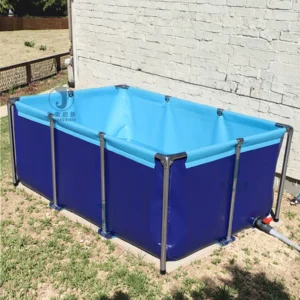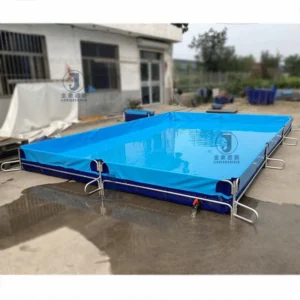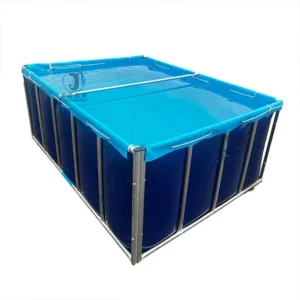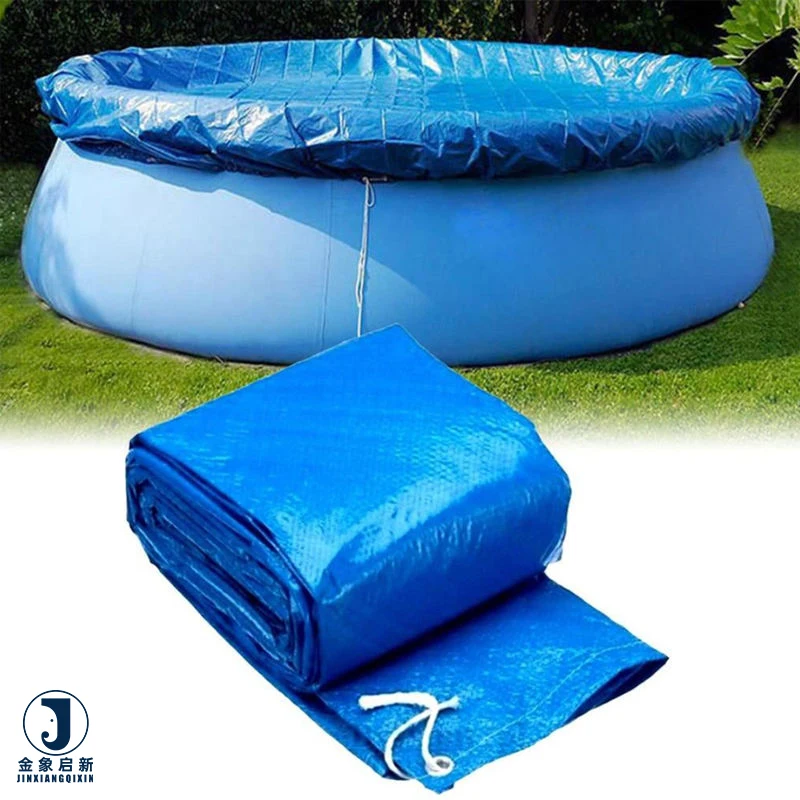
Coating Adhesion Control — Three production lines and 36 sets of professional equipment maintain consistent coating weight and bond integrity across every roll of PVC pond liner for truck and transport cover applications.
Technical Specifications
| Parameter | Value |
|---|---|
| Product Type | PVC Coated Fish Pond Liner |
| Base Fabric | High-strength polyester mesh fabric |
| Coating Material | PVC |
| Coating Method | Laminated technology & Hot-melt coating technology |
| Weight (GSM) Options | 350gsm / 420gsm / 500gsm / 550gsm / 600gsm / 750gsm |
| Total Thickness Options | 0.32mm / 0.35mm / 0.4mm / 0.45mm / 0.5mm / 0.65mm |
| Roll Width Options | 2m / 2.1m |
| Roll Length Options | 75m / 50m |
| Finish Product Size | Custom dimensions available |
| Colour Options | Blue / Red / Yellow / Light blue / Grey (Customised) |
| Key Features | Cold crack resistance, anti-mildew, anti-static treatment, waterproof, sunproof, high tearing strength for welding |
| Fire Retardant | Available as special treatment — confirm the grade required for your market |
| Service Life | 3–7 years under normal circumstances |
| Standards | ISO, CE |
Application Suitability
| Application | Exposure & Requirement |
|---|---|
| Mobile fish ponds on trailers | Constant road vibration, water load shift, tie-down strap abrasion, UV exposure |
| Portable water tanks for transport fleets | Repeated filling and draining, flex stress at corners, puncture from fittings |
| Aquaculture pond lining in field conditions | Permanent water contact, soil chemistry, root penetration, seasonal temperature swings |
| Agricultural water containment | Sun exposure, algae and mildew growth, livestock contact, mechanical damage risk |
| Truck awning and cargo cover with water barrier | Overhead load bearing, wind flap fatigue, road grime and chemical splash |
Why PVC Pond Liner Weight Alone Does Not Predict On-Road Durability
GSM tells you mass per square metre, not how the material behaves when a loaded trailer flexes through a corner.
When a PVC pond liner for truck and transport cover is strapped to a moving load, the stress concentrates at tie-down points and welded seams — not across the flat field of the fabric. A heavier sheet with weak coating adhesion will delaminate at the weld before a lighter sheet with superior bond strength shows any failure. Fleet operators I have spoken to report that most warranty claims on mobile pond installations trace back to seam separation, not puncture or tear in the body of the material [NEED_CITE: tensile and tear test methods for coated fabrics per ISO 1421]. That makes coating method and base fabric tenacity far more consequential than weight alone.
How Transport Loads Change the Equation for Pond Liners
A static pond sits on graded earth. A mobile pond on a trailer endures continuous micro-movement as the chassis twists over uneven surfaces. The PVC pond liner for truck and transport cover must accommodate this flex without the coating separating from the polyester mesh at welded seams. Hot-melt coating technology fuses PVC into the yarn structure rather than sitting on the surface, which improves adhesion at the exact locations where heat welding joins two panels. This matters most along the perimeter hem where tie-down straps pass through and where the liner folds over the trailer edge.
Matching Fabric Construction to Water Containment on the Move
Water is heavy — one cubic metre weighs a tonne. When that load shifts during braking or cornering, the liner experiences sudden point loads at baffle welds and at any fitting penetration. The high-strength polyester mesh base fabric distributes these loads across multiple yarns rather than letting a single puncture propagate into a tear. Combined with laminated and hot-melt coating technology, the resulting composite resists the kind of peel-back failure that cheaper pond liners suffer when a fitting pulls under load [NEED_CITE: adhesion strength test protocols for laminated PVC fabrics]. Cold crack resistance ensures the material stays pliable during winter transport, preventing brittle fracture at fold lines.
Reading the Specification Sheet Beyond GSM
The GSM options — 350gsm through 750gsm — represent different balances of flexibility, weight, and puncture resistance. A lighter grade suits temporary containment where the liner is deployed and retrieved frequently. Heavier grades handle permanent installation or higher water columns. Thickness, ranging from 0.32mm to 0.65mm, correlates with the coating depth over the mesh: deeper coating provides more sacrificial material before abrasion reaches the base fabric. The coating method determines whether that depth is laminated film bonded to the mesh or hot-melt PVC driven into the weave — the latter typically yielding better peel strength at welded joints. Anti-mildew treatment prevents biological degradation in warm, stagnant water, while anti-static treatment reduces dust attraction during dry storage and transport.
The Hidden Cost of Choosing the Wrong Liner Grade for Fleet Use
Specifying a pond liner by price per roll without matching the grade to the actual transport environment leads to predictable failures. An underspecified liner on a long-haul trailer will show coating delamination at the welds within the first few trips, particularly at the rear corners where road vibration is most severe. Colour inconsistency between rolls from different batches becomes visible when multiple panels are welded side by side on a large mobile pond — a cosmetic defect that signals inconsistent coating weight across the batch [NEED_CITE: batch consistency standards for coated fabric colour matching]. Anti-UV or flame retardant claims without supporting test reports leave operators unable to verify compliance when a site inspector or insurance assessor asks for documentation. These are not theoretical risks; they are the routine reasons mobile pond installations get pulled from service prematurely.
What This Manufacturer Brings to Transport-Grade Pond Liner Production
Nearly 30 years focused on coated fabric has built deep process control over coating weight and adhesion at the molecular bond level, directly relevant to PVC pond liner for truck and transport cover reliability. Three full production lines and 36 sets of equipment provide the capacity to fill container orders on schedule without rushing coating parameters. The 10-person R&D team develops custom sizing, eyelet placement, and hem reinforcement specific to trailer bed dimensions rather than supplying generic rectangles. Dedicated QA/QC inspection at every production stage catches GSM deviation and colour drift before rolls leave the factory, supported by 100% pre-shipment inspection. Samples are developed within days so you can weld test pieces and verify seam strength before committing to a full order.
Documentation & Verification
- Material specification sheet confirming GSM, base fabric denier, coating method, and colour reference per roll
- Weight verification record per roll against the stated GSM before dispatch
- Test report for UV and flame retardant grades where applicable to your market requirements
- Pre-shipment inspection record documenting seam integrity and surface condition
- Roll packing list with certificate of origin and customs documentation
- ISO and CE certificates confirming quality management system compliance
Fabrication, Handling & Storage
- Hot-melt coated grades accept standard RF and hot wedge welding; match temperature to the chosen GSM option
- Reinforce eyelet and tie-down points with additional PVC patches on grades below 500gsm to prevent pull-through
- Store rolls horizontally on pallets to avoid permanent creasing in the polyester mesh base fabric
- Allow rolls to acclimatise before unrolling in cold conditions to preserve cold crack resistance integrity
- Clean with mild detergent only; harsh solvents degrade the anti-mildew and anti-static surface treatment
- Repair field punctures with PVC-compatible adhesive patches matching the coating method of the original material
Before You Request a Quotation
Provide your trailer bed dimensions, the maximum water depth planned, and the transport conditions the liner will endure — this lets us recommend the right GSM and thickness from the available options. Specify whether you need rolls for on-site fabrication or finished panels with welded hems and eyelets to match your tie-down configuration. If your market requires flame retardant certification or specific UV test evidence, state the standard you need so we can confirm grade availability before sampling.
Frequently Asked Questions
Q: How do I verify the pond liner GSM matches what was quoted when the rolls arrive?
A: Request the pre-shipment inspection record that documents weight per roll. Upon delivery, cut a measured sample from the roll edge and weigh it on a calibrated scale. The stated GSM should match within the tolerance specified on your material specification sheet. Any deviation beyond that tolerance should be flagged before installation proceeds.
Q: What welding parameters work best for hot-melt coated PVC pond liner grades?
A: Hot wedge and RF welding both work, but temperature and speed settings depend on the GSM and thickness you selected. Request a welding guide with your sample so you can test seam peel strength on your equipment before committing to full production. Hot-melt coated grades generally allow wider parameter windows than laminated-only fabrics.
Q: How do I measure my trailer for a custom-fit mobile pond liner?
A: Measure the internal bed length, width, and desired water depth, then add allowance for hem folds and tie-down clearance at each edge. Identify strap contact points so eyelets or reinforced patches can be positioned accordingly. Send these dimensions with photos of your trailer configuration for a fabrication-ready drawing.
Q: What test evidence accompanies UV and flame retardant pond liner orders?
A: For UV-treated grades, a test report documenting exposure duration and retained tensile strength is provided where applicable. Flame retardant grades ship with the relevant test report for the grade produced. Confirm your market’s required standard at inquiry stage so the correct treatment and documentation are specified on your order.