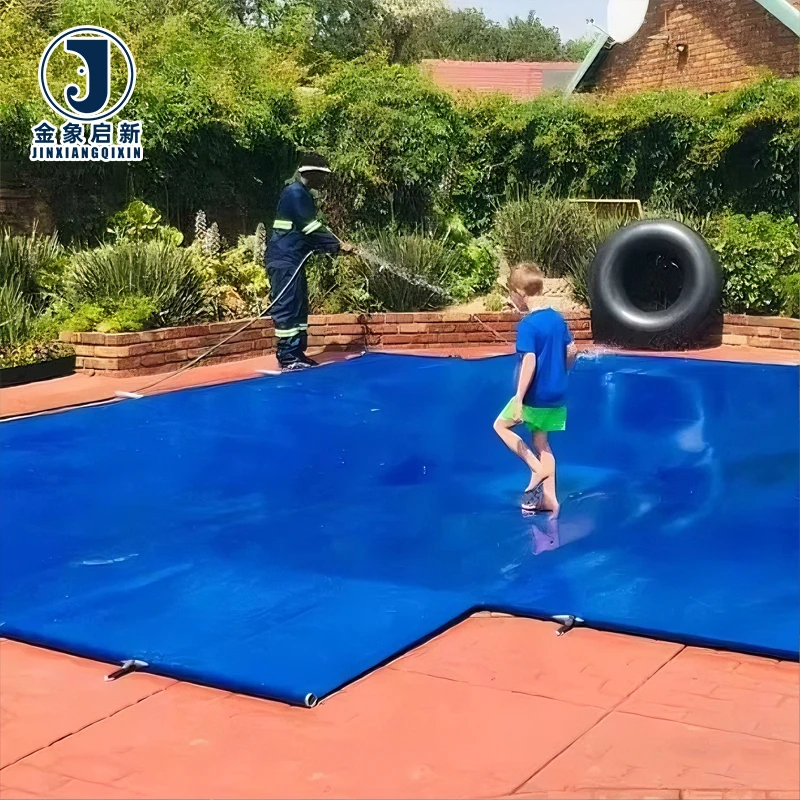
Consistent Batch Output — Every roll of PVC pool cover tarpaulin undergoes 100% pre-shipment inspection for weight, colour and coating adhesion, ensuring the fabric you receive matches the specification agreed at inquiry stage.
Technical Specifications
| Parameter | Value |
|---|---|
| Product Type | Swimming Pool Cover |
| Material | PVC + High-strength polyester mesh fabric |
| Coating Technology | Laminated technology & Hot-melt coating technology |
| Weight Options | 350gsm / 420gsm / 500gsm / 550gsm / 600gsm / 750gsm |
| Thickness Options | 0.32mm / 0.35mm / 0.4mm / 0.45mm / 0.5mm / 0.65mm |
| Roll Width | 2m / 2.1m |
| Roll Length | 75m (for 2m width) / 50m (for 2.1m width) |
| Finished Product Size | Custom cut to pool dimensions |
| Colour Options | Blue / Red / Yellow / Light blue / Grey (Customized) |
| Key Features | Waterproof, anti-mildew, cold crack resistance, UV-resistant (test basis not stated), colour fastness, anti-static (grade not stated) |
| Flame Retardant | Available as special treatment (grade not stated) |
| Mounting Options | Standard hook system (custom shaped pools) / Aluminium bar with ratchet tensioner (rectangular pools) |
| Certifications | ISO, CE |
Application Suitability
| Application | Exposure & Requirement |
|---|---|
| Rectangular swimming pools | Constant UV exposure, water contact, debris load; requires aluminium bar tensioning for wrinkle-free span |
| Custom-shaped swimming pools | Irregular contours, anchor-point stress concentration; requires hook system with reinforced hem |
| Aquaculture ponds and fish tanks | Permanent water immersion, biological growth risk; requires anti-mildew treatment and non-toxic surface |
| On-site water storage at transport depots | Forklift traffic nearby, wind uplift, seasonal temperature swings; requires cold crack resistance and high tear strength |
Why a Pool Cover That Fits Matters More Than the GSM You Pick
A pool cover cut to generic dimensions will fail at the anchor points long before the fabric itself reaches the end of its service life.
Transport depot managers and fleet operators who install water containment or wash-down pool covers know the frustration: the quotation states a heavy-duty GSM, yet the cover sags in the middle, collects standing water on top, and wind catches the loose edges. The problem is rarely the fabric grade alone. Fitment — how the cover meets the pool perimeter and transfers tension to the anchoring hardware — determines whether a PVC coated pool cover tarpaulin performs through multiple seasons or requires replacement after the first winter [NEED_CITE: tension distribution across pool cover anchor points per coated fabric installation guidelines].
Tensioning Systems Matched to Pool Geometry
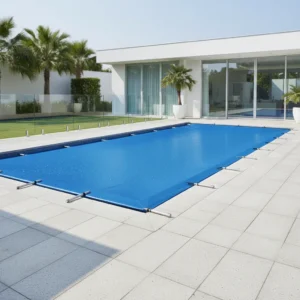
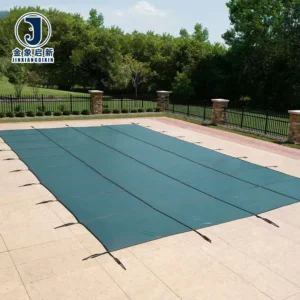
Choosing the right PVC pool cover aftermarket supplier involves understanding that rectangular pools and irregular-shaped pools demand fundamentally different mounting approaches. An aluminium bar encased in PVC with a ratchet tensioner delivers uniform tension across a straight edge, preventing the mid-span sag that allows debris and rainwater to accumulate. For freeform or kidney-shaped pools, a hook system spaced along a reinforced hem follows the contour without creating stress concentrations that tear the fabric at the attachment points.
Coating Adhesion at the Flex Zones
The edges of a pool cover experience repeated flexing every time the cover is removed, reinstalled, or subjected to wind gusts. Hot-melt coating technology bonds the PVC layer to the high-tenacity polyester mesh at a molecular level, which means the coating does not delaminate at the fold lines where mechanical stress is greatest. Laminated construction adds a secondary bond that holds through seasonal temperature swings — from summer heat that softens the PVC surface to winter cold that tests the cold crack resistance of the material [NEED_CITE: hot-melt vs knife-over-roll coating adhesion performance on polyester mesh].
Reading the Specification Sheet Beyond the GSM Number
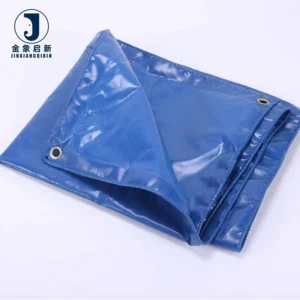
A 550gsm PVC coated pool cover tarpaulin and a 750gsm variant can differ not only in weight but in base fabric denier, weave density and coating ratio. A heavier coating applied over a loosely woven mesh will register a high GSM on the scale yet deliver lower tear strength than a lighter coating applied over a tightly woven high-tenacity base. The polyester mesh count — ends per centimetre in warp and weft — determines how well a puncture or cut is contained before it propagates across the panel. Laminated technology typically yields higher peel strength than simple calendered PVC, which matters when the cover is folded repeatedly at the same hinge line over the pool edge. Thickness values from 0.32mm to 0.65mm correspond to the total composite, not the coating alone, so a thicker reading generally indicates both a heavier base fabric and a more substantial coating layer working together.
What Happens When Colour Consistency Is Not Controlled
A buyer ordering five rolls of grey PVC pool cover fabric for a large commercial installation expects uniform colour across the entire surface. When colour varies between rolls in the same order, the difference becomes visible the moment adjacent panels are laid side by side over the pool. This is not a cosmetic issue alone — inconsistent colour often signals uneven pigment dispersion in the coating compound, which can correlate with uneven UV stabiliser distribution and therefore uneven degradation rates across the cover surface. Roll-to-roll colour verification during production, backed by pre-shipment inspection records, prevents this outcome [NEED_CITE: pigment dispersion correlation with UV stabiliser distribution in PVC coating].
Why Source This PVC Pool Cover Fabric Here
Three full production lines and 36 sets of professional equipment mean that custom-width rolls and non-stock colours are produced on dedicated runs rather than squeezed between standard stock orders, reducing cross-contamination and setup variation. A 10-person R&D team develops samples within days for custom pool dimensions and mounting configurations, so you can verify fitment and tensioning before committing to a full production run. Every roll undergoes 100% inspection before dispatch — weight is checked against the specification sheet, and colour is compared across rolls within the same batch. ISO and CE certifications underpin the quality management system, and documentation packages are assembled per order with the specific test reports and certificates your market requires.
Documentation & Verification
- Material specification sheet stating exact GSM, base fabric denier and coating weight for the pool cover grade supplied
- Pre-shipment inspection record with roll-by-roll weight and colour verification before dispatch
- UV test report provided for anti-UV grades — confirm the test basis required for your market
- Flame retardant certification available — specify the grade required by your local fire safety code
- Certificate of origin and customs documentation included with every export shipment
Fabrication, Handling & Storage
- Hot-air welding temperature must match the laminated PVC coating thickness to achieve full seam strength without burning through the polyester mesh
- Eyelet spacing on hook-system covers should be calculated based on the 350gsm to 750gsm grade selected and the expected wind uplift load
- Aluminium bar pockets on rectangular pool covers require double-fold hem reinforcement to distribute ratchet tensioner force evenly
- Store rolls upright on end caps in a dry warehouse; laying 2.1m-wide rolls flat causes permanent crease marks in the PVC coating
- Clean the PVC surface with mild detergent only; solvent-based cleaners can soften the hot-melt coating layer and reduce adhesion over time
- Field repairs on punctured pool covers should use PVC-compatible adhesive patches matched to the coating technology of the original fabric
What We Need to Quote Your Pool Cover Project
Provide the pool dimensions including any irregular contours, the preferred tensioning method — hook system or aluminium bar — and the target GSM or thickness grade for your climate and exposure conditions. If your market requires flame retardant certification or a specific UV test basis, state the standard so we can confirm the treatment grade before sampling. Let us know whether you need finished cut-to-size covers with reinforced hems and hardware, or roll stock for your own fabrication facility.
Frequently Asked Questions
Q: How do I choose between the hook system and the aluminium bar method for my pool shape?
A: Rectangular pools suit the aluminium bar with ratchet tensioner because straight edges allow uniform tension distribution. Custom-shaped pools with curves or angles require a hook system with reinforced hem, as hooks can be spaced to follow the contour without creating concentrated stress points that tear the PVC coating.
Q: Can you cut covers to exact pool dimensions with reinforcement at the anchor points?
A: Yes. Finished pool covers are cut to your specified dimensions, and anchor points receive additional PVC reinforcement patches or double-fold hems depending on whether you use hooks or aluminium bars. We develop a sample first so you can confirm fitment and tensioning before full production.
Q: What GSM and thickness do you recommend for a pool cover in a high-UV, high-humidity climate?
A: Higher GSM grades such as 600gsm or 750gsm with corresponding thickness options provide greater coating mass for UV absorption and a heavier base fabric for wind-load resistance. Confirm the UV test basis required for your market so we can supply the matching treatment grade and test report.
Q: Do you supply the PVC fabric by the roll for manufacturers who fabricate covers in-house?
A: Roll stock is available in 2m by 75m or 2.1m by 50m configurations. Rolls ship with batch-consistent colour, and pre-shipment inspection records verify GSM per roll. Custom widths and colours are produced on dedicated runs to maintain consistency across your order.
Q: How do you ensure colour consistency if I order multiple covers or rolls in the same batch?
A: Every roll undergoes 100% pre-shipment inspection where colour is compared across rolls within the same order. Pigment dispersion is controlled at the coating stage, and any roll that deviates from the approved colour reference is held before dispatch.