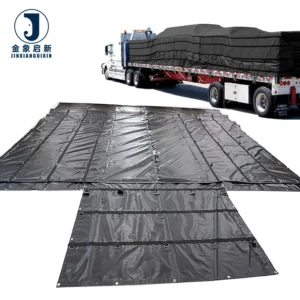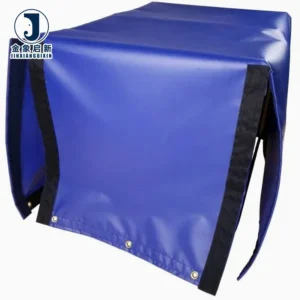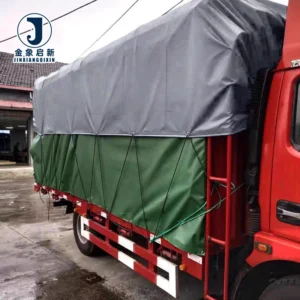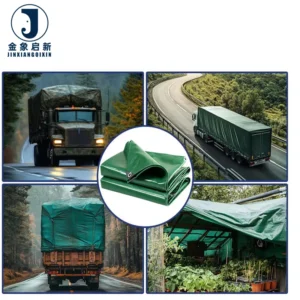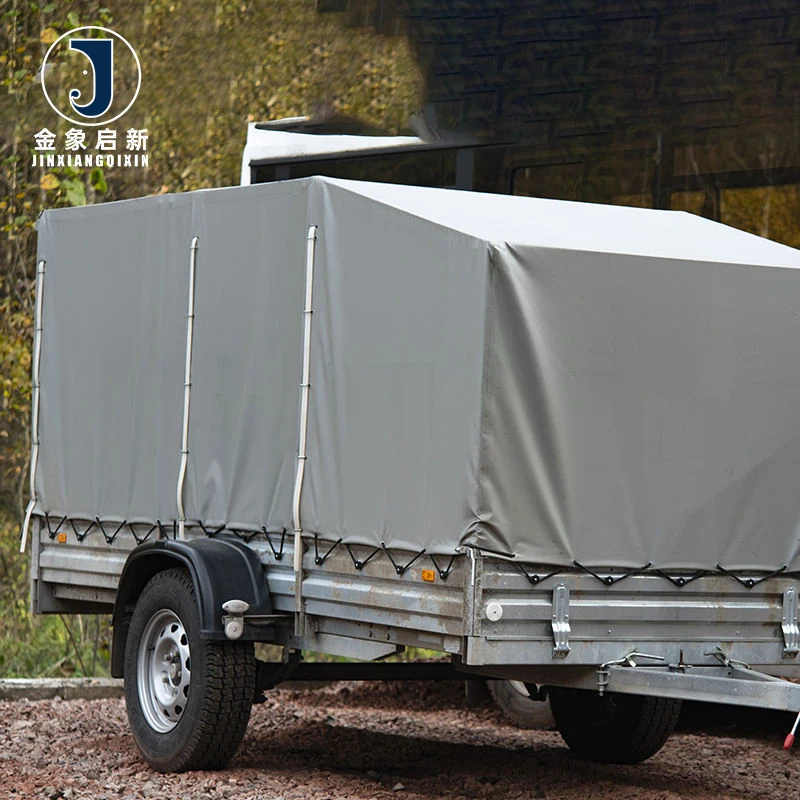
Precision Fitment for Moving Loads — covers are cut and reinforced to exact trailer bed, bow and tie-down geometry, eliminating the flap and tear cycle that generic-size tarps cause at highway speed.
Technical Specifications
| Parameter | Value |
|---|---|
| Product Type | PVC Coated Truck Tarpaulin Cover |
| Material | PVC + High-strength polyester mesh fabric |
| Weight (GSM) | 350gsm / 420gsm / 500gsm / 550gsm / 600gsm / 750gsm |
| Total Thickness | 0.32mm / 0.35mm / 0.4mm / 0.45mm / 0.5mm / 0.65mm |
| Roll Width | 2m / 2.1m |
| Roll Length | 50m / 75m |
| Coating Technology | Laminated technology & Hot-melt coating technology |
| Key Features | Cold crack resistance (test basis not stated in source), anti-mildew, anti-static treatment (grade not stated in source), waterproof, sunproof (test basis not stated in source), color fastness |
| Special Treatments | Flame retardant, anti-static, anti-cold, anti-mildew, 3P — confirm the grade required for your market |
| Finish Product Size | Custom cut to customer vehicle dimensions or sold from inventory |
| Service Life | 3-7 years under normal circumstances |
| Standards | ISO, CE |
Application Suitability
| Application | Exposure & Requirement |
|---|---|
| Lorry flatbed top cover | Continuous highway-speed wind loading, rain and road spray ingress, UV exposure, flex at bow contact points |
| Side curtain for curtain-side trailer | Repeated folding and sliding on runners, abrasion against load edges, tie-down strap friction at hems |
| Tipper truck roll-over cover | Abrasive contact with bulk material, high flexing frequency at hinge points, exposure to aggregate dust |
| Transport equipment OEM bodywork | Factory-fit precision to specific trailer geometry, batch colour consistency across a production run |
What "Anti-UV" Means When Your Truck Cover Crosses Three Climate Zones in One Route
Request the UV test report before you commit the order, not after the material arrives.
A fleet running from a temperate coastal depot into high-altitude desert routes in the same week exposes PVC truck tarpaulin cover fabric to radically different UV loads. Quotations routinely state "UV treated" without specifying the test standard or exposure hours, leaving the buyer with no way to verify whether the stabiliser package matches the actual solar radiation the cover will face [NEED_CITE: ISO 4892-2 accelerated weathering methods for plastics and coated fabrics]. When the coating degrades prematurely, the base fabric loses tensile strength and the first failures appear at the welded seams — exactly where the load flexes most under road vibration.
Matching Coating Weight to the Trailer’s Real Flex Cycle
The PVC truck tarpaulin cover must survive thousands of flex cycles per journey as the load shifts under braking, cornering and road irregularities. Hot-melt coating technology delivers strong adhesion between the PVC layer and the polyester mesh, which resists delamination when the material folds repeatedly at the bow contact zone and along tie-down strap paths. Laminated coating provides a viable alternative for applications where the cover is tensioned flat and flexing is less aggressive.
Reinforcement Strategy at the Points That Actually Fail
Generic truck covers fail first at corners, rub rails and tie-down zones because those areas concentrate mechanical stress beyond what the base fabric handles alone. The specification should identify every high-stress zone on the specific trailer model before production begins, so that additional fabric patches, double-layer hems and reinforced eyelet plates are integrated during the welding stage rather than added as an afterthought. This is the difference between a cover that lasts its full service life and one that requires panel replacement within months of deployment [NEED_CITE: typical failure modes at welded seams on PVC coated tarpaulins under dynamic load].
Reading the Specification Sheet Beyond the GSM Number
GSM alone tells you how much material is present, not how that material will behave under tension and tear. A 550gsm cover built on a high-density, high-tenacity polyester base can outperform a 600gsm cover woven from thicker but fewer yarns, because tear propagation resistance depends on yarn count, weave structure and how well the PVC coating locks the yarn intersections. Coating thickness and the hot-melt or laminated bond strength determine whether the coating stays bonded to the base fabric at fold lines, or separates and exposes the yarns to moisture and abrasion. Roll width of 2m or 2.1m directly affects how many horizontal welds are needed to span a trailer body — fewer welds mean fewer potential failure lines and faster fabrication throughput.
When Batch Colour Variation Forces a Fleet Repaint
A transport company ordering covers for twenty identical trailers expects all panels to look the same when installed side by side in the yard. If colour varies between rolls within the same bulk order, the visual inconsistency is immediately visible once the covers are fitted, and the buyer faces a choice between accepting a mismatched fleet appearance or rejecting the entire shipment. This problem originates at the compounding and coating stage, where pigment dosing must remain constant across every roll produced in the batch, and can be verified by comparing colour swatches cut from the head and tail of each roll during pre-shipment inspection [NEED_CITE: colour fastness and batch consistency standards for coated textiles].
Why Sourcing from a Coated Fabric Specialist Matters Here
Three full production lines running PVC coated fabric daily means coating weight, adhesion strength and colour consistency are controlled through repeatable process parameters rather than adjusted batch by batch. The 10-person R&D team develops cut patterns matched to specific trailer models, producing samples within days so the buyer can verify fitment before the full order enters production. Dedicated QA and QC checkpoints at every production stage, with 100% inspection before shipment, catch GSM deviation, colour drift and weld seam defects before the rolls leave the facility. Nearly 30 years of focused production in coated fabric has built a deep understanding of how coating formulation interacts with base fabric construction under real-world mechanical stress.
Documentation & Verification
- GSM measured per roll and compared to quotation value before dispatch
- UV and flame-retardant test reports provided for treated grades where applicable
- Pre-shipment inspection record covering weld seam integrity and colour consistency
- Roll packing list detailing weight, dimensions and roll count per shipment
- ISO and CE certificates supplied with each export consignment
- Custom cut pattern confirmation showing dimensions matched to trailer model
Fabrication, Handling & Storage
- Heat-weld using temperature settings matched to the selected GSM and coating technology to avoid scorching or weak bonds
- Reinforce eyelet zones with additional PVC patches before punching to distribute tie-down strap loads
- Store rolls horizontally on racking to prevent flat spots and permanent creasing on the coating surface
- Allow cold-stored rolls to reach ambient temperature before unrolling to prevent coating crack at low temperature
- Clean with mild detergent only; avoid solvent-based cleaners that can soften the PVC coating layer
- Plan panel layout from 2m or 2.1m roll width to minimise off-cuts and the number of welded seams
What We Need to Quote Your Cover Accurately
Provide the truck or trailer make, model, bed length, body width and bow profile so the pattern is cut to the actual vehicle rather than a generic template. Specify the operating environment — particularly whether routes include high-UV or sub-zero conditions — so the correct treatment package is selected and documented. Confirm whether you need finished covers with welded hems and eyelets, or roll stock for your own fabrication workshop.
Frequently Asked Questions
Q: How do you ensure the PVC truck tarpaulin cover fits my specific trailer model rather than a generic size?
A: We request the exact trailer make, model, bed dimensions and bow profile, then develop a cut pattern and sample for your approval before full production. This ensures the cover tension, fold lines and tie-down positions match the actual vehicle geometry, not a standard template that shifts at speed.
Q: Can you supply a test report for the UV and flame-retardant treatment you quote?
A: Yes. When your specification calls for UV stabilisation or flame-retardant treatment, we provide the corresponding test report showing the standard used and the result achieved. We recommend reviewing these reports at the sampling stage to confirm the grade matches your market’s regulatory requirements.
Q: What happens if colour varies between rolls in the same bulk order?
A: Our in-process quality control monitors pigment dosing across every roll in the batch. During pre-shipment inspection, colour swatches are compared from the head and tail of each roll, and any deviation outside tolerance is flagged before dispatch, so panels installed side by side on a single trailer match visually.
Q: How are welded seams reinforced at tie-down and flex points?
A: High-stress zones such as corners, rub rails and tie-down anchor points receive additional PVC fabric patches welded over the base seam. The weld parameters are matched to the selected GSM and coating technology so the seam strength meets or exceeds the tear strength of the base fabric itself.
Q: What is the lead time for custom-sized truck tarpaulin orders?
A: Lead time depends on order volume, the complexity of the cut pattern and whether special treatments are required. We provide a confirmed schedule at the quotation stage and develop samples within days of specification agreement so production can begin without unnecessary delay.