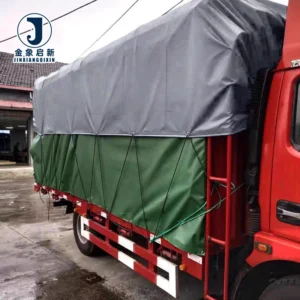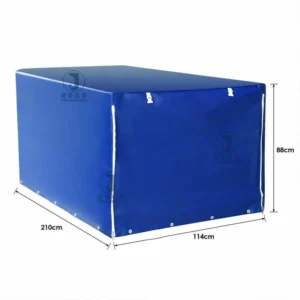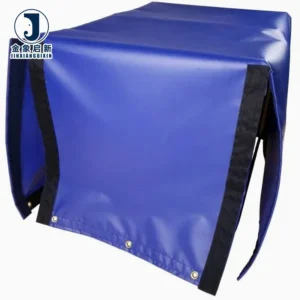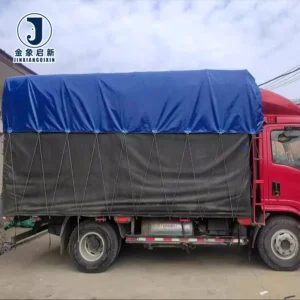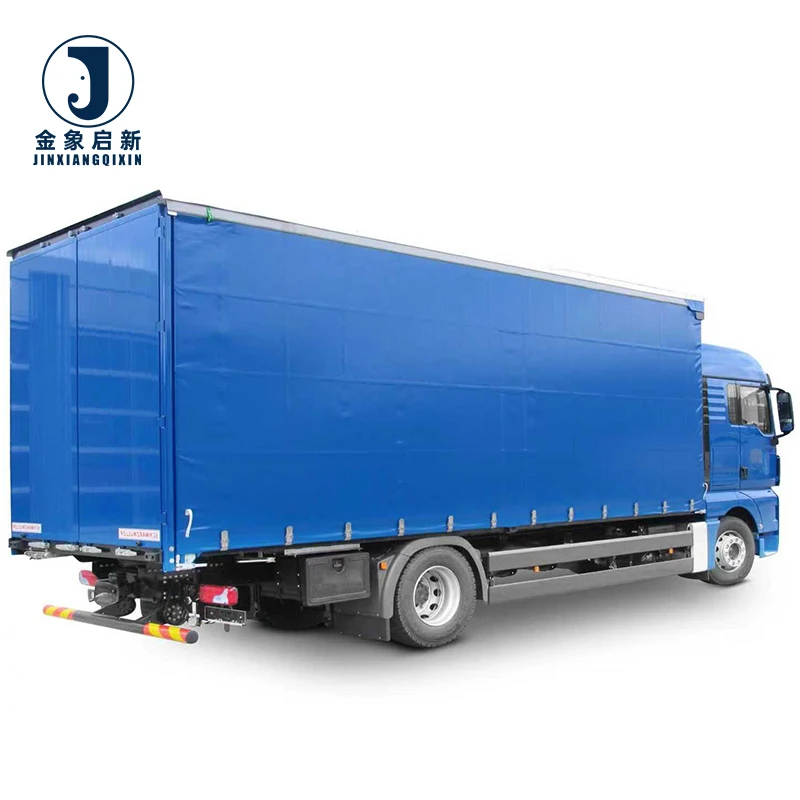
Precision Fitment Engineering — every PVC truck cover is cut to the exact dimensions of your trailer model, eliminating the gap between generic sizing and real-world cargo protection.
Technical Specifications
| Parameter | Value |
|---|---|
| Product Type | PVC Tarpaulin Truck Cover |
| Coating Material | PVC |
| Construction | Double-Faced |
| Water Resistance | Water Resistant |
| UV Protection | Anti-UV treated (test basis not stated — confirm requirement) |
| Flame Retardant | Available (grade not stated — confirm grade required for your market) |
| Color Options | Multiple Colors |
| Customization | Logo printing, custom sizing available |
| Certifications | ISO, CE |
Application Suitability
| Application | Exposure & Requirement |
|---|---|
| Truck and trailer side curtains | Constant flexing at load points, road spray, UV exposure, wind load stress |
| Flatbed cargo protection | Direct rain and sunlight, tie-down strap abrasion, high-speed airflow |
| Curtain-sider systems for fleet operations | Daily roll-up and deployment, repeated folding at hinge lines, friction against load edges |
| Advertising truck tarpaulins with logo printing | Prolonged outdoor visibility, surface exposure to fuel fumes and road chemicals, print durability under weathering |
| Outdoor vehicle cover for parked trailers | Standing water pooling, mildew risk in humid climates, thermal expansion and contraction |
Why Generic-Size Covers Fail on the Road Before the Fabric Does
A PVC truck cover for trailer applications that arrives in a generic size forces installers to fold, tuck or over-stretch material at the edges — creating stress concentrations where seams split within weeks of fitting.
I have reviewed too many return cases where the fabric itself was still intact but the cover had failed at the perimeter. The root cause was not material quality but dimensional mismatch between a standard cut and a specific trailer body. When a cover is not profiled to the vehicle, the eyelets sit off-line from the tie-down anchors, the hem drags on the load deck, and the welded seams bear loads they were never designed to carry. Fleet operators end up paying twice: once for the original cover and again for a replacement cut to the correct dimensions [NEED_CITE: dimensional fitment standards for transport tarpaulins per EN 12195].
Cut to the Trailer, Not to a Catalogue Size
Every PVC truck cover for trailer applications begins with a dimension survey matched to your specific vehicle model — flatbed, curtain-sider, or box trailer. The cover pattern is developed against the trailer profile so that hem lines align with deck edges and eyelet positions correspond to your existing tie-down hardware. This eliminates the installer guesswork that leads to premature seam failure on generic covers.
Reinforcement Where the Load Moves Most
The high-stress zones on any PVC truck cover for trailer side curtains are the tie-down points and the flex lines where the cover bends around the cargo profile. Reinforced eyelets and hem construction are specified at these locations so that strap tension transfers into the base fabric rather than concentrating at the weld boundary. The result is a cover that withstands the daily loading cycle without the reinforcement pulling away from the coated surface [NEED_CITE: reinforcement methods for heavy-duty transport covers].
Specifying the Fabric Behind the Cover
Understanding what sits beneath the PVC surface determines how the cover performs under road conditions. Double-faced PVC coating provides uniform tensile properties on both the weather side and the cargo-contact side, which matters when side curtains flex in crosswinds and the inner face rubs against pallet edges. The base fabric weave and denier govern how a small puncture behaves — a tighter weave limits tear propagation from a stray strap buckle or a forklift corner. Coating weight, expressed in GSM, must be read together with base fabric density because a high GSM achieved through thick coating on a light base fabric will crack at the fold line before a lower GSM on a dense weave will [NEED_CITE: relationship between base fabric denier and coating weight for PVC tarpaulins]. Surface finish selection between available options affects how dirt and road grime release during cleaning, which matters for covers carrying printed fleet branding that must remain legible over time. Available flame retardant grades should be confirmed against your regional transport standard before ordering, as requirements differ between tunnel routes, port facilities and depot storage zones.
The Cost of Specifying on Price Per Square Metre Alone
When covers are selected primarily on unit cost, the GSM stated on the quotation is not always the GSM that arrives on the truck. A lighter coating saves raw material cost but reduces the fabric’s ability to absorb abrasion at the tie-down points, leading to covers that need replacement well before the expected service interval. Colour variation between production rolls becomes visible the moment two panels are hung side by side on a curtain-sider, forcing the operator to either accept a mismatched fleet appearance or reject the batch entirely. Missing flame retardant documentation delays vehicle certification at depots where fire compliance audits are routine [NEED_CITE: fleet compliance audit requirements for flame retardant transport covers].
Why Fleet Operators Source Here
Nearly 30 years of focused production on coated fabrics gives the manufacturing team deep process control over coating weight consistency and adhesion at the weld line, which is where most PVC truck covers fail first. Three full production lines and 36 sets of professional equipment support bulk order volumes while maintaining delivery schedules that fleet maintenance planners depend on. A 10-person R&D team handles pattern development for new trailer models, custom colour matching across fleet replacements, and print layout for branded side curtains. Dedicated quality inspection at every production stage, with 100% pre-shipment verification, means dimensional accuracy and GSM conformance are checked before covers leave the facility. Sample development within days allows fleet operators to trial fitment on a single vehicle before committing to a full fleet rollout.
Documentation & Verification
- Material specification sheet confirming base fabric type, coating weight and colour reference for each PVC truck cover produced
- Pre-shipment inspection record with dimensional check against your trailer model drawing
- Test report for UV and flame retardant grades supplied where applicable to your market standard
- Roll packing list with piece count and weight for container load planning
- Certificate of origin and customs documentation for cross-border shipment
- Custom sizing confirmation signed off against vehicle dimensions before production release
Fabrication, Handling & Storage
- Heat welding parameters should be set for double-faced PVC construction to achieve full seam adhesion across the coating thickness
- Eyelet spacing at tie-down zones must account for base fabric denier to prevent pull-through under strap tension
- Store rolls upright on pallets to prevent permanent crease lines forming in the PVC coating surface
- Allow material to acclimatise before deployment in cold conditions to avoid cracking at the fold during unrolling
- Use mild detergent cleaners only; solvent-based products can degrade the PVC coating surface and affect print adhesion
- Field repairs on minor punctures can be hot-air welded using matching PVC patches from the same production batch
Starting Your PVC Truck Cover Specification
To move from enquiry to sample, share your trailer model designation, the number of vehicles in the fleet, and the route conditions the covers will face — including any tunnel or port fire compliance requirements. If branded printing is needed, provide the artwork files and specify which panels carry the graphics. Confirm whether you need finished covers with eyelets and hems, or roll stock for your own fabrication facility.
Frequently Asked Questions
Q: How do I specify the right PVC truck cover for my trailer model?
A: Provide the trailer manufacturer, model designation, body length, and the type of side curtain system fitted. The cover pattern is then developed against these dimensions so that hem lines and eyelet positions match your existing hardware. A sample cover is produced for trial fitment before bulk manufacturing begins, ensuring the PVC truck cover for trailer dimensions aligns precisely with your vehicle.
Q: Can you match existing colour across replacement panels in my fleet?
A: Colour matching is done against a physical sample from your current cover or a RAL reference you specify. Production rolls for a single order are pulled from the same coating batch to maintain consistency. If the existing covers have weathered, we recommend matching to the original specification rather than the faded surface, so replacements blend as the older panels are phased out.
Q: What reinforcement is included at eyelet and tie-down zones?
A: High-stress zones receive additional hem material and reinforced eyelet plates designed to distribute strap load into the base fabric rather than the coating alone. The reinforcement specification is matched to the tie-down strap width and tension rating used in your operation, preventing the common failure mode where the eyelet pulls free from the PVC surface under load.
Q: Do you supply test certificates for UV and flame retardant claims?
A: Test reports are provided for the specific grades ordered. Since flame retardant requirements vary by market and application — such as tunnel transit or depot storage — confirm the standard applicable to your operation during the enquiry stage. UV test documentation is supplied based on the treatment level specified for your PVC truck cover for trailer use.
Q: What is the lead time for custom-sized truck covers?
A: Lead time depends on the number of distinct trailer models in the order and whether custom colour or print is required. Standard sizes in stock colours ship faster, while bespoke patterns with branded printing require additional time for sample approval and production scheduling. Confirm your required delivery window at the enquiry stage so the production plan aligns with your fleet maintenance calendar.