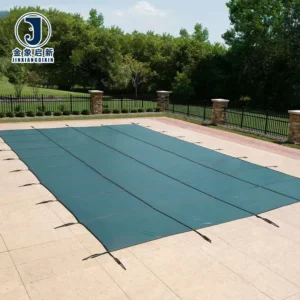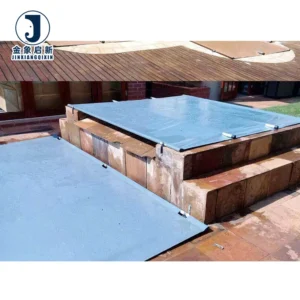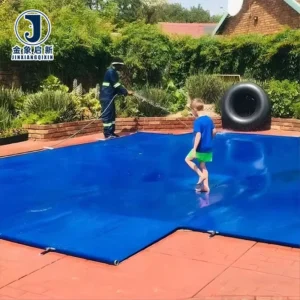
Precision Fit Engineering — custom-sized covers eliminate the gaps and misalignment that generic products leave on irregular pool profiles, supported by site-specific dimension verification before production.
Technical Specifications
| Parameter | Value |
|---|---|
| Product Type | Pool Cover |
| Material | PC polycarbonate (stronger and more durable than PVC — confirm grade required for your project) |
| Operation | Automatic retractable, one-button opening and closing |
| UV Resistance | UV resistant (test basis not stated) |
| Waterproof | Yes |
| Motor Voltage | 12V / 24V low voltage system |
| Input Voltage Compatibility | 110V–240V |
| Pool Type | Inground pool |
| Custom Size | Available (fits 15x30ft rectangular inground pools referenced) |
| Color Options | Light blue, transparent blue, beige, ivory white |
| Impact Resistance | High impact resistance, bears heavy weight without cracking |
| Yellowing Resistance | No yellowing or brittle under strong sunlight (test basis not stated) |
| Motor Noise | Stable and quiet motor, smooth operation with low noise |
| Safety Feature | Prevents children and pets from falling in |
Application Suitability
| Application | Exposure & Requirement |
|---|---|
| Residential inground swimming pools | Daily automated operation, direct sunlight, child and pet safety barrier |
| Outdoor leisure pool environments | Prolonged UV exposure, weather variability, debris protection |
| Family households with young children | Mandatory safety compliance, quiet motor for frequent use, load-bearing surface |
| Property-managed residential complexes | Consistent aesthetic across units, durable slats, low maintenance mechanism |
Why Generic Pool Covers Fail Where Custom Fit Matters Most
An automatic retractable pool cover that does not match the exact dimensions of your inground pool leaves gaps that compromise both safety and thermal retention.
Generic covers are built to standard pool sizes, but most inground pools deviate from those nominal dimensions by inches that matter. When the slats do not span the full width or the tracks sit slightly off-level, water and debris enter through the gaps, defeating the purpose of the cover entirely. More critically, a child or pet can slip through a misaligned edge — the very hazard the cover is supposed to prevent. The automatic retractable pool cover aftermarket supplier you choose should confirm your pool measurements before cutting any slat. [NEED_CITE: ASTM F1346 safety standard for pool covers and barrier requirements]
Motor System Safety and Residential Compliance
The 12V/24V low voltage motor system is specified for environments where children, pets, and wet conditions coexist. Standard household voltage would present an unacceptable shock risk around standing water, which is why the motor steps down from 110V–240V input to a safe operating voltage at the drive unit. When specifying an automatic retractable pool cover for a residential site, verify that the motor documentation matches your local electrical code requirements. [NEED_CITE: IEC 60335 safety requirements for household electrical appliances near water]
Slat Material and Load-Bearing Under Direct Sunlight
PC polycarbonate slats provide high impact resistance, meaning the cover surface can bear significant weight without cracking — a requirement when snow accumulation, fallen branches, or a person stepping onto the closed cover are realistic scenarios. The material is stated to resist yellowing and embrittlement under strong sunlight, though the specific UV stabiliser package and test duration are not documented. Request the UV resistance test basis and confirm the grade required for your market’s exposure conditions before finalising the order.
Understanding Polycarbonate Selection for Pool Environments
PC polycarbonate is chosen here over standard PVC sheet because of its inherent impact strength and optical clarity in transparent variants. The material’s ability to distribute point loads across a wider area means that concentrated weight — a knee, a branch tip, accumulated ice — does not create a failure point the way brittle plastics do. The color options (light blue, transparent blue, beige, ivory white) serve different aesthetic and functional roles: transparent slats allow solar gain into the pool water, while opaque options reduce algae growth by limiting light penetration. The one-button retractable mechanism relies on the slats being rigid enough to push through the track without buckling, which is where material stiffness directly affects motor sizing and track geometry. [NEED_CITE: material property comparison between polycarbonate and PVC for outdoor structural applications]
What Happens When the Cover Does Not Fit the Pool Geometry
An undersized cover leaves exposed water surface at the edges, meaning leaves, insects, and rainwater still enter the pool and the safety barrier remains incomplete. An oversized cover bunches inside the track, creating friction that overloads the motor and accelerates wear on the drive mechanism. In rectangular pools referenced at 15x30ft, even a small dimensional error compounds along the full track length. Color mismatch between slat batches installed side by side is visible in transparent and light-toned options, requiring batch-consistent production for any single order. [NEED_CITE: dimensional tolerance standards for custom-fit retractable pool covers]
Sourcing Considerations for Automatic Pool Cover Systems
The production facility operates three full lines with 36 sets of professional equipment, supporting capacity for custom-sized orders without extended queue times. A 10-person R&D team handles dimension-specific sample development, allowing you to verify fit and track compatibility before committing to a full production run. Every unit undergoes inspection before dispatch with a pre-shipment record, and documentation includes the material specification sheet and motor voltage details matched to your target market. Custom color and sizing requests are processed through sample approval, ensuring the slat profile and finish are confirmed in hand before bulk fabrication begins.
Documentation & Verification
- Material specification sheet stating polycarbonate grade and slat dimensions per order
- Motor voltage and input compatibility documentation for the target market
- Pre-shipment inspection record confirming dimensional accuracy against pool measurements
- Color reference swatch matched to the selected option for batch consistency
- Certificate of origin and customs documentation for international shipment
Fabrication, Handling & Storage
- Verify pool dimensions with tape-measured length, width, and diagonal before submitting order
- Store rolled slat assemblies flat to prevent permanent curvature that affects track alignment
- Use only manufacturer-approved cleaning agents to avoid surface scratching on polycarbonate
- Inspect track channels for debris before each seasonal commissioning to protect motor load
- Confirm motor voltage compatibility with site electrician before hardwiring the drive unit
- Handle transparent slats with clean gloves to avoid embedded fingerprints visible in sunlight
Inquiry Guidance for Pool Cover Specification
Provide your exact inground pool dimensions, including any non-standard corners or step-outs that affect slat run length. Specify your target market so the motor voltage documentation and electrical certifications can be prepared accordingly. Confirm whether you need the complete retractable system including tracks and housing, or slat replacement for an existing mechanism. Indicate your preferred color option and whether you require a sample slat for site approval before full production.
Frequently Asked Questions
Q: How is the custom size measured and what tolerances apply for non-standard pool shapes?
A: Pool dimensions should be tape-measured at multiple points along length, width, and both diagonals to account for any deviation from perfect rectangular geometry. The manufacturer uses these measurements to configure slat length and track placement. For pools with step-outs, radiused corners, or non-parallel walls, provide a detailed drawing so the automatic retractable pool cover can be engineered to the specific profile without gaps.
Q: What electrical certifications does the 12V/24V motor system hold for different markets?
A: The motor operates on a 12V/24V low voltage system with 110V–240V input compatibility. Specific certifications vary by destination market — confirm with the supplier whether UL, CE, or regional approvals are included in the documentation package. Request the applicable test reports before installation to satisfy local building inspectors and electrical code requirements at your project site.
Q: How does PC polycarbonate compare to PVC-coated fabric in long-term outdoor durability?
A: PC polycarbonate offers higher impact resistance and rigidity than flexible PVC-coated fabric, making it suited to load-bearing pool cover applications where structural stiffness is required. PVC-coated fabric excels in flexible tarpaulin and transport cover roles where folding and rolling are frequent. The automatic retractable pool cover uses rigid slats by design, which is where polycarbonate’s strength-to-weight advantage becomes relevant for daily automated operation.
Q: What maintenance is required for the retractable mechanism and motor under continuous outdoor use?
A: Track channels should be cleared of debris and inspected for alignment at least seasonally to prevent motor overload. The polycarbonate slats require only mild detergent and water — avoid abrasive cleaners that scratch the surface. Motor housing should be checked for moisture ingress, particularly in climates with heavy rainfall or snow melt. Lubrication of moving parts should follow the manufacturer’s maintenance schedule provided with the system documentation.
Q: Is the product compatible with existing pool automation or smart-home control systems?
A: The one-button operation uses a standard low-voltage control signal, which may integrate with existing pool automation depending on the controller protocol. Compatibility varies by system manufacturer, so provide your existing automation details to the supplier for assessment. The motor’s 12V/24V operating voltage is common across residential control platforms, but interface wiring and signal type must be verified before installation.