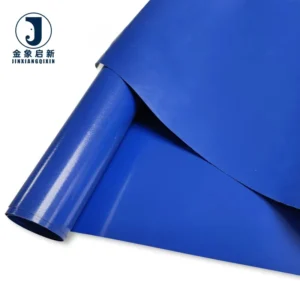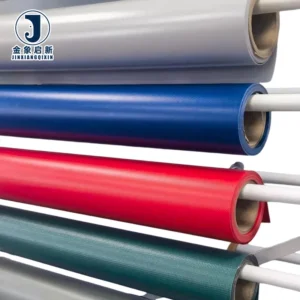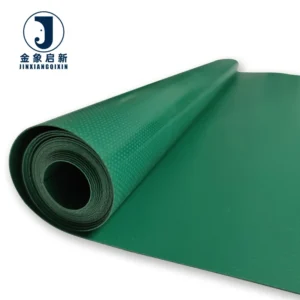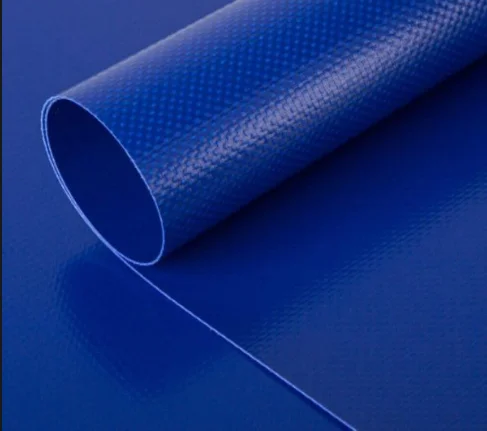
Deep Coating Adhesion Control — three dedicated production lines maintain consistent PVC penetration into the base fabric, preventing delamination under repeated flex cycles common in transport covers.
Technical Specifications
| Parameter | Value |
|---|---|
| Product Type | PVC Coated Tarpaulin Roll |
| Material | PVC Knife Coated Fabric |
| Coating Method | Knife Coated |
| Welding Compatibility | HF, Hot Air, Sewing |
| Surface Finish | Self-cleaning surface; available in glossy or matte finish |
| Chemical Resistance | Oil, stain, acid and alkali resistant |
| Environmental Resistance | Anti-mildew, anti-oxidation, high and low temperature resistant |
| Fire Retardancy | Available in flame retardant grades — confirm the grade required for your market |
| UV Stability | Available with UV treatment — request test report for your exposure conditions |
| Custom Options | Custom width and length, single or double side colour, pattern printing and branding |
Application Suitability
| Application | Exposure & Requirement |
|---|---|
| Truck and trailer side curtains | Constant flexing at load points, road spray, UV exposure, abrasion from tie-downs |
| Flatbed truck covers | Direct weather exposure, repeated tensioning and release, wind flutter fatigue |
| Portable storage structures | Sustained wind load, UV degradation, thermal expansion and contraction |
| Tensile and architectural membranes | Long-term UV and weather exposure, structural tension loads, aesthetic surface requirements |
| Airport hangars and stadium roofs | Large-span tension, fire code compliance, weather resistance over extended service periods |
Why Seams Fail Before the Fabric on Truck Covers
The joint method must match the stress zone, not just the fabric weight.
When a PVC knife coated tarpaulin for truck cover and transport applications fails on the road, the tear rarely starts in the middle of the panel. It begins where the fabric is joined — at a weld line or stitch row that experiences concentrated stress every time the load shifts or the trailer flexes over uneven surfaces. Fleet operators frequently replace covers not because the material wore through, but because the seam separated first [NEED_CITE: tensile and tear test methods for coated fabrics per ISO 1421]. Specifying the correct welding method for each stress zone, and verifying that the seam strength approaches the base fabric strength, is what keeps a cover on the trailer rather than in the repair bay.
Matching Weld Method to Flex Zone on Moving Loads
High-frequency welding produces a bond where the PVC layers fuse into a single continuous piece, eliminating the mechanical weak point that a sewn seam introduces. For side curtain fabric that flexes with every turn and braking event, HF welding at the horizontal stress lines reduces the chance of seam-driven failure. Hot air welding suits curved or irregular joints on custom-shaped truck covers where HF tooling cannot reach.
Reinforcement at Tie-Down and Edge Points
Tie-down straps and bungee cords concentrate load into small contact areas along the cover edge. The PVC knife coated tarpaulin for truck cover and transport use must handle this point loading without the coating cracking or peeling from the base fabric. Knife coating, by forcing PVC paste into the weave under blade pressure, creates a mechanical lock between coating and yarn that resists this peeling force far better than laminated alternatives [NEED_CITE: coating adhesion test methods for PVC coated polyester fabrics].
Reading the Specification Sheet Beyond GSM
GSM tells you the total weight of coating and base fabric combined, but two rolls at the same GSM can perform very differently depending on how that weight is distributed. A fabric with a heavier base yarn and thinner coating will resist tearing better than one that achieves the same GSM through thick coating over a light base. For truck and trailer covers subject to abrasion and flex fatigue, the balance between base fabric denier and coating thickness matters more than the headline weight figure alone. The knife coating process allows precise control over this balance, as the blade gap and paste viscosity are set to target both coating weight and penetration depth.
The Cost of Colour Drift Across Rolls in One Fleet Order
When a logistics company orders twenty rolls to refurbish a fleet of side curtain trailers, even a slight colour shift between rolls becomes visible once installed side by side on adjacent vehicles. This is not a cosmetic complaint — it triggers rejection at delivery, forces re-ordering, and delays vehicles returning to service. Batch-to-batch colour consistency depends on pigment dosing accuracy and coating line temperature stability during production [NEED_CITE: colour fastness and batch consistency standards for coated technical textiles]. Requesting a pre-shipment inspection record that documents colour verification across every roll in the order prevents this failure before the container ships.
What Supports Your Specification on Paper and in Practice
Each roll ships with a material specification sheet stating the base fabric construction, coating weight, and GSM — verified by measurement, not estimated from a product family range. Our ten-person R&D team develops samples within days when custom widths, colours, or flame retardant grades are required, so you approve the actual material before bulk production begins. Three full production lines and thirty-six sets of professional equipment support volume orders with reliable scheduling. Every roll undergoes inspection at each production stage and a full check before dispatch, documented in the pre-shipment inspection record included with your shipment.
Documentation & Verification
- Material specification sheet stating base fabric denier, coating weight and verified GSM per roll
- Test reports for UV and flame retardant grades where applicable to your market requirements
- Pre-shipment inspection record confirming colour consistency and surface quality across all rolls
- ISO and CE certificates supporting material compliance for international transport applications
- Roll packing list with individual roll dimensions and weights for customs and warehouse receiving
- Certificate of origin and customs documentation for cross-border shipment
Fabrication, Handling & Storage
- HF welding parameters must be tuned to the specific coating thickness of this PVC knife coated fabric for optimal fusion
- Hot air welding temperature and speed should be tested on a scrap piece of the same roll before production seams
- Store rolls upright on pallets in a dry environment to prevent edge creasing that affects unrolling and cutting accuracy
- Avoid dragging the self-cleaning surface across abrasive workshop floors during lay-up to preserve the finish
- When sewing is required, use UV-stable thread and seal needle holes with PVC-compatible adhesive to maintain waterproof integrity
- Allow cold-stored rolls to reach ambient temperature before unrolling to prevent coating stiffness and cracking at the fold
What to Include in Your Inquiry
Provide the specific truck or trailer models the covers must fit, along with the operating climate and any fire safety codes applicable in your destination market. State whether you need full rolls for your own fabrication or finished cut-to-size covers with edge reinforcement. If colour matching to an existing fleet or printed branding is required, share the reference standard so we can develop a sample for your approval before production.
Frequently Asked Questions
Q: How is the GSM on delivery verified against what was quoted for my truck cover order?
A: Every roll is weighed and measured during pre-shipment inspection, and the results are documented in the inspection record you receive with the shipment. This confirms the actual GSM matches the material specification sheet, rather than relying on a generic product family figure stated at the quotation stage.
Q: Which welding method is best for seams at trailer flex points?
A: High-frequency welding fuses the PVC layers into a single continuous bond, which generally performs best at high-stress flex zones on side curtain fabric. Hot air welding is effective for curved or irregular joints. We recommend testing the weld on a sample of the actual roll to confirm seam strength before full production.
Q: Can you supply test reports for UV and flame retardant claims?
A: Yes. Where UV treatment or flame retardant grades are specified for your order, the corresponding test reports are included in the documentation package. We confirm the grade required for your target market before production to ensure compliance with local regulations.
Q: How do you ensure colour consistency across multiple rolls in a single fleet order?
A: Pigment dosing and coating line conditions are controlled throughout the production run. The pre-shipment inspection includes visual colour comparison across all rolls in your order, documented in the inspection record, so any variation is caught before the material ships.