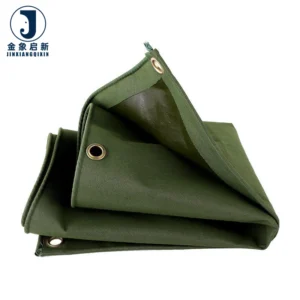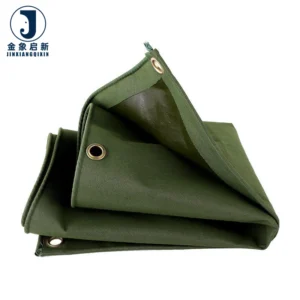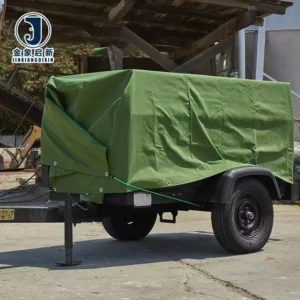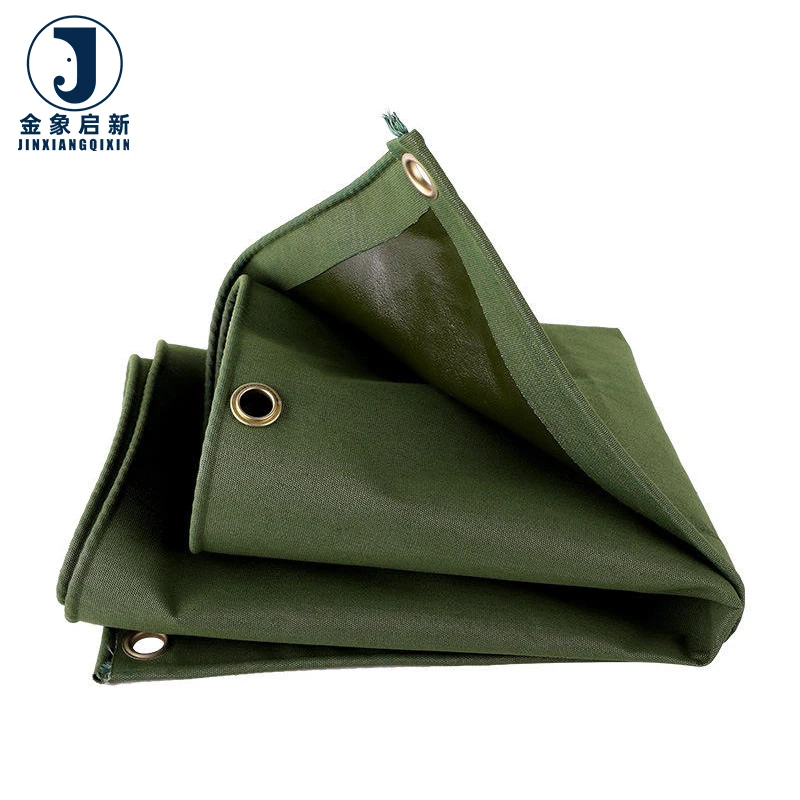
Proven Coating Control — Deep process mastery over PVC lamination weight and adhesion ensures every roll of this 600gsm polyester-cotton canvas meets the exact specification quoted, verified before dispatch.
Technical Specifications
| Parameter | Value |
|---|---|
| Product Type | PVC Laminated Canvas Tarpaulin |
| Base Fabric | Polyester cotton industrial textile, 8-12 strands of fine cotton yarn |
| Weight | 600gsm |
| Total Thickness | 0.5mm / 0.6mm / 0.7mm |
| Coating Method | Laminated |
| Roll Size | 2m width × 100m length |
| Colour Options | Army Green Camouflage / Custom |
| Finish Product Size | Custom cut-to-fit or sold by inventory |
| Eyelet Specification | Rust-proof aluminum eyelets every 1 meter at corners and hem |
| Seam Construction | Folded, welded and sewn with poly-rope reinforcement |
| UV Treatment | Claimed UV resistant (test basis not stated — confirm test standard for your market) |
| Waterproofing | Claimed waterproof (rating not stated) |
| Flame Retardant Grade | Not stated — available in flame retardant grades on request, confirm the grade required for your market |
| Anti-Static | Not stated |
| Standards | CE, ISO |
Application Suitability
| Application | Exposure & Requirement |
|---|---|
| Truck and trailer load covers | Constant road vibration, tie-down stress at eyelets, flex-point abrasion where the load shifts, full weather exposure |
| Flatbed and open-deck transport | Wind uplift force, rain ingress risk at seams, UV exposure during long-haul transit |
| Construction fleet equipment covers | Site dust and debris abrasion, repeated folding and unfolding, puncture risk from sharp-edged machinery |
| Side curtain fabric for transport vehicles | Continuous flex cycling, friction against load edges, thermal expansion and contraction across seasons |
Why Welded Seams Fail Before the Fabric Does on Truck Covers
Seam integrity depends on reinforcement at the exact point where road vibration concentrates stress.
When a PVC Laminated Canvas Tarpaulin for truck and transport covers a shifting load, the highest mechanical stress lands on the welded joints and eyelet zones — not the field of the fabric. Fleet operators regularly see the base material holding strong while the seam delaminates or the eyelet pulls through at the hem [NEED_CITE: tensile and tear test methods for coated fabrics per ISO 1421]. This failure mode leaves cargo exposed mid-transit and forces premature replacement of the entire cover. The issue is rarely the fabric itself; it is the absence of poly-rope reinforcement inside the folded hem and inconsistent weld penetration through the laminated coating layer.
How Load Flexure Dictates Cover Construction
A flatbed cover flexes continuously as the trailer articulates over uneven road surfaces. Each flex cycle transfers force to the nearest fixed point — typically the eyelet line and the perimeter seam. The polyester-cotton base fabric in this PVC laminated canvas tarpaulin distributes that load across 8-12 strands of fine cotton yarn, reducing point stress concentration. But without a poly rope sewn into the folded hem, the repeated bending eventually cracks the laminated PVC coating at the fold line, allowing moisture ingress and progressive delamination.
Tie-Down Security Under Road Vibration
Rust-proof aluminum eyelets placed every one meter at corners and along the hem provide the anchor points for ratchet straps and bungee cords. Spacing matters: wider intervals allow the fabric between eyelets to billow under highway-speed airflow, accelerating abrasion against the load surface. The one-meter spacing keeps the PVC Laminated Canvas Tarpaulin tensioned evenly across the trailer deck, reducing flutter-induced fatigue at the weld line [NEED_CITE: wind load and fabric tension standards for transport covers].
Reading the Specification Sheet Beyond GSM
Weight alone tells only part of the story. The 600gsm figure represents the combined mass of the polyester-cotton base fabric and the laminated PVC coating. A heavy coating on a light base fabric yields high GSM but poor tear resistance; a dense base with thin coating gives tensile strength but limited waterproofing longevity. The laminated construction method bonds the PVC film to the textile under heat and pressure, creating a mechanical interlock that resists peeling at flex points — a different failure profile from knife-over-roll coated fabrics where adhesion relies on chemical bonding.
Thickness options of 0.5mm, 0.6mm, and 0.7mm correspond to different coating weights applied to the same base construction. Thicker lamination increases abrasion resistance at contact points but adds stiffness, which affects how tightly the cover conforms to irregular load shapes. For side curtain applications where the fabric folds and unfolds daily, a mid-range thickness balances flexibility with surface wear resistance.
The Hidden Cost of Generic Sizing on Fleet Covers
Ordering truck covers in generic cut sizes rather than model-specific dimensions creates excess fabric that flaps in transit. That loose material rubs against itself and the load, wearing through the PVC lamination at fold lines within months rather than seasons. Fleet operators who specify custom cut-to-fit dimensions eliminate the loose material, reduce tie-down strap count, and extend the interval between cover replacements [NEED_CITE: field abrasion patterns on oversized versus fitted transport tarpaulins]. Colour inconsistency across rolls in the same order compounds the problem when a fleet replaces one damaged cover and the new unit visibly mismatches the rest of the vehicles.
Sourcing Decisions Backed by Production Evidence
Three full production lines and 36 sets of professional equipment support bulk volume with consistent coating weight across every roll in an order. The 10-person R&D team develops custom cut-to-fit patterns against specific trailer model dimensions rather than relying on generic size charts. Dedicated QA and QC inspection at each production stage means the 600gsm weight is verified against the quoted specification before packing, not assumed from the production run average. Samples for custom colour and sizing are developed within days, allowing fleet buyers to confirm fit and finish before committing to full production. ISO and CE certified processes underpin the documentation trail that accompanies every dispatch.
Documentation & Verification
- Material specification sheet stating base fabric composition, coating method, and 600gsm weight reference for each roll
- Pre-shipment inspection record confirming GSM verification, eyelet count, and seam weld integrity
- Roll packing list with individual roll identification matching the purchase order line items
- Certificate of origin and customs documentation supporting import clearance in destination market
- Colour reference standard for cross-roll consistency verification upon receipt
Fabrication, Handling & Storage
- Weld temperature must match laminated PVC coating thickness — test on offcut before full production run
- Poly rope reinforcement inside folded hems distributes eyelet load across the 600gsm base fabric
- Store rolls horizontally on racking to prevent permanent creasing in the polyester-cotton base
- Unfold and allow the tarpaulin to relax before tensioning to avoid cold-crease cracking in the lamination
- Clean with mild detergent only — solvent-based cleaners degrade the PVC laminated surface finish
- Repair minor punctures with PVC-compatible adhesive patches matching the lamination chemistry
Preparing Your Enquiry for Accurate Quotation
To receive a specification that matches your fleet requirements, provide the exact trailer make, model, and deck dimensions for each vehicle in your fleet. Indicate whether you need finished covers with eyelets and welded hems or roll stock for in-house fabrication. Specify any colour matching requirements against existing fleet livery and the annual volume forecast so production can be scheduled for batch-consistent output. If your operating region mandates specific fire classification or UV test standards for transport covers, reference the standard in your enquiry.
Frequently Asked Questions
Q: How is the 600gsm weight verified on arrival to match the quotation?
A: Every roll undergoes pre-shipment inspection where a sample is cut, weighed, and recorded against the quoted 600gsm specification. The inspection report accompanies the shipment so you can cross-check the documented weight against your own scale measurement on receipt. Any deviation is flagged before dispatch, not after delivery.
Q: Can the tarpaulin be cut to fit my specific trailer model rather than a generic size?
A: Yes. Provide the trailer make, model, and exact deck or curtain dimensions. The R&D team develops a cut pattern specific to your vehicle, and a sample is produced for fitment confirmation before full production runs. This eliminates excess fabric that causes wind flutter and abrasion.
Q: How do welded seams perform at flex points under road vibration?
A: The seams are folded, welded, and sewn with poly-rope reinforcement inside the hem. This construction distributes stress across a wider zone rather than concentrating it at the weld line. The result is a seam that resists delamination under continuous flex cycling typical of highway transport conditions.
Q: What eyelet spacing and reinforcement options are available for tie-down security?
A: Standard configuration places rust-proof aluminum eyelets every one meter at corners and along the hem. Each eyelet is set through reinforced fabric with the poly-rope hem distributing pull-out force. Custom spacing can be specified for higher tie-down density on long flatbed loads or high-wind routes.
Q: How is batch colour consistency maintained when ordering multiple truck covers?
A: Production for a single fleet order is scheduled as one continuous run using the same PVC lamination batch and colour master. A colour reference standard is retained for cross-roll comparison during pre-shipment inspection, and any visible variation between rolls is rejected before packing.